
Assessing Market Momentum in a Stabilized Environment: What's Next for Equity Futures?
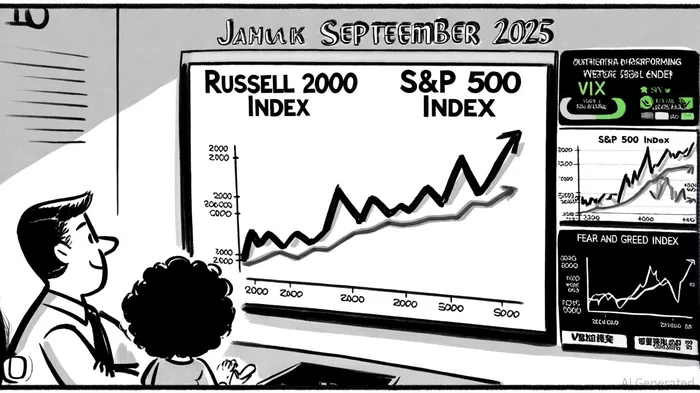
In the third quarter of 2025, equity markets have navigated a delicate balance between stabilization and uncertainty. While corporate earnings remain robust and the Federal Reserve signals a dovish pivot, lingering policy risks—particularly around U.S. trade and tariff negotiations—continue to shape investor behavior. This environment has fueled a notable shift in market momentum, with small-cap and value stocks outperforming their large-cap and growth counterparts. To assess the sustainability of these trends and their implications for equity futures, it is critical to dissect the interplay of market psychology, historical cycles, and macroeconomic signals.
Small-Cap Outperformance: A Cyclical Reversal?
The Russell 2000 Index surged 7.1% in August 2025, outpacing the S&P 500's 2.0% gain, as investors flocked to undervalued small-cap equities[1]. This rally aligns with historical patterns: the 14-year stretch of large-cap dominance (2011–2024) has historically preceded a decade of small-cap outperformance[3]. Analysts at Hartford Funds and Wellington Management argue that the current cycle is nearing its inflection point, with small-cap valuations trading at multiyear lows relative to large caps and earnings growth projected to outpace them by 22% in 2025[2].
The Federal Reserve's anticipated rate cuts—projected at -0.25% by September—have further amplified this shift. Lower borrowing costs are expected to boost small-cap earnings, particularly in sectors like manufacturing and technology, where reshoring and AI-driven demand are reshaping fundamentals[4]. Additionally, the migration of small-cap firms into the large-cap space—a historical driver of performance—has accelerated, reinforcing the case for sustained momentum[2].
Market Psychology: Complacency or Caution?
Market psychology indicators suggest a landscape of low volatility and cautious optimism. The VIX, often dubbed the “fear gauge,” fell to 14 in August 2025—its lowest level of the year—before stabilizing at 16.36 in September[5]. Concurrently, the CNN Fear and Greed Index hovered near neutral territory, reflecting a market neither gripped by panic nor driven by exuberance[5]. These readings contrast with the extreme greed levels observed in early 2024, which preceded a correction in growth stocks tied to AI and tech[6].
However, complacency persists. The Investors Intelligence Bull/Bear ratio reached 62.9% in favor of bulls, a level historically associated with market overextension[6]. Meanwhile, foreign buying of U.S. equities has hit record highs, a contrarian signal as international investors often chase rallies into unsustainable peaks[6]. Such dynamics underscore the fragility of the current stabilized environment, where sentiment-driven rotations could reverse swiftly if macroeconomic data or policy developments falter.
Sustainability of Trends: Historical Precedents and Risks
The sustainability of small-cap and value outperformance hinges on two key factors: macroeconomic stability and valuation discipline. Historically, small-cap cycles reverse when interest rates normalize and economic growth stabilizes—a scenario now unfolding as the Fed signals rate cuts[3]. For instance, the 1990s saw a decade of small-cap dominance following a prolonged large-cap cycle, driven by similar dovish monetary policy and earnings growth differentials[3].
Yet risks remain. Persistent inflation, though moderating, could delay rate cuts, prolonging the pressure on small-cap liquidity. Additionally, the recent rotation into value stocks—led by yield-focused equities returning 4.7% in August—may face headwinds if growth sectors rebound amid AI breakthroughs[1]. Contrarian indicators, such as the S&P 500 trading above its 200-day moving average and record consumer confidence, also hint at a market driven more by sentiment than fundamentals[6].
What's Next for Equity Futures?
Equity futures in a stabilized environment are likely to remain sensitive to both macroeconomic data and policy clarity. The Federal Reserve's September rate decision will be pivotal: a 0.25% cut could cement the small-cap rally, while a delay might reignite volatility. Meanwhile, international equities—particularly in Europe—offer a compelling alternative as U.S. valuations stretch[1].
For investors, the path forward requires balancing growth and value exposures. As BlackRock and Lombard Odier emphasize, quality and diversification will be critical in navigating potential corrections[6]. Small-cap and value stocks, while attractive at current valuations, should be approached with caution in a market where complacency and policy uncertainty coexist.
Conclusion
The 2025 equity market is at a crossroads. Small-cap and value outperformance, supported by favorable valuations and dovish monetary policy, appears poised to continue. However, the sustainability of these trends depends on the Fed's ability to deliver on rate-cut expectations and the resilience of corporate earnings. Market psychology, currently skewed toward caution, offers a mixed signal: while low volatility supports momentum, contrarian indicators warn of overextension. For equity futures, the coming months will test whether this stabilization is a durable shift or a prelude to renewed turbulence.







Comentarios
Aún no hay comentarios