
Assessing Market Implications of Key September U.S. Economic Data
The U.S. economy in September 2025 presents a nuanced picture of inflation and monetary policy, offering critical signals for investors navigating a shifting landscape. With the Federal Reserve having cut rates by 25 basis points in September, reducing the federal funds target range to 4.00–4.25%[2], the focus now turns to how recent inflation data and forward guidance shape asset positioning strategies.
Inflation Trends: A Mixed Signal
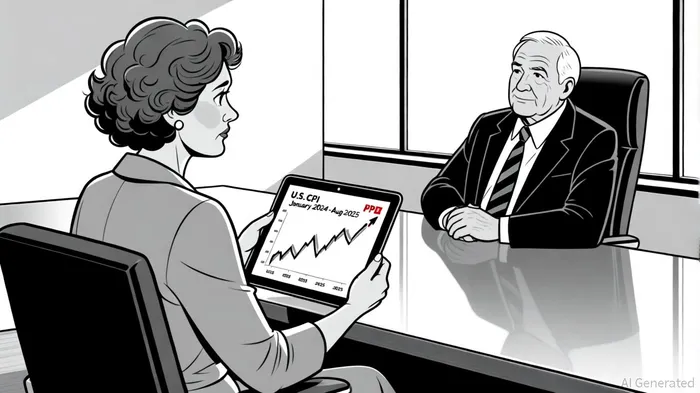
The latest data reveals a bifurcated inflation environment. The Consumer Price Index (CPI) rose 0.4% in August 2025, with a 2.9% annual increase, driven by shelter costs (up 0.4%), food prices (up 0.6%), and gasoline (up 1.9%)[1]. Meanwhile, the Producer Price Index (PPI) fell 0.1% monthly, with a 2.6% year-over-year decline, signaling easing wholesale pressures[2]. This divergence—stronger consumer-side inflation versus moderating producer prices—suggests that while core goods and services are stabilizing, housing and energy remain stubbornly inflationary.
The core CPI, a key Fed focus, climbed 0.3% in August, maintaining an annual rate of 3.1%[3]. This persists above the central bank's 2% target, underscoring the challenge of balancing price stability with growth. However, the PPI's decline, particularly in energy and core goods, supports the narrative of waning inflationary momentum[2].
Rate Decision Rationale and Forward Guidance
The September rate cut reflects the Fed's attempt to navigate a cooling labor market and moderating inflation. The FOMC's projections, released in September, anticipate a gradual decline in core PCE inflation to 2% by 2028, with a median unemployment rate of 4.5% in Q4 2025[3]. These signals indicate a cautious approach: the Fed is prioritizing economic resilience over aggressive tightening, while leaving room for further cuts in 2025 and 2026.
Market expectations align with this trajectory, with a high probability assigned to additional rate reductions in October and December[3]. This forward guidance has already spurred a rotation into risk assets, as investors price in lower borrowing costs and improved corporate borrowing conditions[2].
Strategic Asset Positioning
Given this backdrop, investors should consider the following strategies:
Equities and Cyclical Sectors: A rate-cutting cycle typically benefits equities, particularly sectors sensitive to borrowing costs, such as industrials, real estate, and consumer discretionary. The Fed's easing could also bolster small-cap stocks, which have historically underperformed during tightening phases[2].
Fixed Income and Duration: While the Fed's rate cuts may push bond yields lower, the persistent 3.1% core CPI suggests caution in extending duration. Short- to intermediate-term Treasuries and TIPS (Treasury Inflation-Protected Securities) could offer a balance between yield and inflation protection[1].
Commodities and Inflation Hedges: Despite moderating PPI, shelter and energy costs remain inflationary. Gold and energy equities may retain appeal as hedges against residual price pressures[3].
Diversification Across Geographies: Global economic uncertainty, including potential spillovers from emerging markets, warrants a diversified approach. Defensive assets like utilities and healthcare may provide stability amid volatility[2].
Outlook and Risks
The coming months will hinge on the October 15 release of the September CPI and October 16 PPI data[1]. A moderation in core CPI to 3.0% or below could accelerate rate cuts, while a rebound in shelter costs or energy prices might delay policy easing. Additionally, the Fed's projections assume a stable labor market, but surging jobless claims and wage growth could complicate this outlook[3].
Investors must also weigh external risks, such as geopolitical tensions or a global slowdown, which could amplify market volatility. A flexible, dynamic portfolio—responsive to both inflationary signals and monetary policy shifts—will be critical in navigating this environment.
Conclusion
The September 2025 economic data and rate cut underscore a Fed in transition, balancing inflation control with growth support. For investors, the key lies in aligning portfolios with the dual forces of moderating inflation and accommodative policy. By prioritizing sectors poised to benefit from lower rates while hedging against residual inflationary risks, strategic positioning can capitalize on the evolving macroeconomic landscape.







Comentarios
Aún no hay comentarios