
Assessing the Market Impact of Weakened Hepatitis B Vaccine Recommendations for Newborns
The recent shift in U.S. hepatitis B (HepB) vaccine policy for newborns has sparked intense debate among public health experts, pharmaceutical stakeholders, and investors. In December 2025, the CDC's Advisory Committee on Immunization Practices (ACIP), restructured under Health Secretary Robert F. Kennedy Jr., voted to eliminate the universal recommendation for HepB vaccination at birth, replacing it with a targeted approach based on maternal testing and shared decision-making between parents and providers. This reversal of a 30-year-old policy, which had reduced childhood HepB infections by over 95%, raises critical questions about its cascading effects on public health, healthcare costs, and the pharmaceutical sector.
Public Health Policy Risks and Epidemiological Consequences
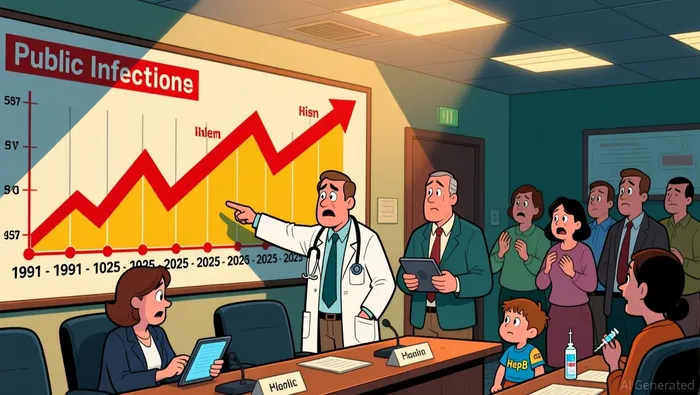 The universal HepB birth dose, first adopted in 1991, has been a cornerstone of U.S. public health success, virtually eliminating chronic HepB infections in children. Critics of the policy change argue that delaying the vaccine increases transmission risks, particularly due to gaps in prenatal testing and inconsistent follow-up. For instance, a 2025 study modeled that delaying the birth dose to two months could result in 1,400 preventable infections annually, while delaying it to 12 years could lead to 2,700 preventable infections and over $313 million in excess healthcare costs per year. These projections underscore the potential for a resurgence in HepB-related liver disease, which could strain healthcare systems and erode decades of progress.
Pharmaceutical Sector Implications
The policy shift directly impacts manufacturers of HepB vaccines, including GSKGSK--, SanofiSNY--, and MerckMRK-- & Co., which produce either standalone HepB vaccines or combination shots. A delay in the administration schedule could disrupt supply chains, as these companies face challenges in adjusting production timelines for a vaccine with a fixed shelf life. Merck and Sanofi have already flagged concerns about potential supply chain bottlenecks, with one analyst noting that such disruptions could persist for over a year. Additionally, the ACIP's decision to bypass direct consultation with manufacturers-a departure from prior practices-has introduced uncertainty into the market, complicating long-term revenue forecasts for these firms.
Healthcare Cost Projections and Economic Burden
The financial implications of the policy change extend beyond pharmaceutical companies. A 2025 economic analysis estimates that delaying the HepB birth dose could generate $222 million in annual excess healthcare costs due to preventable infections, liver cancer cases, and premature deaths. If the delay is extended further-such as to 12 years-the costs balloon to $313 million annually. These figures highlight the long-term fiscal risks for insurers, hospitals, and taxpayers, particularly as HepB-related complications (e.g., cirrhosis, hepatocellular carcinoma) require costly, lifelong management.
Stock Market Reactions and Investor Sentiment
The stock market has already reacted to the policy uncertainty. In late 2025, vaccine manufacturers like Moderna and BioNTech saw share prices decline following an internal FDA memo questioning vaccine safety, which coincided with the ACIP's deliberations. While the HepB vaccine itself has not been linked to safety concerns, the broader regulatory scrutiny and policy instability have eroded investor confidence. Analysts warn that the sector's volatility could intensify if the CDC director finalizes the ACIP's recommendations, potentially triggering a reevaluation of vaccine portfolios by institutional investors.
Conclusion: Balancing Policy and Market Stability
The HepB vaccine policy reversal exemplifies the delicate interplay between public health mandates and market dynamics. While the pharmaceutical sector faces immediate operational and financial challenges, the broader economic and health risks of delayed vaccination could prove far more costly in the long term. Investors must weigh these factors against the potential for regulatory reversals or public health interventions that could mitigate the policy's unintended consequences. As the CDC director prepares to approve or reject the ACIP's recommendation, stakeholders across industries will be watching closely for signals of stability-or further disruption.





Comentarios
Aún no hay comentarios