
Assessing the Market Impact of Trump's Escalating Military Posturing in the Caribbean
The U.S. military buildup in the Caribbean under the has emerged as a pivotal geopolitical and economic development in 2025. Operation Southern Spear, launched in November 2025, represents a dramatic escalation of U.S. military activity in the region, with significant implications for defense sector stocks and global risk assessments. This analysis examines the interplay between military posturing, defense industry profits, and , offering insights for investors navigating this complex landscape.
Defense Sector Opportunities: Contractors Benefiting from Escalation
The Trump administration's aggressive in the Caribbean has directly boosted demand for advanced weaponry and systems, creating windfall opportunities for major defense contractors. Lockheed MartinLMT-- (LMT), for instance, stands to profit from the deployment of and Aegis missile defense systems in the region, while are critical to U.S. operations against suspected drug-trafficking vessels. Similarly, RTXRTX-- Corporation (RTX) has seen heightened demand for Tomahawk cruise missiles, , as the U.S. restocks its arsenal to sustain prolonged operations.
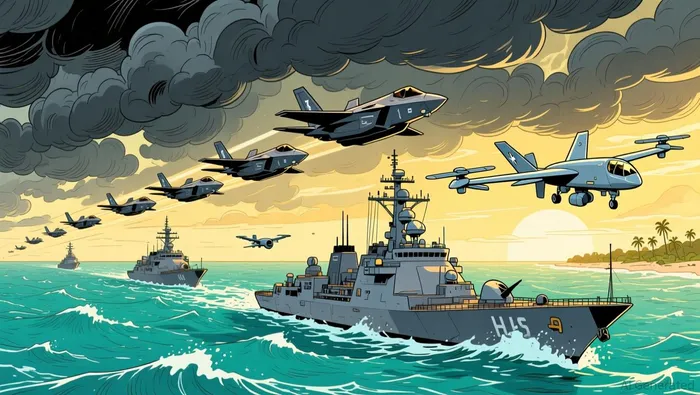 (NOC) is another key beneficiary, leveraging its expertise in and (Command, Control, Communications, Computers, Intelligence, Surveillance, and Reconnaissance) technology to support intelligence-gathering missions. The deployment of and Arleigh-Burke class destroyers further underscores the scale of military engagement, with sustainment contracts likely to extend for years. Smaller firms like General Atomics, which for support, are also poised to capitalize on the region's heightened security demands.
Geopolitical Risks: Tensions and Regional Instability
While defense contractors thrive, the military escalation has exacerbated geopolitical risks, particularly in Venezuela and neighboring Latin American nations. The U.S. , fueling accusations of efforts by Venezuela and its allies. The deployment of long-range near the Venezuelan coast has further signaled a readiness for potential land-based operations, raising fears of broader conflict.
Regional tensions are compounded by Venezuela's territorial dispute with Guyana over the Essequibo region, with the U.S. explicitly warning that any military action by Venezuela against Guyana would provoke a strong response. These dynamics have elevated the , which now ranks the Caribbean as a top concern alongside global technology decoupling and cyber risks. The U.S. military's reactivation of , such as Roosevelt Roads in Puerto Rico, signals a long-term strategic commitment to the region, further polarizing Latin American governments.
Market Reactions and Investment Implications
The market has responded to the Caribbean crisis with a mix of optimism and caution. like LMTLMT-- and RTX have outperformed due to increased procurement demand, but broader economic sectors face headwinds. The energy industry, for example, is at risk of if Venezuela's oil exports are impacted by military operations or regime instability. Chevron (CVX) and Exxon Mobil (XOM) could face both threats and opportunities, depending on whether U.S. intervention facilitates access to Venezuela's oil reserves.
Investors must also contend with legal uncertainties. The Trump administration's military actions have sparked congressional debates over the , with some lawmakers arguing that strikes on drug vessels constitute hostilities requiring legislative approval. Such legal challenges could delay operations or force cost overruns, indirectly affecting .
Conclusion: Balancing Opportunities and Risks
Trump's Caribbean military campaign presents a dual-edged sword for investors. While defense contractors are reaping substantial short-term gains, the region's geopolitical volatility poses long-term risks for global markets. The underscores the Caribbean's growing prominence as a flashpoint, with potential spillovers into energy, trade, and . Investors should adopt a hedged approach, capitalizing on defense sector opportunities while mitigating exposure to regional instability through .
As the U.S. continues to frame its actions as a counter to and Chinese influence, the Caribbean's strategic importance is unlikely to wane. However, the path forward will depend on whether military escalation leads to stability or further destabilization-a question with profound implications for both investors and policymakers.







Comentarios
Aún no hay comentarios