
Assessing the Market Impact of the Fed Chair Probe: A Structural Shift in U.S. Monetary Policy Credibility
The Federal Reserve's independence has entered a new and dangerous phase. In a dramatic escalation, federal prosecutors have opened a criminal investigation into Chair Jerome Powell, specifically targeting his testimony last June on the central bank's $2.5 billion headquarters renovation. The probe, approved by a Trump-aligned U.S. attorney in November, includes an analysis of Powell's public statements and spending records. The immediate trigger was a Friday grand jury subpoena served on the Fed, threatening a criminal indictment.
Powell has framed the investigation as a direct political attack. In a rare video statement, he called it a "pretext" resulting from his ongoing struggle with the administration over interest rates. He stated the threat of criminal charges is a consequence of the Fed "setting interest rates based on our best assessment of what will serve the public, rather than following the preferences of" President Donald Trump. This is not a new feud; the president has repeatedly attacked Powell for resisting demands to slash rates and has even threatened to fire him. The probe, Powell argues, is part of a broader campaign to intimidate the central bank into aligning policy with political pressure.
The market's first reaction was a clear vote of no confidence. The U.S. dollar index fell 0.3% to 98.899, snapping a five-day winning streak. Analysts noted the move was a direct response to the heightened political turbulence, with one strategist stating the open warfare between the Fed and the administration "is clearly not a good look for the U.S. dollar." The event also sparked a flight to safety, with gold prices jumping to a record high.
This raises the central question for financial markets: does this undermine the Fed's credibility? The investigation directly challenges the core principle of central bank independence, suggesting that a chair's resistance to political pressure can lead to personal legal jeopardy. If the probe proceeds, it will test whether the Fed can operate free from intimidation, a condition essential for maintaining market trust in its monetary policy decisions.
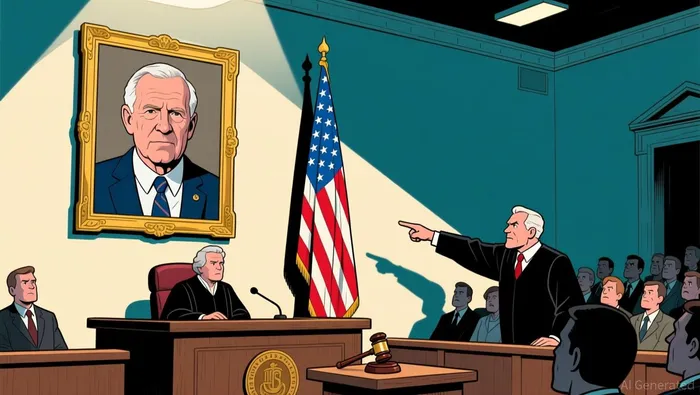
The Structural Risk: A Precedent for Political Interference
The investigation's long-term threat lies not in its immediate outcome, but in the precedent it establishes. By being led by US Attorney Jeanine Pirro, a longtime ally of President Trump appointed to the role last year, the probe signals a fundamental politicization of the Department of Justice's oversight of an independent agency. This is not a neutral legal review; it is an exercise of political power, raising the specter that a central bank chair's resistance to the White House can trigger a personal legal reckoning.
This follows a clear pattern of sustained pressure. The investigation is the latest escalation in a long-running feud where the president has repeatedly attacked Powell for policy decisions, threatened to fire him, and even floated lawsuits. The probe, therefore, appears as part of a broader campaign to assert control over monetary policy, not an isolated incident. The message is chilling: defiance of political leadership carries tangible personal risk.
The structural risk is to the Fed's independence itself. The core principle of central banking is that monetary policy decisions are made free from political interference. This investigation directly challenges that by suggesting leadership can face criminal jeopardy for actions taken in their official capacity. As Powell stated, the threat is about whether the Fed can set rates based on evidence or be directed by intimidation. If this precedent holds, it will likely chill future dissent within the institution. Officials may become more risk-averse, less transparent in their communications, and more inclined to align with political preferences to avoid similar legal exposure.
The credibility of the entire system is at stake. When the DOJ, under political direction, targets a central bank chair, it undermines the perceived neutrality of the legal system itself. This was underscored by Senator Thom Tillis, who warned that the probe calls into question the independence of the Department of Justice. For markets, this is a deeper erosion than a single policy shift. It attacks the foundational trust that monetary policy is a technical, evidence-based function, not a political battleground. The structural risk is that this precedent normalizes political interference, making future Fed chair appointments a more contentious and less credible process.
Financial Market Implications and Forward Scenarios
The structural risk to the Fed's independence is now translating into concrete market moves. The immediate reaction was a clear flight to safety, with gold prices surging to a record $4,563.61 per ounce. At the same time, the U.S. dollar weakened, with the dollar index falling 0.3% to 98.899 and snapping a five-day winning streak. This combination-strong safe-haven demand and a weaker dollar-is the classic signature of a crisis of confidence in the U.S. financial system's stability.
The primary risk is a loss of trust in the Fed's ability to set policy based on economic data, not political pressure. When markets doubt the central bank's independence, they demand a higher risk premium. This typically manifests as higher long-term U.S. Treasury yields, as investors price in the potential for future policy distortions. The recent data shows inflation remains above target and the labor market is resilient, which already provided some upward pressure on yields. The Powell probe adds a new, political dimension to that calculus, likely amplifying the pressure.
This sets up a broader risk-off sentiment. If the investigation proceeds, it could trigger a reassessment of the entire U.S. financial ecosystem. The credibility of U.S. debt, the stability of the dollar, and the predictability of regulatory policy are all at stake. The market's early move suggests it is already pricing in this new source of volatility and uncertainty.
The critical catalyst on the horizon is the upcoming announcement of Powell's successor in May. This decision will be under intense scrutiny, as the new chair's perceived independence will be the market's primary gauge of whether the Fed's autonomy has been permanently compromised. The search process itself may become politicized, further clouding the forward view. For now, the probe has injected a new, high-stakes variable into the investment equation, one that could persistently weigh on confidence in U.S. monetary policy credibility.
Catalysts and Key Watchpoints
The market's initial reaction has set the stage, but the true test of deteriorating policy credibility will come from a series of near-term events. The primary catalyst is the scope and trajectory of the Department of Justice investigation itself. The probe, led by a Trump-aligned U.S. attorney, is already examining Powell's public statements and spending records related to the $2.5 billion headquarters renovation. The critical watchpoint is whether this inquiry broadens beyond the renovation details to scrutinize the Fed's broader policy communications or financial decisions. Any formal charges filed against Powell or the institution would be a definitive, negative signal, confirming the political weaponization of legal process. For now, the investigation remains in its early stages, but its politicized origins make a narrow focus unlikely.
The most immediate and consequential development will be the announcement of Powell's successor in May. The president has already decided on who he wants to replace Powell, and the search process is expected to be highly politicized. The market will closely monitor the nominee's background and public statements on independence. A choice perceived as a loyalist to the administration would be seen as a structural victory for political interference, likely triggering a sustained reassessment of the Fed's future credibility. Conversely, a nominee with a strong record of independence could provide a temporary confidence boost, though the precedent of the investigation would remain.
Financial markets will serve as the real-time barometer of confidence. The U.S. Treasury market, particularly the 10-year yield, is the key metric. As noted, the investigation has already contributed to upward pressure on both U.S. Treasury yields and the U.S. dollar, though the dollar has since retreated. The sustained path of the 10-year yield will reveal whether investors are pricing in a permanent risk premium for U.S. policy uncertainty. A persistent climb above recent levels would signal deep-seated doubts about the Fed's long-term independence. Similarly, the performance of the U.S. dollar against a basket of currencies will reflect global confidence in the stability of the American financial system.
Finally, watch for any shift in the Fed's own communication or policy stance in the coming months. The institution may adopt a more cautious or defensive posture in its public statements, a subtle adjustment to the new political reality. Any deviation from its standard, data-driven narrative could be an early sign of internal pressure. The bottom line is that the market's forward view hinges on these concrete events: the investigation's evolution, the successor appointment, and the Treasury market's reaction. They will confirm whether this is a temporary political storm or the beginning of a lasting structural shift in monetary policy credibility.







Comentarios
Aún no hay comentarios