
Assessing Long-Term Resilience and Growth Potential in Robert Half (RHI)
Assessing Long-Term Resilience and Growth Potential in Robert HalfRHI-- (RHI)
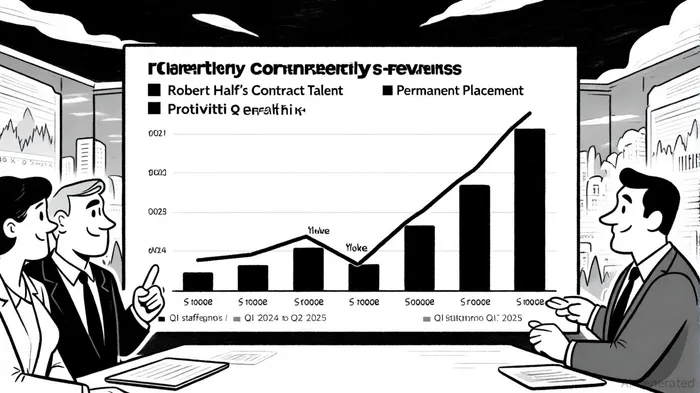
Robert Half Inc. (RHI) has navigated a turbulent 2025 with a mixed performance, reflecting both the challenges of a slowing global economy and the strategic resilience of its consulting arm, Protiviti. For investors evaluating the company's long-term prospects, the interplay of management execution, industry tailwinds, and balance sheet strength offers a nuanced picture of risk and opportunity.
Management Execution: A Tale of Two Segments
The company's core staffing operations-Contract Talent Solutions and Permanent Placement-have faced headwinds, with year-over-year revenue declines of 11% and 13%, respectively, in Q2 2025, according to a Panabee earnings summary. These contractions were exacerbated by a 98% drop in operating income to $1.5 million, driven by a 3.1 percentage point increase in SG&A expenses as a percentage of revenue, according to a BeyondSPX analysis. Despite these setbacks, management has prioritized cost discipline, implementing $80 million in annual savings through workforce reductions and operational streamlining, as noted in the BeyondSPX analysis.
However, the most compelling narrative lies in Protiviti, Robert Half's consulting segment. While the broader company struggled, Protiviti achieved a 1.8% revenue increase in Q2 2025, supported by a 3.4% rise in billable hours and cross-segment resource sharing, per the Panabee summary. This performance underscores the strategic value of Protiviti as a counterbalance to volatile staffing markets. Management's focus on AI integration-such as the ARC platform to enhance recruiter productivity-also signals a commitment to innovation, as the BeyondSPX analysis notes. Yet, the stark contrast between Protiviti's resilience and the core segments' struggles raises questions about the scalability of these initiatives.
Industry Tailwinds: Navigating a Shifting Labor Market
The broader staffing industry remains under pressure from macroeconomic uncertainty, with elevated global job market volatility dampening hiring activity, according to a PR Newswire release. However, Robert Half's emphasis on hybrid and remote work arrangements aligns with evolving job seeker preferences, potentially enhancing retention and hiring success, as discussed by BeyondSPX. Additionally, the consulting sector's growth trajectory-bolstered by demand for digital transformation and risk advisory services-positions Protiviti to capitalize on long-term trends, per the Panabee summary.
Management has also signaled optimism about an eventual market recovery, citing elevated U.S. job openings and historically strong performance during prior economic upturns, as observed by BeyondSPX. While near-term challenges persist, the company's strategic pivot toward higher-margin consulting services and AI-driven efficiency could create asymmetric upside if the labor market stabilizes.
Balance Sheet Strength: Liquidity and Leverage
Robert Half's balance sheet reveals a delicate balance between liquidity and debt management. As of Q2 2025, the company reported $380.5 million in cash and equivalents, a 30.5% decline from prior periods, according to Yahoo earnings highlights. Total liabilities stand at $1.48 billion, with current liabilities increasing 4.7% to $1.32 billion (Yahoo highlights). Despite these pressures, cash flow from operations remained robust at $119 million in Q2, and the company secured a new $100 million credit facility to bolster flexibility, per the Panabee summary.
The decision to increase dividends by 11.3% to $0.59 per share, while reducing share repurchases by 32%, reflects a cautious capital allocation strategy, as noted by BeyondSPX. However, the 52% year-to-date decline in net operating cash flow raises concerns about the company's ability to fund operations without external financing, according to the Panabee summary. Investors must weigh these liquidity risks against the potential for margin expansion as cost discipline and AI adoption take hold.
Conclusion: A Calculated Bet on Resilience
Robert Half's 2025 performance highlights both vulnerabilities and strengths. While core staffing segments grapple with macroeconomic headwinds, Protiviti's resilience and strategic investments in AI and hybrid work models offer a path to differentiation. The balance sheet, though under pressure, retains sufficient liquidity to navigate near-term challenges, supported by the new credit facility.
For long-term investors, the key question is whether management can sustain cost discipline while scaling high-growth initiatives. If the labor market rebounds as anticipated, Robert Half's diversified portfolio-anchored by Protiviti-could deliver outsized returns. However, the path to recovery will require disciplined execution and a favorable macroeconomic environment.





Comentarios
Aún no hay comentarios