
Assessing the Long-Term Investment Potential of Google DeepMind's Automated Lab in the UK
The UK's strategic embrace of artificial intelligence (AI) as a catalyst for scientific and industrial innovation has positioned it at the forefront of a global race to harness AI for material science breakthroughs. At the heart of this initiative is Google DeepMind's automated laboratory in the UK, a project poised to redefine the pace and scope of material discovery. This article evaluates the long-term investment potential of DeepMind's lab, contextualizing its technological ambitions within the UK's geopolitical and economic priorities, while scrutinizing financial projections, sector growth forecasts, and risk factors.
Strategic Alignment with UK Geopolitical Priorities
Google DeepMind's automated lab is not merely a scientific endeavor but a geopolitical asset for the UK. The facility, set to open in 2026, leverages AI models like Gemini and robotics to synthesize and characterize hundreds of materials daily, accelerating research in superconductors, semiconductors, and clean energy technologies. This aligns with the UK's AI for Science Strategy, which to strengthen AI-driven innovation, . By prioritizing AI in scientific discovery, the UK aims to solidify its leadership in while addressing global challenges such as decarbonization and energy security.
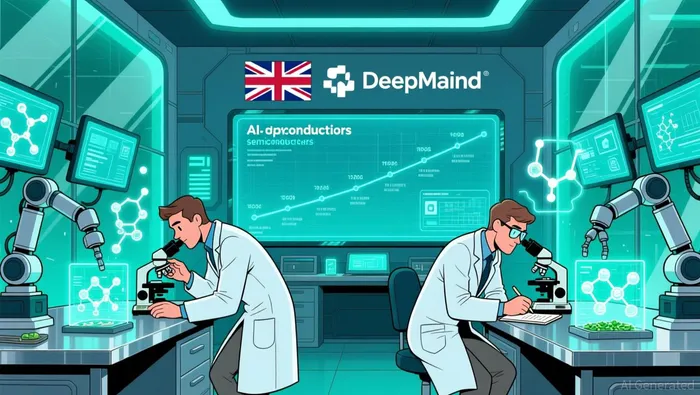 The lab's focus on superconductors and advanced materials directly supports the UK's industrial strategy, which emphasizes clean energy and as pillars of economic resilience. Furthermore, the collaboration with the UK's AI Security Institute underscores a commitment to , ensuring that technological advancements align with national security and ethical standards. This strategic alignment reduces the risk of misalignment between corporate innovation and public policy, a critical factor for long-term investment viability.
Financial Potential and Sector Growth
The financial case for DeepMind's lab is underpinned by the UK government's . While specific ROI metrics for the lab remain undisclosed, the sector's growth trajectory is compelling. AI-driven material science is compressing R&D timelines , as demonstrated by startups like Altrove. This acceleration reduces capital intensity and increases the likelihood of rapid commercialization, key drivers for investor returns.
Institutional reports highlight mixed ROI outcomes for AI investments. A 2025 MIT study found , . DeepMind's lab, with its access to cutting-edge AI tools like AlphaFold and AlphaGenome, is well-positioned to outperform these averages. The UK's , such as the , further amplify the ecosystem's financial potential by fostering regional clusters of innovation and high-skilled employment.
Risk Assessments and Mitigation
Despite its promise, the lab faces risks inherent to AI-driven innovation. for existential safety planning, highlighting gaps in risk mitigation frameworks. Additionally, , longer than traditional tech investments. These challenges are compounded by geopolitical uncertainties, such as supply chain disruptions for rare earth materials, which the lab aims to address through AI-driven alternatives.
However, DeepMind's updated and partnerships with entities like the AI Security Institute demonstrate a proactive approach to risk management. mitigates talent shortages, a critical bottleneck for AI adoption. For investors, these measures suggest a balanced risk profile, where technological and regulatory risks are actively managed.
Conclusion: A High-Potential, High-Stakes Bet
Google DeepMind's automated lab represents a convergence of technological ambition, strategic alignment, and financial incentives. Its capacity to accelerate material science discovery aligns with the UK's vision of AI-driven national renewal, while institutional backing and sector growth forecasts bolster its long-term viability. However, investors must remain cognizant of the sector's nascent ROI realities and safety challenges. For those willing to navigate these complexities, the lab offers a compelling opportunity to capitalize on the intersection of AI, geopolitics, and industrial innovation.







Comentarios
Aún no hay comentarios