
Assessing the Long-Term Infrastructure and Development Value of the Xerox Campus in Webster, NY
Strategic Infrastructure Upgrades: A Catalyst for Industrial Readiness
The FAST NY Grant, awarded by the New York State Department of Transportation, is pivotal in preparing the Xerox Campus for advanced manufacturing and logistics. According to a report by , the grant will fund road dedication for subdivision, road reconstruction and extension, multimodal transportation connections, and electrical master planning. These upgrades are designed to meet the demands of high-tech manufacturers, a sector critical to New York's economic strategy. By improving access and connectivity, the infrastructure investments reduce development risks for future tenants, making the site more attractive to large-scale industrial operators.
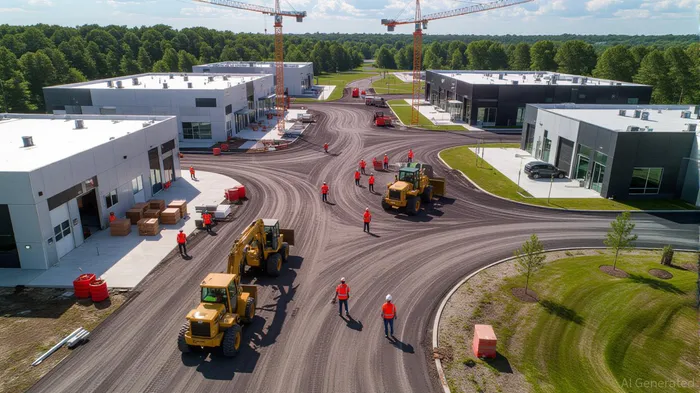 The grant also addresses the site's historical challenges as a brownfield. Environmental remediation efforts, compliant with EPA standards, are integral to the project. initiative, the area has been designated a Brownfield Opportunity Area, streamlining future funding and regulatory approvals. This proactive approach mitigates liability concerns for developers and investors, accelerating the site's transition from underutilized land to a high-value industrial hub.
Municipal Realignment and Roadway Rehabilitation: Enhancing Accessibility
Complementing the FAST NY Grant, the Webster Economic Access Project focuses on rehabilitating industrial roadways on the Xerox Campus. Construction, slated for late 2025 or mid-2026, will include expanded sewer systems and updated electrical infrastructure to support advanced manufacturing. These municipal line realignments are critical for accommodating heavy industrial traffic and ensuring compliance with modern logistics requirements.
The realignment efforts also align with broader regional economic goals. By improving multimodal connections-such as proximity to the Thruway and rail networks-the Xerox Campus becomes a more viable location for companies seeking to optimize supply chain efficiency. For institutional investors, this infrastructure resilience translates to long-term asset stability, as the site's accessibility directly correlates with tenant demand and operational viability.
Projected Real Estate Value Growth: A Compelling Investment Thesis
The Xerox Campus redevelopment is projected to drive significant real estate value appreciation between 2025 and 2026. indicates that the 300-acre site is being transformed into a $1 billion industrial hub, with infrastructure upgrades expected to reduce industrial vacancy rates to just 2%. This scarcity-driven dynamic is further amplified by the planned $650 million fairlife® dairy facility, which will create 250 new jobs and anchor the campus as a regional employment center.
Residential real estate in Webster has already benefited from the project's momentum. Annual home price increases of 10.1% underscore the area's growing desirability, driven by the influx of high-paying jobs and improved infrastructure. As the Xerox Campus nears completion by 2026, the integration of industrial and residential developments is likely to create a self-sustaining economic ecosystem, further boosting property values and rental yields for investors.
Strategic Implications for Investors
For private equity firms, REITs, and institutional investors, the Xerox Campus represents a rare convergence of public and private value creation. The $9.8 million FAST NY Grant, combined with EPA-compliant remediation and municipal realignments, reduces upfront development costs and accelerates time-to-revenue for future tenants. Additionally, the site's designation as a Brownfield Opportunity Area ensures continued access to state funding, enhancing long-term return on investment (ROI) projections.
Investors should also consider the macroeconomic context. As global supply chains prioritize nearshoring and regional manufacturing hubs, the Xerox Campus's proximity to major transportation networks and its focus on advanced manufacturing position it as a strategic asset. The projected 2% vacancy rate and 10.1% annual home price growth provide quantifiable metrics for assessing risk-adjusted returns, particularly in a post-pandemic economy where industrial real estate remains a resilient asset class.
Conclusion
The Xerox Campus in Webster, NY, is a testament to the power of strategic infrastructure investment in unlocking brownfield potential. By leveraging the FAST NY Grant, municipal realignments, and environmental remediation, the project is poised to deliver substantial value for investors across both industrial and residential sectors. As the site transitions into a $1 billion industrial hub by 2026, its success underscores the importance of aligning public policy with private capital to drive sustainable economic growth. For investors seeking long-term, high-impact opportunities, the Xerox Campus offers a compelling case study in infrastructure-driven development.







Comentarios
Aún no hay comentarios