
Assessing the Long-Term Bearish Implications of Venezuela's Oil Resurgence for WTI and Brent Prices
in 2023 due to systemic mismanagement, U.S. sanctions, and infrastructure decay. Recent developments, however, suggest a tentative resurgence in Venezuela's oil output, with in November 2025, . While this recovery might seem bullish for global supply, a deeper analysis reveals a structural bearish narrative for WTI and Brent prices, driven by market oversupply and a geopolitical timeline disconnect that will likely prolong downward pressure on oil prices.
Structural Oversupply: A Persistent Drag on Prices
in 2026, . Venezuela's role in this dynamic is twofold: first, its current production levels, though modest, remain a drag on prices due to the heavy-sour crude it exports, which requires costly refining and faces limited demand in a market increasingly prioritizing cleaner energy. Second, even optimistic scenarios for Venezuela's production recovery- in two years and 2.5 million bpd by 2030-will not materialize quickly enough to offset existing imbalances.
The U.S. sanctions regime, while constraining Venezuela's exports, has paradoxically exacerbated oversupply by forcing crude into floating storage. In December 2025, , . This logistical bottleneck highlights how geopolitical tensions can distort supply chains without necessarily reducing global supply, further compounding the oversupply problem.
Geopolitical Timeline Disconnect: A Mismatch Between Potential and Reality
The disconnect between Venezuela's theoretical production potential and its actual output is rooted in both technical and political challenges. Despite the U.S. capture of President in early 2026 and subsequent plans to rebuild the country's oil sector, , a fraction of its historical capacity. , along with stable governance and infrastructure overhauls. U.S. oil majors like ChevronCVX--, ExxonMobilXOM--, and ConocoPhillipsCOP-- have been identified as potential partners, but their participation hinges on resolving political uncertainties and navigating the high costs of upgrading Venezuela's aging facilities. 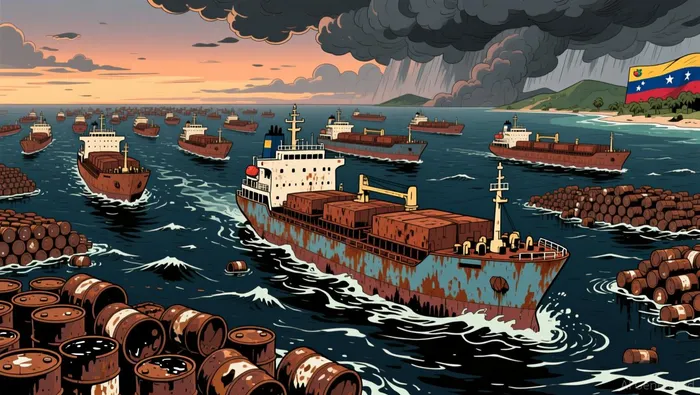
This timeline mismatch-where Venezuela's oil resurgence is decades away-means the market will continue to price in oversupply rather than potential. Even under optimistic scenarios, , a volume insufficient to offset broader supply-demand imbalances. Meanwhile, , as the cartel's influence wanes in a market increasingly dominated by U.S. shale and renewable energy transitions.
Bearish Implications for WTI and Brent
The cumulative effect of these dynamics is a bearish outlook for WTI and Brent. Structural oversupply, compounded by Venezuela's slow recovery and geopolitical bottlenecks, will likely keep prices anchored to the lower end of their historical ranges. Data from the underscores this, noting that global oil demand growth has stagnated, .
Moreover, the market's muted response to Venezuela-specific risks-such as U.S. military activity in the Caribbean or the potential for a 50% production drop in a full-scale conflict-further illustrates its focus on broader fundamentals . Investors and traders are increasingly pricing in a future where Venezuela's oil, despite its vast reserves, remains a marginal player in a market already oversaturated by OPEC+ and U.S. production.
Conclusion
Venezuela's oil resurgence, while symbolically significant, is unlikely to alter the bearish trajectory of WTI and Brent in the near term. Structural oversupply, geopolitical bottlenecks, and a prolonged timeline for production recovery will continue to weigh on prices, reinforcing the market's shift toward a low-price equilibrium. For investors, the lesson is clear: the global oil market's challenges are not confined to Venezuela but are systemic, driven by a mismatch between supply resilience and demand elasticity. As the IEA and OPEC+ struggle to reconcile their production strategies with a rapidly evolving energy landscape, Venezuela's crude remains a cautionary tale of potential unmet.





Comentarios
Aún no hay comentarios