
Assessing JinkoSolar's Strategic Expansion Amid Global Headwinds
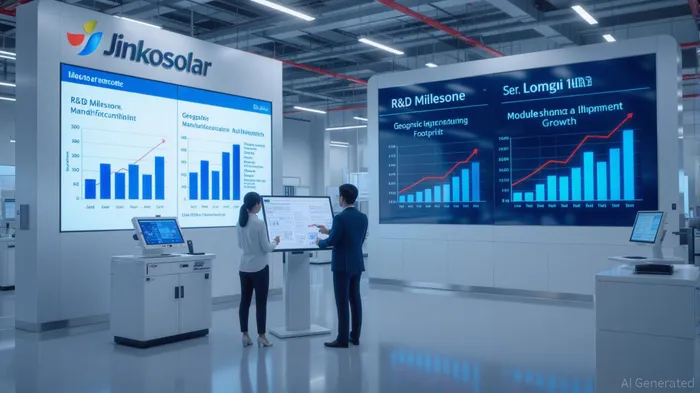
The global solar industry in 2024 is navigating a turbulent landscape marked by price erosion, supply-demand imbalances, and geopolitical fragmentation. Against this backdrop, JinkoSolarJKS-- has emerged as a case study in operational resilience, leveraging technological innovation and geographic diversification to counter systemic headwinds. This analysis evaluates JinkoSolar's strategic initiatives—particularly its N-type TOPCon technology leadership, supply chain investments, and energy storage expansion—while benchmarking its approach against key competitors like LONGi and First SolarFSLR--.
Strategic Expansion: Technology and Geography as Dual Levers
JinkoSolar's third-quarter 2024 results underscore its aggressive push into high-efficiency solar solutions. The company achieved record module shipments of 25,910 MW, with N-type TOPCon modules accounting for 90% of its global output [5]. This shift reflects a calculated pivot toward premium products, as N-type technology offers superior efficiency and longevity compared to traditional P-type modules. By the end of Q3, JinkoSolar's mass production efficiency for N-type TOPCon cells reached 26.2%, a critical threshold for maintaining margins amid pricing pressures [5].
Geographically, the company has diversified its manufacturing footprint to mitigate risks. A new ingot and wafer factory in Vietnam, announced in 2024, doubles its non-China capacity, reducing reliance on a single region and aligning with global demand for localized production [2]. Simultaneously, JinkoSolar expanded its U.S. operations with a tariff-free module assembly plant in Jacksonville, Florida, a strategic move to capitalize on the Inflation Reduction Act's incentives while avoiding U.S. import tariffs [1]. These investments highlight a dual focus on technological differentiation and geographic resilience.
Financial Pressures and Cost Optimization
Despite these strides, JinkoSolar's financials reveal the sector's broader challenges. Total revenues for Q3 2024 fell to RMB24.51 billion (US$3.49 billion), a year-over-year decline driven by plummeting module prices [5]. Net income attributable to shareholders plummeted to RMB22.5 million (US$2 million), a stark contrast to RMB1.32 billion in Q3 2023 [5]. This erosion underscores the industry's margin compression, yet JinkoSolar has prioritized cost optimization through integrated supply chain management and technical advancements. For instance, its R&D-driven efficiency gains in TOPCon cells reduce production costs, enabling the company to maintain competitiveness despite price declines.
Benchmarking Against Competitors: LONGi and First Solar
LONGi Solar, a key rival, has similarly prioritized R&D and geographic expansion. In 2024, LONGi achieved a world-record 27.30% efficiency for heterojunction back contact (HBC) solar cells, outpacing JinkoSolar's TOPCon efficiency by 1.1 percentage points [1]. This milestone positions LONGi as a leader in next-generation photovoltaic technology. Additionally, LONGi operates seven strategic global locations, a footprint that mirrors JinkoSolar's internationalization but with a stronger emphasis on emerging markets [2].
First Solar, however, remains a wildcard in this comparison. While the company is renowned for its cadmium telluride (CdTe) thin-film technology and robust supply chain strategies, specific data on its 2024 initiatives—particularly energy storage solutions—remains opaque . This lack of transparency complicates direct comparisons, though First Solar's historical focus on U.S. markets and module recycling programs suggests a distinct approach to sustainability and resilience.
Market Adaptability: Energy Storage and Sustainability
JinkoSolar's introduction of EAGLE® Storage in 2024 marks a pivotal expansion into integrated solar-storage solutions, a sector projected to grow rapidly as grid instability and energy price volatility persist [5]. This move aligns with Bloomberg New Energy Finance's recognition of JinkoSolar as a Tier 1 energy storage provider, a credential that enhances its credibility in a market increasingly dominated by hybrid systems [3]. By bundling solar and storage, JinkoSolar addresses customer pain points such as intermittency and peak demand management, differentiating itself from peers focused solely on modules.
Sustainability also figures prominently in JinkoSolar's strategy. The company has adopted measures to reduce greenhouse gas emissions and promote product recycling, aligning with global regulatory trends and investor expectations [3]. These efforts, while not unique, reinforce its position as a responsible actor in an industry under scrutiny for environmental practices.
Conclusion: Resilience in a Fragmented Landscape
JinkoSolar's 2024 strategy exemplifies a blend of technological ambition and operational pragmatism. While financial headwinds persist, its investments in N-type TOPCon, geographic diversification, and energy storage position it to weather industry volatility. However, the company faces stiff competition from LONGi's cutting-edge R&D and First Solar's entrenched U.S. presence. For investors, the key question is whether JinkoSolar's cost-optimization measures and product innovation can sustain its market share as the sector consolidates.
Historical backtesting of JinkoSolar's earnings releases since 2022 reveals mixed signals for investors. Over 13 events, the stock showed a median underperformance relative to benchmarks in the 30-day post-announcement window, with no statistically significant patterns in individual-day metrics. While a 46–54% win rate was observed around the +23- to +24-day mark (≈+6% vs. −0.55% benchmark), the immediate post-earnings reaction averaged a mild negative drift (≈−1%) . These findings suggest that a simple buy-and-hold strategy around earnings dates lacks a consistent edge, underscoring the importance of broader fundamental and macroeconomic analysis for long-term positioning.





Comentarios
Aún no hay comentarios