
Assessing the Investment Risk of Trump's 10% Credit Card Rate Cap Proposal
The investment landscape in 2026 is shaped by a pivotal policy proposal: President Donald Trump's call for a one-year cap on credit card interest rates at 10%, effective January 20, 2026. This move, framed as a response to consumer affordability concerns, has sparked intense debate over its legislative feasibility and sectoral implications. For investors, the proposal raises critical questions about political dynamics, regulatory capacity, and the financial sector's resilience.
Legislative Feasibility: A Tenuous Path Forward
Trump's proposal lacks clarity on implementation, leaving open whether it will rely on executive action, congressional legislation, or voluntary compliance. Historical precedents suggest that unilateral executive measures in financial regulation face significant hurdles. For instance, the Trump administration's dismantling of the CFPB has weakened the agency's ability to enforce consumer protections, raising doubts about its capacity to oversee a rate cap.
Congressional efforts to address high credit card rates, such as the bipartisan S.381 and H.R.1944 bills introduced in 2025, have stalled despite cross-party support. While these bills aim to cap rates at 10% for five years, they have not advanced beyond committee referrals, reflecting the challenges of navigating a Republican-controlled Congress amid banking industry opposition. Critics, including Senator Elizabeth Warren, argue that Trump's proposal lacks a viable legislative pathway and risks undermining existing consumer safeguards.
The banking sector's resistance further complicates the proposal's prospects. The American Bankers Association and the Bank Policy Institute have warned that a rate cap could reduce credit availability for high-risk borrowers, pushing them toward predatory alternatives like payday loans. These concerns, combined with the absence of a clear enforcement mechanism, suggest that legislative action remains uncertain.
Sectoral Impact: Market Volatility and Structural Shifts
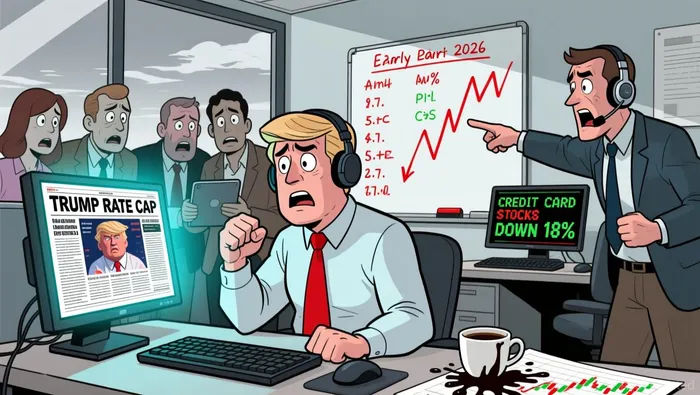
The financial sector's immediate reaction to Trump's proposal underscores its sensitivity to regulatory uncertainty. In January 2026, shares of major credit card issuers plunged as much as 10% in premarket trading, with analysts estimating potential pre-tax earnings declines of 5%-18% for large banks. Jefferies analysts noted that while the proposal is unlikely to materialize without congressional backing, the mere threat of regulatory intervention has already rattled investor confidence.
Long-term implications for the sector hinge on the interplay between consumer behavior and institutional responses. A 10% rate cap could force banks to tighten credit underwriting standards, potentially limiting access for low-creditworthiness borrowers who rely on high-interest cards for liquidity. Conversely, proponents argue that the cap could save consumers $100 billion annually in interest payments, according to research by the Vanderbilt Policy Accelerator. However, this benefit may be offset by a shift in demand toward alternative lenders, such as buy-now-pay-later (BNPL) platforms, which saw their shares rise in response to the proposal.
The credit card market's projected growth-forecasted to reach $930 billion by 2029-also faces headwinds from regulatory uncertainty. While innovations like AI-driven underwriting and digital payment ecosystems are expanding access, a rate cap could disrupt these trends by altering risk models and transaction volumes. For investors, the sector's exposure to policy shifts necessitates a dual focus on short-term volatility and long-term structural adjustments.
Strategic Considerations for Investors
For equity investors, the key risks lie in the proposal's ambiguity and the banking sector's vulnerability to regulatory shocks. While the one-year nature of Trump's cap may limit its long-term impact, the potential for extended legislative battles or executive overreach cannot be ignored. Investors should monitor congressional debates on S.381 and H.R.1944, as well as the Federal Reserve's stance on consumer credit accessibility.
Fixed-income investors, meanwhile, must assess the credit risk of financial institutions. A prolonged reduction in credit card revenues could strain balance sheets, particularly for banks with high exposure to subprime lending. Conversely, alternative lenders-such as BNPL providers-may benefit from a shift in consumer borrowing patterns, presenting asymmetric opportunities.
Conclusion
Trump's 10% credit card rate cap proposal epitomizes the intersection of political ambition and market reality. While its legislative feasibility remains uncertain, the proposal has already triggered significant market volatility and highlighted the fragility of the financial sector's regulatory environment. For investors, the path forward demands vigilance in navigating both political developments and sectoral adjustments. As the 119th Congress grapples with bipartisan priorities and industry resistance, the investment community must prepare for a landscape where policy uncertainty and market dynamics are inextricably linked.







Comentarios
Aún no hay comentarios