
Assessing the Investment Potential of Emerging Blockchain Technologies in a Fragmented Market
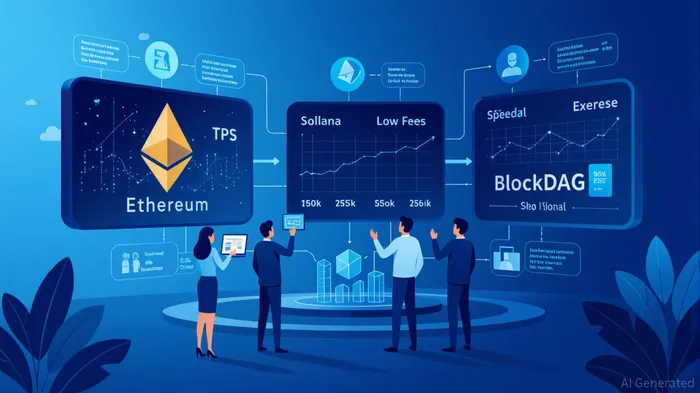
The Fragmented Blockchain Landscape: A Tale of Trade-Offs
The blockchain market in 2025 remains a fragmented ecosystem, with competing architectures vying for dominance. Layer 1 protocols like EthereumETH-- and SolanaSOL-- have carved out distinct niches, while next-gen BlockDAG solutions such as IOTAIOTA--, HederaHBAR--, and the emerging BlockDAG project (BDAG) challenge traditional models with novel approaches to scalability and decentralization. For investors, the key lies in understanding the trade-offs between speed, cost, security, and real-world adoption.
1. Performance Metrics: TPS, Fees, and Scalability
Ethereum's base layer processes 15–30 transactions per second (TPS) [1], a stark contrast to Solana's 2,000–65,000 TPS under normal and peak conditions [2]. While Ethereum relies on Layer 2 solutions (e.g., Arbitrum, zkSync) to scale, Solana's Proof-of-History (PoH) and parallel processing enable native high throughput. BlockDAG, however, claims to bridge the gap: its hybrid DAG-PoW architecture supports 10,000–15,000 TPS while maintaining energy efficiency and decentralization [3].
Transaction fees further differentiate these platforms. Solana's $0.00025 average fee [2] makes it ideal for microtransactions and retail-driven use cases like memecoins, whereas Ethereum's fees fluctuate between $0.10–$5, even with Layer 2 optimizations [1]. BlockDAG's $0.001–$0.01 range [3] positions it as a middle ground, balancing affordability with security.
Scalability remains a contentious issue. Ethereum's sharding roadmap aims to address congestion, but its reliance on off-chain solutions introduces complexity. Solana's high TPS has been marred by occasional outages and centralization risks due to high-end hardware requirements [2]. BlockDAG's DAG structure, by contrast, enables parallel transaction processing without compromising decentralization, a claim supported by its 312,000+ global holders and 3 million daily miners [3].
2. Decentralization and Security: The Unseen Battle
Decentralization metrics reveal stark contrasts. Ethereum's 600,000+ validators [1] underscore its robust security model, while Solana's 1,400–2,000 validators raise concerns about centralization [2]. BlockDAG's community-driven approach, with no exclusive VC allocations and a globally distributed validator base, appears to mitigate these risks [3].
Security trade-offs are equally critical. Hedera's hashgraph consensus offers asynchronous Byzantine Fault Tolerance but lacks the cryptographic rigor of PoW [4]. IOTA's Tangle model, while innovative, has faced adoption hurdles. BlockDAG's PoW-DAG hybrid, however, combines the security of Bitcoin's mining model with DAG scalability, a feature that has attracted $405 million in presale funding [3].
3. Real-World Adoption: From DeFi to Enterprise
Ethereum's dominance in decentralized finance (DeFi) and NFTs is unmatched, with $50 billion in TVL and institutional backing via ETFs [1]. Solana's focus on speed has fueled growth in gaming (e.g., Magic Eden) and high-frequency trading, though its retail-centric ecosystem lacks Ethereum's institutional depth [2].
BlockDAG's real-world deployment, including its Singapore Deployment Event, highlights its practical scalability. Its EVM and WASM compatibility allows developers to migrate Ethereum-based dApps while leveraging Rust and C++ for performance [3]. Meanwhile, Hedera's enterprise partnerships (Google, IBM) emphasize stability over innovation, limiting its appeal to speculative investors [4].
4. Institutional Adoption: The New Frontier
Institutional interest in Solana has surged, with public companies holding 1% of its circulating supply and ETF filings targeting 7–8% staking yields [2]. Ethereum's $7.09 billion in ETF inflows [4] reinforces its status as a blue-chip asset. BlockDAG, while less established, has attracted 312,000 holders across 130 countries, suggesting strong grassroots momentum [3].
Conclusion: Navigating the Fragmented Market
The blockchain market's fragmentation presents both risks and opportunities. Ethereum's security and institutional trust make it a safe bet for long-term investors, while Solana's speed and low fees cater to high-growth, retail-driven sectors. BlockDAG's hybrid model, however, offers a compelling middle path: it combines Ethereum's security with Solana's scalability and introduces a decentralized, community-driven framework.
For investors, the key is to align with projects that address current limitations—whether through Layer 2 innovations, novel consensus mechanisms, or hybrid architectures. As the market evolves, the winners will be those that balance performance, decentralization, and real-world utility.






Comentarios
Aún no hay comentarios