
Assessing the Investment Implications of Rising U.S.-Iran Tensions via Polymarket Predictive Data
The U.S.-Iran geopolitical landscape in 2025 has become a focal point for investors navigating energy market volatility and geopolitical risk. With Polymarket contracts offering real-time probabilistic insights into potential military escalation, the interplay between predictive data and oil price dynamics is critical for hedging strategies. This analysis synthesizes Polymarket trends, historical energy market responses, and emerging risk models to evaluate how investors can position themselves in this high-stakes environment.
Polymarket Data: A Barometer of Escalation Risk
As of June 2025, Polymarket contracts indicate a 43% probability of U.S. military action against Iran between June 19 and June 21, 2025, with broader escalation risks (June 11–July 31, 2025) also at 43%. By December 2025, the probability of U.S. military personnel entering Iran for combat operations had stabilized at 34%, while the likelihood of a U.S. invasion by December 31, 2025, remained low. However, the cumulative probability of a U.S. strike on Iranian soil by June 30, 2026, rose to 69%, reflecting growing trader sentiment about regional instability. These metrics underscore a gradual escalation in perceived risk, driven by factors such as Iran's nuclear ambitions and domestic political shifts, including a 56% Polymarket probability of Supreme Leader Khamenei's removal by December 2026.
Energy Market Volatility: Historical Patterns and Predictive Models
Historical data reveals that U.S.-Iran tensions have historically triggered oil price surges, albeit with tempered responses when supply disruptions are perceived as unlikely. For instance, during the June 2025 airstrikes on Iranian nuclear sites, WTI crude prices jumped from $67 to $76 per barrel before retreating, as traders discounted risks of self-inflicted supply shocks by Iran. The Strait of Hormuz, a critical chokepoint for 20% of global oil flows, remains a high-impact, low-probability risk. A closure could push oil prices above $100 per barrel, though such scenarios are rare.
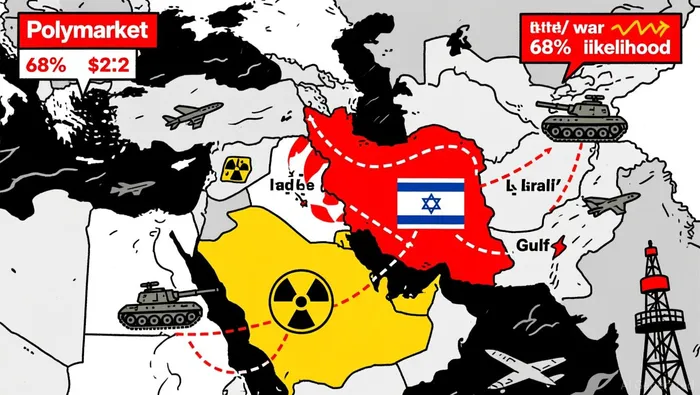
Geopolitical risk models further clarify these dynamics. The Geopolitical Risk Index (GPR) has shown strong predictive power for oil volatility, particularly during regime shifts or acute conflicts. Studies by Qian et al. (2022) and Özdemir (2025) highlight that GPRTHREAT (geopolitical risk threats) outperforms GPRACTION (actual geopolitical events) in forecasting volatility, emphasizing the market's forward-looking nature. For example, the June 2025 aerial bombardment by Israel and Iran triggered a 14% spike in WTI prices, driven by risk premiums rather than immediate supply disruptions.
Hedging Strategies: Navigating Uncertainty
Investors must adopt multi-layered hedging strategies to mitigate exposure to U.S.-Iran tensions. Key approaches include:
1. Long Crude Oil Futures: Positioning in WTI or Brent crude futures allows investors to capitalize on potential price rebounds while hedging against short-term volatility.
- Currency and Inflation Hedges: Given the inflationary risks of oil shocks, allocations to inflation-protected securities (TIPS) and diversified currency baskets can offset macroeconomic headwinds.
- Options and Derivatives: Call options on Brent crude and energy sector equities provide asymmetric upside potential during geopolitical spikes.
- Diversification into Energy-Exporting Economies: The U.S., as a net energy exporter, is less vulnerable to oil price spikes than import-dependent nations like India or Indonesia.
High-Impact Scenarios and Market Resilience
While the probability of a Strait of Hormuz closure remains low, its potential impact is catastrophic. Historical models suggest such a closure could add $15–25 per barrel to oil prices, with temporary inflationary effects (e.g., a 1.28 percentage point spike in U.S. PCE inflation). However, markets have shown resilience through tools like satellite surveillance and tanker tracking, which reduce uncertainty and enable rapid recalibration.
Conclusion: A Call for Vigilance and Adaptability
The U.S.-Iran tensions of 2025–2026 present both risks and opportunities for investors. Polymarket data, combined with historical volatility patterns and geopolitical risk models, offers a roadmap for hedging and positioning. As the probability of escalation rises-particularly with Khamenei's potential ouster and the looming June 2026 strike deadline-investors must remain agile, leveraging predictive markets and diversified hedging tools to navigate this volatile landscape.







Comentarios
Aún no hay comentarios