
Assessing the Investment Case for a Post-Maduro Venezuela
The core event is a dramatic geopolitical shift: the U.S. captured President Nicolás Maduro and declared a total blockade of all sanctioned tankers, paralyzing Venezuela's oil exports. This action, framed by President Trump as reclaiming stolen assets, opens a new chapter for the world's largest oil reserves. Yet the immediate market reaction has been muted, with analysts projecting only a at most. . In a market already oversupplied and facing weak demand, this volume is simply too small to cause a price shock.
The U.S. claim of ownership is rooted in a historical narrative of nationalization. Trump asserts that American talent built Venezuela's industry, which was then "stolen" by the socialist regime. This mirrors the pattern of asset seizures that began under Hugo Chávez in the early 2000s, which systematically pushed out Western oil companies. ChevronCVX-- remains the only U.S. operator, but its role is now defined by a U.S. Treasury license that strictly limits its operations. The new U.S. "oversight" of a political transition introduces profound uncertainty, but the immediate impact on global oil flows is negligible.
The bottom line is a paradox. The event is a massive geopolitical earthquake, yet its market tremors are faint. The muted price move underscores that the world's oil market is now a function of supply and demand, not just political headlines. The real story is in the long-term implications: the potential for a new, U.S.-aligned government to eventually unlock Venezuela's vast reserves, which could have a bearish impact on prices over years. For now, the market is focused on the immediate reality-Venezuela's oil is a minor player in a crowded field.
The Structural Challenge: From Reserves to Revenue
The paradox of Venezuela's oil sector is one of the most extreme in the world. The nation holds about 17% of global oil reserves, . . This isn't a cyclical downturn; it's a structural failure where vast reserves have been rendered functionally worthless due to decades of mismanagement, underinvestment, and nationalization. The disconnect is fundamental: reserves are a static stock, while revenue requires a functioning, productive system.
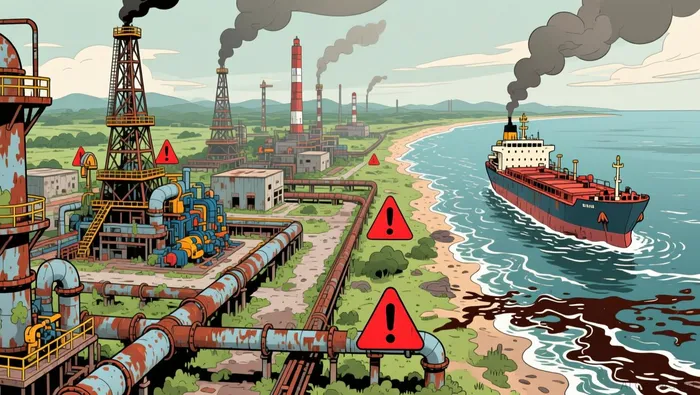
The operational strain is now acute, centered on the Orinoco Belt. This region, which produces roughly , is experiencing severe bottlenecks. , . The cause is a classic infrastructure failure: the company is running out of storage space and can't export quickly enough, forcing it to shut wells. This is the immediate symptom of a broken system, where the physical ability to move oil from the ground to the market has atrophied.
Restoring this system to even a fraction of its former capacity would require a monumental, sustained investment. Analysts estimate that returning production to over a decade. This figure underscores the scale of the challenge. It's not a quick fix but a multi-year, capital-intensive rebuild of infrastructure, technology, and operational capability. The Trump administration's promise of a U.S. return to the industry, with companies spending "billions and billions of dollars," must be viewed through this lens of immense, long-term cost.
The bottom line is that Venezuela's oil wealth remains locked. The reserves are a potential asset, but the operational and political realities have created a near-impenetrable barrier to converting that potential into revenue. Until that $110 billion is committed and the Orinoco Belt's bottlenecks are resolved, the country's vast endowment will continue to be a source of geopolitical tension rather than economic salvation.
The Investment Thesis: Re-entry Conditions and Corporate Calculus
The U.S. plan to re-engage with Venezuela's oil sector faces a fundamental credibility gap. While President Trump has publicly declared that American oil companies will lead the rebuilding effort, the corporate response has been one of deep skepticism and strategic caution. The administration's condition-that companies must return to be reimbursed for seized assets-has been met with a firm, if quiet, refusal to commit. The only remaining U.S. operator, Chevron, has stated it will continue to operate in full compliance with all relevant laws and regulations, a stance that signals compliance, not expansion. This is the core of the investment thesis: the political offer is on the table, but the corporate calculus is not yet aligned.
The reasons for this hesitation are structural and immediate. First, the security and political environment remain undefined. Industry officials have described the administration's outreach as "at its best in the infancy stage" and a "shoot-ready-aim exercise". The shape of a post-Maduro government is unclear, and the promise of U.S. involvement is not a guarantee of safety for personnel or equipment. Second, the global market context is hostile to new, high-risk capital expenditure. The oil market is entering a period of oversupply, with prices near multi-year lows. In this environment, companies are "very selective of where they invest", prioritizing known, lower-risk projects over a capital-intensive gamble in a decaying, politically uncertain nation.
This creates a stark contradiction. The U.S. is offering a path to compensation for decades of nationalized assets, but the conditions for that compensation-immediate, large-scale investment-are being rejected. The market's reaction to Maduro's capture has been bearish, with analysts noting the "expectation of more Venezuelan crude on the market in the near term". This suggests that the immediate impact of U.S. action is to increase supply, not to create a scarcity premium that would justify the billions in upfront costs Trump demands. The math simply does not add up for majors when prices are depressed and the infrastructure is dilapidated.
The bottom line is that the viability of the U.S. plan hinges on a policy shift that has not yet occurred. For companies to re-enter, they need more than a promise of reimbursement; they need a stable security guarantee, a clear path to profitable production, and a market where Venezuelan crude can command a premium. Without these, the plan remains a political statement, not a commercial blueprint. The corporate calculus, for now, is one of wait-and-see, with Chevron's narrow, compliant export of as the only tangible sign of continued U.S. presence.
Catalysts, Scenarios, and Key Risks
The investment story for Venezuela is now defined by a single, high-stakes political event: the U.S. capture of President Nicolás Maduro. The forward-looking catalysts and risks are starkly bifurcated, hinging entirely on the nature of the political transition that follows.
The primary bearish catalyst is a prolonged power vacuum or civil conflict, mirroring Libya's post- experience. In this scenario, the country remains in disarray, with multiple opposition leaders in exile vying for power and the Chavismo movement maintaining internal support. This instability would lock out foreign investment, keep production depressed, and provide a minor bullish price tailwind. As geopolitical analyst Jorge León noted, a Libya-like outcome would likely result in a "slightly bullish increase in geopolitical risk and slightly bullish [impact] on pricing in the short term." The mechanism is straightforward: any disruption to Venezuela's already fragile production system would tighten global supply, particularly for its heavy-sour crude, which is a key diesel input.
Conversely, the bullish catalyst is a swift, stable transition to a pro-Western government that lifts sanctions and guarantees property rights. This scenario, akin to the post- opening in Syria, would unlock the nation's massive reserves. The long-term impact would be bearish for oil prices as significant new supply enters the market over 3-5 years. Analysts project that exports could approach 3 million barrels per day in the medium term if foreign investors return. The key risk, however, is that this transition is not a quick fix. As former State Department official David Goldwyn emphasized, "transitions are hard," and companies are unlikely to commit billions for long-term operations until the terms are clear. The U.S. military presence and its stated plan to "run the country" until a "safe, proper and judicious transition" is achieved is not a sustainable long-term solution. The lack of a clear, stable political successor regime remains the single greatest barrier to any investment case.
The primary risk is that the U.S. "running" of Venezuela is a temporary, coercive arrangement that fails to establish a durable political foundation. The current situation-where top members of the Maduro regime remain in place, including a vice president who claims Maduro is still the only president-creates profound uncertainty. This sets the stage for a volatile period where production could plummet further, . The bottom line is that while the immediate market impact is likely muted due to Venezuela's current low production share, the long-term investment thesis is entirely contingent on a political outcome that is currently impossible to predict.







Comentarios
Aún no hay comentarios