
Assessing Insider Trading Risks in High-Profile Crypto Whale Activity: A 2025 Market Integrity Analysis
The Growing Shadow of Whale Activity in Crypto Markets
The cryptocurrency market's rapid evolution has brought unprecedented attention to the influence of "whales"-large holders whose transactions can sway prices and sentiment. In 2025, high-profile whale activity has become a focal point for investors and regulators alike, with events such as a $437 million Bitcoin-to-Ethereum transfer by a Satoshi-era whale and a $340 million short position ahead of Trump's China tariff announcement sparking debates about market integrity, according to a OneSafe analysis. These actions, while often framed as strategic bets, raise critical questions about the potential for insider trading and manipulation.
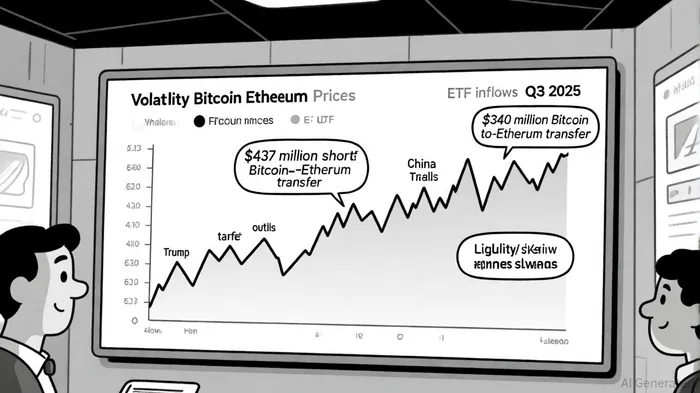
Whale-driven volatility is particularly pronounced in thinly traded markets. For instance, a long-dormant BitcoinBTC-- whale offloading 1,176 BTC ($136.2 million) during a weekend caused Bitcoin's price to plunge from $115,000 to $111,000 within hours, exacerbating liquidity challenges, according to a Bit Journal report. Such events highlight the fragility of crypto markets, where large players can exploit low-volume periods to execute trades with minimal resistance. Meanwhile, Ethereum's ETF inflows of $3.87 billion in August 2025 contrast sharply with Bitcoin's outflows, suggesting divergent institutional confidence levels, as noted by the Bit Journal report.
Insider Trading: From Speculation to Enforcement
While whale activity often remains speculative, confirmed cases of insider trading in crypto markets are emerging. The landmark 2023 prosecution of Ishan Wahi, a former CoinbaseCOIN-- product manager, marked a turning point. Wahi and his brother exploited confidential information about upcoming asset listings to execute profitable trades, netting over $1.5 million before the SEC and DOJ intervened, in a DOJ press release. The U.S. Attorney for the Southern District of New York emphasized that "the laws against insider trading apply to cryptocurrency markets as well," signaling a regulatory shift toward stricter enforcement.
More recently, a March 2025 event involving a $200 million leveraged trade on Bitcoin and Ethereum-executed just before Trump's announcement of a U.S. Crypto Reserve-has fueled speculation. The whale's 50x leverage and precise timing, aligning with Trump's Truth Social post, resulted in a $6.8 million profit. While no concrete evidence of non-public information has been presented, the trade's execution-requiring a 2% price drop to trigger liquidation-underscores the risks of informational asymmetry, as reported by a Coin Republic report.
Regulatory Responses and Market Implications
Regulators are increasingly prioritizing crypto market integrity. The SEC's Crypto Task Force and FinHub office have intensified efforts to clarify securities law applications, while the DOJ's prosecution of Wahi demonstrates a willingness to leverage traditional fraud statutes regardless of asset classification, as discussed in a Global Relay analysis. Meanwhile, decentralized exchanges are exploring technological solutions like TWAP (Time-Weighted Average Price) pricing and whale detection algorithms to mitigate manipulation, according to a OneSafe post.
However, enforcement challenges persist. The pseudonymous nature of crypto transactions and the lack of universal regulatory frameworks complicate investigations. For example, the "Trump Insider Whale" who shorted $340 million ahead of Trump's tariff announcement denied any connection to the administration, citing client funds as the source of capital, according to a Yahoo Finance article. While such denials are common, they highlight the difficulty of proving intent in a decentralized ecosystem.
Conclusion: Balancing Innovation and Integrity
The 2025 crypto landscape reveals a market at a crossroads. Whale activity, while a natural feature of asset markets, poses unique risks due to the sector's low liquidity and regulatory ambiguity. As seen in the WLFI whale's $1.6 million loss from leveraged positions and the buyback strategies of projects like World Liberty FinancialWLFI--, short-term volatility can obscure long-term fundamentals, as discussed in a OneSafe overview.
For investors, the key takeaway is to remain vigilant about whale-driven risks while advocating for clearer regulatory guardrails. For regulators, the challenge lies in fostering innovation without stifling the decentralized ethos that defines crypto. As the Wahi case and Trump-related trades demonstrate, the line between strategic trading and insider manipulation is increasingly blurred-a reality that demands both technological and legal innovation to preserve market trust.





Comentarios
Aún no hay comentarios