
Assessing the Implications of Goldman Sachs' 2026 Oil Surplus Forecast for Energy Investors
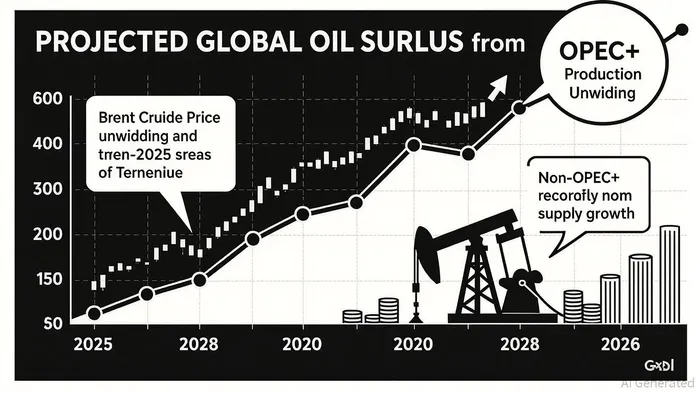
Goldman Sachs’ latest oil market forecast paints a starkly bearish picture for 2026, with a projected global surplus of 1.8–1.9 million barrels per day (mb/d) by year-end and Brent crude prices falling to the low $50s [1]. This forecast, rooted in a confluence of rising non-OPEC+ supply, OPEC+ production normalization, and subdued demand growth, signals a deflationary shift for energy investors. For those navigating this landscape, strategic positioning must balance risk mitigation with opportunities in resilient sectors and alternative assets.
Market Dynamics: The Drivers of Deflation
Goldman Sachs attributes the looming surplus to a dual surge in supply and a slowdown in demand. OPEC+’s gradual unwinding of production cuts—projected to add 411,000 mb/d in May 2025—will be compounded by non-OPEC+ output growth, particularly from U.S. tight oil, Brazil, and Canada [2]. Meanwhile, global demand growth is expected to decelerate to 1.4 million mb/d in 2025, with further contraction to 690,000 mb/d in 2026 due to macroeconomic volatility and trade tensions [3]. The result? A surplus that could expand from 800,000 mb/d in 2025 to 1.4–1.9 mb/d in 2026, driving down prices and inventory builds [4].
The EIA corroborates this bearish outlook, forecasting Brent prices to decline from $74 in 2025 to $66 in 2026, with a potential dip to $49 in early 2026 amid inventory overhangs [5]. However, geopolitical risks—such as unexpected Chinese stockpiling or Russian production shortfalls—remain wild cards that could temporarily stabilize prices [6].
Strategic Positioning: Navigating the Deflationary Shift
Energy investors must adapt to a market where traditional oil producers face margin compression while alternative energy and infrastructure playbooks gain traction.
- Sectoral Diversification
- Resilient Energy Stocks: Firms with exposure to energy security concerns or AI-driven electricity demand (e.g., nuclear, gas-fired power plants) may outperform [7]. For example, companies like ShellSHEL-- and BPBP--, which are pivoting toward low-carbon energy, could benefit from sustained demand for reliable power amid AI and data center growth [8].
High-Value Innovation: Lower oil prices may curb capex in legacy energy sectors but could spur investment in cost-efficient technologies, such as enhanced oil recovery (EOR) or carbon capture [9].
Hedging Mechanisms
- Options Strategies: Protective puts and collars can shield portfolios from price volatility, particularly for underhedged U.S. producers (only 21% of 2025 output is hedged) [10]. Multi-leg options spreads offer downside protection without capping upside potential.
Commodity Diversification: Gold, with its inverse correlation to oil during geopolitical shocks, and art—historically a safe haven during energy booms—provide non-correlated hedging avenues [11].
Macro-Linked Instruments
- Inflation-Protected Bonds: U.S. Treasury Inflation-Protected Securities (TIPS) and longer-duration government bonds (U.S., U.K.) offer attractive yields in a low-inflation environment [12].
- Geopolitical Risk Tools: AI-driven platforms for volatility forecasting can help investors adjust hedging strategies in real time, mitigating exposure to sudden supply shocks [13].
The Road Ahead: Balancing Caution and Opportunity
While Goldman Sachs’ forecast underscores a deflationary trajectory, investors should remain cognizantCTSH-- of structural shifts. The energy transition and AI-driven electricity demand may create new growth corridors, even as oil markets face oversupply. A balanced approach—combining sectoral agility, hedging, and macroeconomic alignment—will be critical to capitalizing on these dynamics.
Source
[1] Goldman SachsGS-- Forecasts Brent Crude to Fall Below $55 ..., [https://www.fastbull.com/news-detail/goldman-sachs-forecasts-brent-crude-to-fall-below-4341415_0]
[2] Oil Forecast and Price Predictions 2025, 2026-2030 [https://naga.com/ae/news-and-analysis/articles/oil-price-prediction]
[3] Global Economics Intelligence executive summary, July 2025 [https://www.mckinsey.com/capabilities/strategy-and-corporate-finance/our-insights/global-economics-intelligence]
[4] Oil Goes From Bad to Worse in First Takes on 2026 [https://www.bloomberg.com/news/newsletters/2025-04-15/oil-goes-from-bad-to-worse-in-first-takes-on-2026]
[5] Oil Forecast and Price Predictions 2025, 2026-2030 [https://naga.com/ae/news-and-analysis/articles/oil-price-prediction]
[6] Why Analysts Misjudge Oil's Future [https://www.artberman.com/blog/why-analysts-misjudge-oils-future/]
[7] 13 Energy Stocks to Buy Even as Oil Prices Fall, According ..., [https://www.barrons.com/articles/vista-shell-oil-price-energy-stocks-roundtable-e521febc]
[8] Oil and gas news: 7 key challenges for energy traders in ... [https://permutable.ai/oil-and-gas-news-key-challenges/]
[9] S&P Global Commodity Insights Releases its 2025 Energy Outlook [https://press.spglobal.com/2024-12-11-S-P-Global-Commodity-Insights-Releases-its-2025-Energy-Outlook]
[10] American Oil Is Underhedged and Heavily Exposed [https://oilprice.com/Energy/Crude-Oil/American-Oil-Is-Underhedged-and-Heavily-Exposed.html]
[11] Are Gold and Oil Effective Hedging Tools for Investors? [https://www.ishares.com/us/insights/gold-oil-commodity-hedging]
[12] Investment StrategyMSTR-- Focus February 2025, [https://wealthmanagement.bnpparibas/en/insights/market-strategy/investment-strategy-focus-february-2025.html]
[13] Oil and gas news: 7 key challenges for energy traders in ... [https://permutable.ai/oil-and-gas-news-key-challenges/]





Comentarios
Aún no hay comentarios