
Assessing the Impact of the Ukraine Peace Talks on Geopolitical Risk and Commodity Markets
The global commodity markets are at a pivotal inflection point as the 2025 Ukraine-Russia peace negotiations gain momentum. With U.S. envoy Steve Witkoff poised to engage Russian leaders in Moscow, the potential for a ceasefire has triggered a recalibration of geopolitical risk indices and commodity price dynamics. For investors, this shifting landscape demands a nuanced understanding of how peace talks could reshape supply chains, sanctions regimes, and market fundamentals.
Oil: A Bearish Outlook Amid Sanctions Relief Hopes
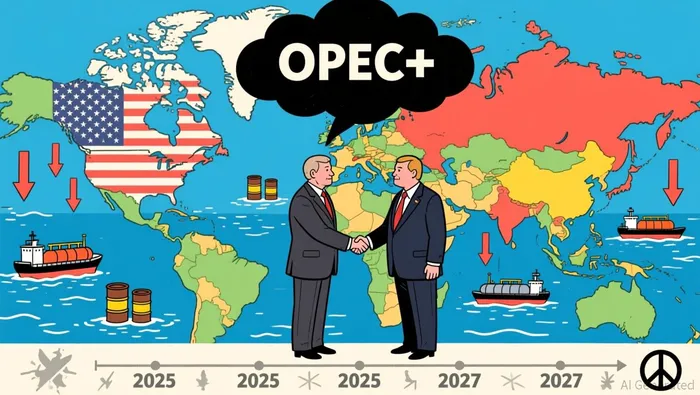
The most immediate and profound impact of the peace talks is on the oil market. A ceasefire would likely accelerate the normalization of Russian refinery operations and reduce Ukraine's drone attacks on energy infrastructure, easing supply concerns. According to a Reuters report, market participants are already pricing in a bearish outlook, with Brent crude projected to fall toward $60 per barrel if U.S. sanctions are eased. This aligns with data from Bloomberg, which notes that OPEC+ is expected to maintain production levels unchanged, given the uncertainty surrounding Russian oil supply and global demand.
However, the interplay of structural oversupply and rising OECD commercial inventories complicates the picture. A peace deal arriving in an already oversupplied market could drive prices lower, with some analysts forecasting a long-term range of $45–$55 per barrel if sanctions are fully lifted. Investors must weigh the risk of a sudden supply surge against the potential for OPEC+ to adjust output in response to geopolitical developments.
Geopolitical Risk Indices: Uncertainty as a Double-Edged Sword
While peace talks reduce the risk of prolonged conflict, they also introduce uncertainty around the timing and extent of sanctions relief. This duality is reflected in geopolitical risk indices, which have shown mixed signals. A Discovery Alert report highlights that renewed hopes for a resolution have created volatility in oil market sentiment, as traders grapple with the implications of a potential shift in Russian crude exports.
The European Commission's 2027 target for a full ban on Russian fossil fuel imports adds another layer of complexity. Even if a peace deal is reached, the gradual phaseout of Russian gas in Europe may limit the immediate upside for global gas prices. According to Bloomberg, investors should monitor central bank actions and trade policy shifts, as these could amplify or mitigate the geopolitical risk premium embedded in commodity prices.
Agriculture and Metals: Normalization or Disruption?
Ukraine's role as a critical supplier of wheat, corn, and sunflower oil means that a peace deal could stabilize global food markets. According to Bloomberg, Ukraine accounts for 10–12% of global wheat and 15–20% of corn exports, with its sunflower oil dominance exceeding 50%. Restoring these supply chains could alleviate food security concerns, though recovery timelines may span years due to infrastructure and production challenges.
Metals markets, particularly copper, nickel, and aluminum, may also see normalization as Russian exports re-enter global trade. A report by Aegis Hedging notes that price surges observed at the start of the conflict could subside if sanctions are lifted, though compliance costs and logistics hurdles may persist. Gold, meanwhile, remains a safe-haven asset amid de-dollarization trends, with central bank buying-led by China, Turkey, and India-pushing prices above $4,000 per ounce.
Strategic Positioning: Diversification and Scenario-Based Hedging
For commodity investors, the key to navigating this shifting landscape lies in diversified portfolios and scenario-based hedging. J.P. Morgan's mid-year 2025 outlook emphasizes the importance of balancing exposure to energy, agriculture, and precious metals while accounting for geopolitical tail risks. Instruments like the WisdomTree Enhanced Commodity Strategy Fund offer a vehicle to hedge against both immediate volatility and long-term structural shifts. According to research, the fund provides exposure to a broad range of commodities while mitigating risk through strategic positioning.
Actionable strategies include:
1. Short-term hedging: Using futures contracts to lock in prices for oil and agricultural commodities as peace talks progress.
2. Long-term diversification: Allocating to gold and critical minerals (e.g., copper, lithium) to hedge against currency devaluation and energy transition demand.
3. Scenario planning: Preparing for both rapid sanctions relief and delayed normalization by stress-testing portfolios against multiple outcomes.
Conclusion: Adapting to a New Geopolitical Paradigm
The Ukraine peace talks represent more than a diplomatic effort-they are a catalyst for redefining global commodity markets. While the immediate bearish outlook for oil and the potential normalization of agricultural and metal flows are clear, investors must remain agile in the face of evolving geopolitical risks. By prioritizing diversification, leveraging hedging tools, and staying attuned to policy shifts, commodity investors can position themselves to thrive in this dynamic environment.







Comentarios
Aún no hay comentarios