
Assessing the Impact of Toncoin's Reserve and Buyback Strategy on TON Strategy Shares and Long-Term Value
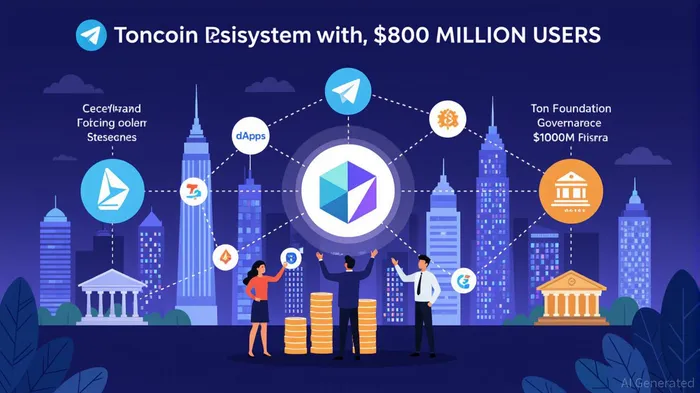
In the rapidly evolving landscape of blockchain and digital assets, Toncoin (TON) has emerged as a compelling case study for value investors. As the native token of The Open Network (TON), a decentralized layer-1 blockchain, TON's utility spans transaction fees, staking, smart contracts, and governance. However, the recent emergence of corporate initiatives—such as AlphaTONATON-- Capital Corp.'s $100 million TON reserve and the TON StrategyTONX-- Company's $250 million buyback program—has sparked debate about their alignment with value investing principles and corporate governance standards. This analysis explores these strategies' potential to bolster TON's long-term value while scrutinizing their structural and governance implications.
The TON Ecosystem: Governance and Utility
Toncoin operates within a decentralized governance model where token holders influence protocol upgrades via platforms like Ton.vote[5]. The TON Foundation, a Switzerland-based non-profit, stewards the network's development but does not unilaterally control decisions[3]. This structure emphasizes community-driven governance, a cornerstone of value investing in crypto assets, which prioritizes long-term sustainability over short-term speculation.
The tokenomics of TON further reinforce its utility: with a maximum supply of 5 billion tokens and a circulating supply of ~3.47 billion[1], TON's scarcity model supports its role in staking, transaction fees, and decentralized applications (dApps). Integration with Telegram's 800 million users—via initiatives like the TON Space wallet—has expanded its real-world utility, particularly in decentralized finance (DeFi) and peer-to-peer transactions[5].
Reserve and Buyback Strategies: A Double-Edged Sword?
While the TON Foundation has not explicitly endorsed reserve or buyback programs, third-party entities have taken bold steps to inject liquidity and confidence into the ecosystem. AlphaTON Capital Corp., a Nasdaq-listed firm, announced a $100 million TON reserve in September 2025, funded by a $38.2 million private placement and a $35 million loan facility secured by TON tokens[1]. This initiative aims to incubate Telegram mini-apps in DeFi, gaming, and productivity, potentially driving adoption[4].
Separately, the TON Strategy Company launched a $250 million stock repurchase program in September 2023, targeting below-NAV (net asset value) buybacks to enhance TON's intrinsic value[3]. These corporate actions, though not directly tied to the TON Foundation, signal institutional confidence in the ecosystem. However, their alignment with TON's decentralized governance model remains ambiguous.
Value Investing Implications
Value investing in crypto assets hinges on evaluating fundamentals such as utility, scarcity, and governance transparency. The TON ecosystem's integration with Telegram's user base and its proof-of-stake (PoS) consensus model[4] align with these principles. However, the lack of official TON Foundation endorsement for the reserve and buyback programs introduces uncertainty.
For instance, AlphaTON's $100 million reserve could stabilize TON's price by reducing sell pressure, but its success depends on the company's ability to generate yield through staking and validation[2]. Similarly, the TON Strategy Company's buybacks may artificially inflate demand, yet their impact is contingent on broader market conditions and investor sentiment[3].
Corporate Governance Considerations
Decentralized governance frameworks, like TON's, prioritize community participation over centralized control. While the TON Foundation coordinates development, it does not dictate protocol changes[3]. This contrasts with traditional corporate governance, where buybacks and reserves are often centralized decisions. The absence of TON Foundation oversight for AlphaTON and the TON Strategy Company raises questions about accountability and alignment with the network's long-term vision.
Moreover, the TON Foundation's stated goal of empowering 500 million users by 2028[1] underscores the importance of ecosystem growth over token price manipulation. If reserve and buyback programs divert resources from core development or user adoption, they could undermine this objective.
Conclusion: Balancing Innovation and Governance
Toncoin's reserve and buyback strategies, while ambitious, must be evaluated through the lens of TON's decentralized governance and value-investing principles. Corporate initiatives like AlphaTON's reserve and the TON Strategy Company's buybacks could enhance liquidity and investor confidence, but their long-term success hinges on alignment with the TON Foundation's vision. For value investors, the key lies in monitoring how these strategies interact with the network's utility, governance transparency, and adoption metrics.





Comentarios
Aún no hay comentarios