
Assessing the Impact of Tax Credits and Cash Payouts on Consumer Spending and Equity Markets in Japan's Fiscal Stimulus Under the LDP
Japan's Liberal Democratic Party (LDP) has deployed a series of fiscal stimulus measures in 2024 and 2025 to counter inflationary pressures, support households, and stimulate economic growth. These efforts, including tax credits, cash payouts, and structural reforms, aim to address Japan's long-standing demographic and economic challenges. However, the effectiveness of these measures in boosting consumer spending and equity markets remains a subject of debate. This analysis evaluates the design, implementation, and outcomes of Japan's fiscal stimulus, drawing on recent data and market reactions to assess its broader implications.
The Design and Scope of the 2024/2025 Stimulus
The LDP's 2024 stimulus package, totaling ¥39 trillion ($250 billion), included a one-time cash payout of ¥30,000 for low-income households and an additional ¥20,000 per child, alongside tax threshold adjustments and energy subsidies[2]. These measures were designed to directly increase disposable income for vulnerable populations while signaling a commitment to wage growth and regional revitalization[5]. By early 2025, the government abandoned universal cash handouts due to public opposition and fiscal concerns[4], shifting focus to targeted support and bipartisan discussions on refundable tax credits for low- and middle-income earners[1].
The 2025 tax reform further emphasized wage growth, with a raised tax-free salary threshold and incentives for companies to invest in education and childcare[4]. However, the planned increase in the consumption tax from 10% to 12% in 2025 introduces a potential offset to these stimulus effects[3].
Impact on Consumer Spending
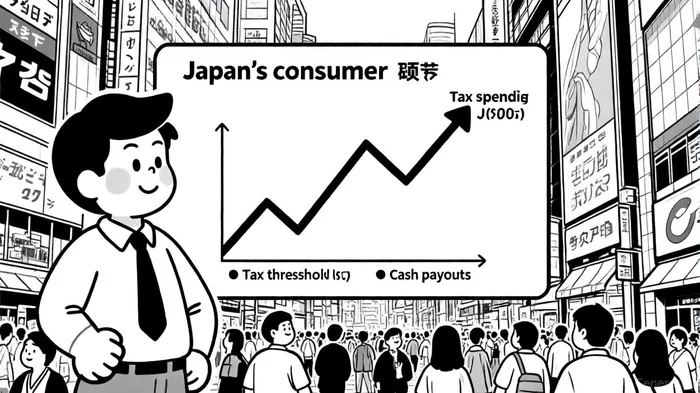
Data from Q2 2025 shows a modest but measurable increase in consumer spending, rising to ¥300,860.90 billion from ¥299,667.40 billion in Q1[1]. This aligns with the government's projections that the stimulus would reduce consumer prices by 0.3 percentage points and boost inflation-adjusted GDP by 1.2 percentage points annually[2]. The cash payouts and tax cuts appear to have provided immediate relief, particularly for households grappling with rising food and energy costs[5].
However, the long-term sustainability of this spending boost remains uncertain. The upcoming consumption tax hike could dampen consumer confidence, especially if inflation persists above the Bank of Japan's 2% target[3]. Analysts caution that export-dependent industries may face headwinds from a stronger yen, which has appreciated in response to the stimulus package[2].
Equity Market Reactions
The equity market's response to the stimulus has been cautious. The Nikkei 225 rose by 0.2% following the announcement of the ¥39 trillion package, with some stocks like M3 and Inpex seeing gains[2]. Broader market trends, however, reflect a more nuanced picture. Japanese equities have outperformed global benchmarks in 2024, driven by corporate governance reforms, share buybacks, and a return of foreign capital[1]. The TOPIX index, for instance, surged 17.8% in H1 2024, crossing the 2900 threshold[3].
The stimulus's emphasis on wage growth and regional revitalization has bolstered optimism about long-term economic resilience. Institutional investors remain bullish, citing Japan's ability to fund its debt domestically and the Bank of Japan's cautious normalization path[5]. Yet, political uncertainties—such as the LDP's leadership contest—have tempered enthusiasm, with the market awaiting clarity on fiscal priorities[1].
Challenges and Risks
While the stimulus has delivered short-term benefits, structural challenges persist. Japan's public debt, already among the highest in the world, could worsen if populist spending continues[3]. The abandoned universal cash handouts underscore growing public scrutiny of fiscal sustainability[4]. Additionally, a stronger yen threatens export competitiveness, a critical concern for a nation reliant on global trade[2].
The bipartisan panel on refundable tax credits offers a potential path forward, but its success will depend on balancing immediate relief with long-term fiscal discipline[1].
Conclusion
Japan's 2024/2025 fiscal stimulus has provided a modest boost to consumer spending and equity markets, reflecting the LDP's dual focus on short-term relief and structural reforms. While the cash payouts and tax cuts have alleviated household pressures, the looming consumption tax hike and inflationary risks pose challenges. For investors, the key lies in monitoring how these measures interact with broader economic trends, including corporate governance reforms and global demand for Japanese exports.







Comentarios
Aún no hay comentarios