
Assessing the Impact of U.S. Sanctions on Venezuela's Oil Exports Amid a Global Oversupply Outlook
The interplay between U.S. sanctions on Venezuela's oil sector and the broader global oil market's oversupply dynamics presents a complex challenge for investors. As Washington escalates its enforcement of sanctions through measures like the "total and complete" blockade of sanctioned oil tankers according to reports, Venezuela's ability to export crude has been further constrained. Yet, these developments must be contextualized within a global oil market already grappling with surpluses and geopolitical volatility. Strategic asset allocation in this environment requires a nuanced understanding of how Venezuela's oil sector fits into-and is shaped by-these dual forces.
The U.S. Sanctions Regime and Venezuela's Oil Resilience
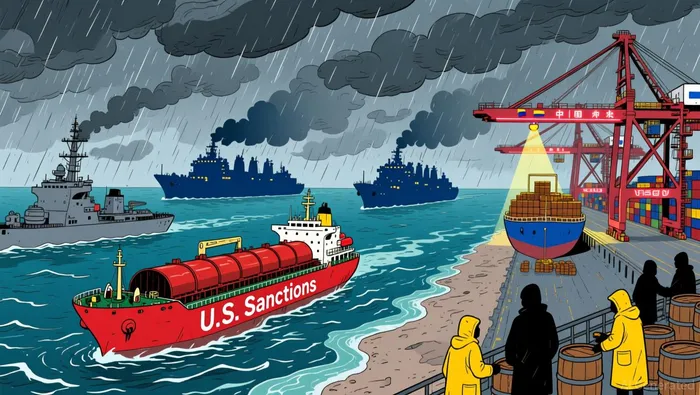 The Trump administration's recent actions, including the seizure of the tanker Skipper in the Caribbean according to reports, underscore a hardening stance against Venezuela's oil exports. These measures have forced the country to rely increasingly on a "shadow fleet" of tankers to bypass sanctions, with China absorbing 80% of Venezuela's oil through black-market channels according to analysis. Despite these efforts, Venezuela's oil exports fell to 702,000 barrels per day (bpd) in December 2025, the lowest since May 2025 according to Reuters, as U.S. enforcement actions disrupted shipping networks.
However, Venezuela's oil sector remains a critical asset. With the world's largest proven reserves-303.8 billion barrels according to Energy News Beat-the country could theoretically play a pivotal role in global energy markets if sanctions ease. Current production, though, stands at just 1 million bpd, a fraction of its 1998 peak of 3.4 million bpd according to FDD analysis. The Trump administration's designation of the Maduro regime as a foreign terrorist organization according to Al Jazeera has further complicated foreign investment, leaving ChevronCVX-- as the sole U.S. company operating under a limited sanctions exemption according to BBC.
Global Oversupply and Geopolitical Volatility
The global oil market is entering a period of structural oversupply, with surpluses projected to reach 2 million bpd in 2026 according to Think.ing. This is driven by OPEC+ and non-OPEC producers like the U.S. and Brazil, which have ramped up output despite weak demand growth. The resulting contango in WTI futures according to Bloomberg and forecasts of $57-per-barrel prices for 2026 according to Think.ing highlight the bearish outlook.
Geopolitical risks, however, introduce volatility. While the Ukraine conflict's resolution has reduced fears of supply disruptions, tensions in the Middle East and U.S.-China trade dynamics continue to create uncertainty according to Bloomberg. For Venezuela, this environment complicates its ability to attract investment. Even if sanctions are lifted, a production recovery would require $15–20 billion in capital over a decade to restore output to 2.5 million bpd according to WoodMac. Meanwhile, alternative suppliers-such as Canadian oil sands and Mexican heavy crude-are filling the gap left by Venezuela's decline according to Discovery Alert.
Strategic Asset Allocation: Navigating Divergence
For investors, the key lies in balancing exposure to Venezuela's potential with the realities of a surplus-driven market. Here are three strategic considerations:
Diversification Across OPEC+ and Non-OPEC Producers: While Venezuela's oil sector remains politically fraught, its OPEC+ membership ties it to production agreements that could limit supply growth. Investors should diversify across OPEC+ members (e.g., Saudi Arabia, UAE) and non-OPEC producers (e.g., U.S. shale, Guyana) to hedge against Venezuela's instability according to Deloitte.
Focus on Midstream and Downstream Sectors: With upstream producers facing headwinds from low prices and high costs, midstream and downstream assets-such as refining infrastructure and LNG terminals-offer more stable returns. U.S. Gulf Coast refineries, for instance, remain uniquely suited to process Venezuela's heavy crude according to BBC, suggesting long-term value if sanctions ease.
Scenario Planning for Geopolitical Shifts: A regime change in Venezuela could unlock $20 billion in investment over a decade according to Energy News Beat, but the transition period would likely be volatile. Investors should prepare for short-term price spikes during instability while factoring in the medium-term risk of oversupply as production recovers according to Allianz GI.
### Conclusion
The U.S. sanctions on Venezuela's oil exports have exacerbated a sector already weakened by underinvestment and political turmoil. Yet, these developments must be viewed through the lens of a global market oversupplied with oil and increasingly shaped by geopolitical risks. For investors, the path forward lies in strategic diversification, a focus on resilient sectors, and a readiness to adapt to shifting geopolitical landscapes. Venezuela's oil remains a wildcard-its potential to disrupt or stabilize markets hinges on whether sanctions ease and how global demand evolves. In this divergence of forces, agility and foresight will be paramount.





Comentarios
Aún no hay comentarios