
Assessing the Impact of Renewed US-China Trade Tensions on Energy Markets: Strategic Hedging and Risk Management in Petroleum Futures Trading
The renewed escalation of U.S.-China trade tensions in 2025 has sent shockwaves through global energy markets, triggering sharp declines in crude oil prices and forcing energy companies to recalibrate their risk management strategies. As tit-for-tat tariffs and export restrictions intensify, the petroleum futures market has become a battleground for hedging against geopolitical uncertainty. This analysis explores how energy firms are navigating this volatile landscape, the tools they are deploying, and the broader implications for the global energy transition.
Trade Tensions and Oil Price Volatility
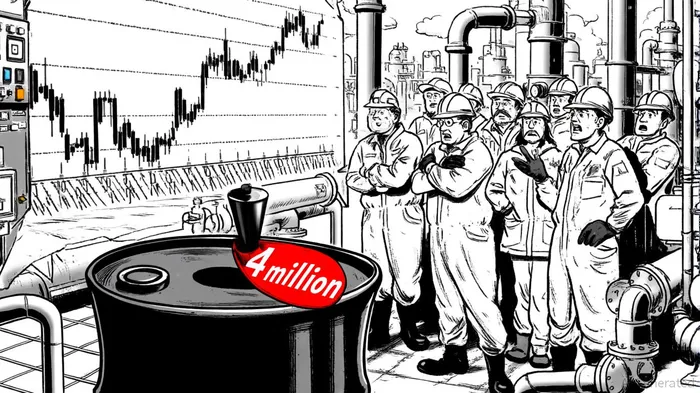
The immediate impact of trade hostilities between the U.S. and China has been a bearish outlook for oil markets. On October 14, 2025, global crude prices plummeted by over 2% as China imposed new rare earth mineral export restrictions and the U.S. threatened 100% tariffs on Chinese goods[1]. The International Energy Agency (IEA) compounded these fears with a report projecting a 4 million barrel-per-day global oil surplus in 2026[1]. This confluence of factors has created a perfect storm for energy companies, particularly upstream exploration and production (E&P) firms, which face declining revenues and margin pressures[1].
Downstream industries, however, have benefited from lower crude prices. Refiners, airlines, and shipping companies have seen operational costs shrink, offering a partial offset to upstream losses[1]. Yet, the broader economic implications are dire: fears of a global slowdown have led to downward revisions in GDP forecasts, with the IMF cutting its 2025 growth projection by 1.2%[3].
Hedging Strategies in a Turbulent Market
To mitigate price volatility, energy companies have increasingly turned to strategic hedging in petroleum futures. National oil companies (NOCs) and independent producers are adopting a mix of futures contracts, options, and costless collars to lock in prices and protect cash flows[4]. For example, the use of costless collars-which combine put and call options to create a price range-has surged, allowing firms to cap downside risk without sacrificing upside potential[4].
A notable shift has been the move toward "rainy day" hedging, where companies hedge only a fraction of their production to preserve flexibility in rising markets. In 2025, U.S. and Canadian producers left over 80% of their first-half oil output unhedged, a stark contrast to previous years when hedging coverage often exceeded 90%[6]. This strategy reflects confidence in rising prices and improved balance sheets post-deleveraging, though it exposes firms to significant market swings[6].
Case Studies: Adapting to Geopolitical Uncertainty
The practical application of these strategies is evident in the actions of major players. For instance, U.S. shale producers like EQT have reduced hedging coverage for natural gas, maintaining protection for only 65% of 2023 output compared to 90% in prior years[6]. This approach has allowed them to capitalize on price increases while safeguarding near-term cash flow. Similarly, companies in Wood Mackenzie's analysis have aligned hedging timelines with debt repayment schedules, using fixed-price swaps and average-price options to manage volatility[6].
However, the effectiveness of these strategies is constrained by external factors. OPEC+ supply decisions, U.S. dollar strength, and trans-Pacific shipping declines have added layers of complexity[4]. For example, the U.S. dollar's 6.3% rise in Q1 2025 made oil more expensive for emerging markets, further suppressing demand[4].
Broader Implications for the Energy Transition
The trade war's ripple effects extend beyond traditional energy markets. China, the world's largest manufacturer of clean energy technologies, faces reduced export opportunities to the U.S., potentially slowing domestic deployment of renewables[5]. Export controls on rare earth minerals and critical components for wind turbines and electric vehicles could also hinder global clean energy production[5].
Energy companies are thus forced to balance short-term survival with long-term sustainability. While hedging provides immediate stability, it may divert resources from investments in decarbonization. As one industry analyst notes, "The trade war has created a paradox: energy firms must hedge against today's volatility while preparing for tomorrow's low-carbon economy"[5].
Conclusion: Navigating the New Normal
The U.S.-China trade tensions of 2023–2025 have underscored the need for agile risk management in energy markets. Petroleum futures trading has evolved into a sophisticated toolset, with costless collars, selective hedging, and scenario-based planning becoming industry standards[4]. Yet, the path forward remains fraught with challenges, from geopolitical uncertainties to the dual pressures of profitability and sustainability.
For investors, the key takeaway is clear: energy firms that integrate dynamic hedging with strategic foresight will outperform in this volatile era. As the IEA's surplus forecast and IEA's surplus forecast and IEA's surplus forecast loom, the ability to adapt will separate resilient players from those left behind.







Comentarios
Aún no hay comentarios