
Assessing the Impact of a Record U.S. Corn Yield on Agricultural and Commodity Markets in 2025
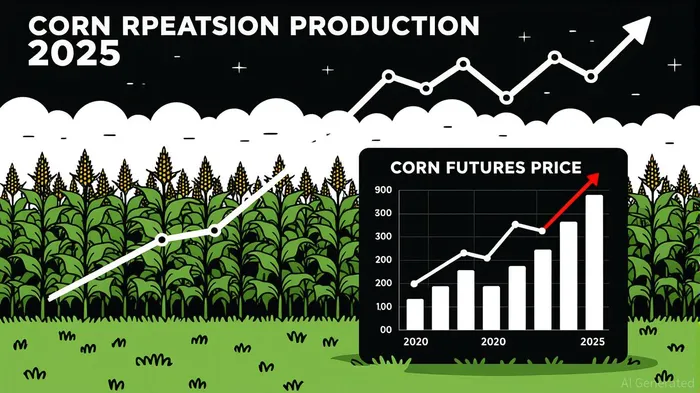
The U.S. corn market in 2025 has been defined by a paradox: record-breaking production coexisting with muted price gains and cautious investor sentiment. According to the USDA, 2025 U.S. corn production is projected at 16.7 billion bushels, a 13% increase from 2024, driven by a record yield of 188.8 bushels per acre and expanded planted acreage of 97.3 million acres [1]. This supply-side surge, however, has not translated into robust profitability for farmers or corn-linked investment vehicles, underscoring the complex interplay of global competition, speculative positioning, and macroeconomic headwinds.
Supply-Side Surge and Its Market Implications
The 2025 corn harvest has created a significant overhang in global grain markets. With Brazil’s record corn production and Argentina’s competitive exports, U.S. corn faces stiff international competition [2]. Despite strong U.S. export growth—up 29% year-over-year—global demand has been tempered by logistical bottlenecks and a weaker dollar, which reduces the cost advantage for American producers [4]. This dynamic has kept December 2025 corn futures prices around $4.47 per bushel, a modest rebound from 2024’s struggles but far below levels that would incentivize aggressive investment [2].
Corn-linked investment vehicles, including futures and ETFs, have mirrored this mixed performance. While managed money has built a net long position in recent months, signaling optimismOP--, commercial hedging by producers and aggressive shorting at lower price levels have constrained volatility [3]. The launch of micro corn futures by the CME GroupCME-- in early 2025 has increased market accessibility, yet liquidity remains uneven, with corn ETFs underperforming broader commodity indices [3].
Volatility Patterns and Historical Context
Grain markets have long been sensitive to supply shocks, as evidenced by the 2012 U.S. drought, which drove global corn prices up 50%, and the 2022 Russia-Ukraine conflict, which disrupted 12% of global wheat exports [4]. In 2025, the TVP-VAR-Connectedness model highlights corn’s susceptibility to spillover effects from soybean markets, compounding volatility risks [2].
Recent USDA downward revisions to U.S. corn production estimates—despite the record yield—have already triggered a 1.4% weekly gain in Chicago corn futures, illustrating how incremental data shifts can amplify price swings [3]. Weather remains a critical wildcard, with dryness or early frost in the Corn Belt potentially derailing yield expectations and reigniting volatility.
Investor Sentiment and Strategic Considerations
Investor positioning reflects a tug-of-war between optimism and caution. As of June 30, 2025, corn futures held a net short exposure of -204,000 contracts, a historically narrow range compared to post-COVID benchmarks [1]. Money managers have under-owned corn at $4.04 per bushel, suggesting reluctance to commit capital despite strong production [1]. This hesitancy is partly due to compressed profit margins for farmers, with corn and soybean prices falling below breakeven levels for many U.S. producers [1].
For investors, the key lies in balancing the structural tailwinds—such as ethanol demand growth and a resilient export sector—with near-term headwinds like global oversupply and speculative positioning. Ethanol consumption, which accounts for 40% of U.S. corn use, could provide a floor for prices if production capacity expands [4]. However, this depends on policy stability and input cost trends, which remain uncertain.
Conclusion
The 2025 U.S. corn harvest exemplifies the duality of agricultural markets: record yields can stabilize supply but fail to guarantee price stability or investment returns. Corn-linked vehicles remain vulnerable to global oversupply, speculative shifts, and geopolitical risks. Investors must navigate this landscape with a nuanced understanding of both fundamental supply dynamics and the volatility inherent in interconnected grain markets.
**Source:[1] USDA Forecasts U.S. Corn Production Up and Soybean ... [https://www.nass.usda.gov/Newsroom/2025/08-12-2025.php][2] Corn, Soybean, Wheat, Cotton: Let's Break Down What You ... [https://finance.yahoo.com/news/corn-soybean-wheat-cotton-let-201249560.html][3] Corn Prices Rebound in 2025: Is the Rally Here to Stay? Want ... [https://www.kalmbachmarkets.com/news/story/30826060/corn-prices-rebound-in-2025-is-the-rally-here-to-stay-want-less-risk-to-participate][4] Will December Corn Prices Rally in May 2025? [https://www.legacyfarmers.com/news/story/32140085/will-december-corn-prices-rally-in-may-2025]






Comentarios
Aún no hay comentarios