
Assessing the Impact of New Iran-Related Sanctions on Global Energy Markets and Commodity Exposure
The reimposition of stringent U.S. and U.N. sanctions on Iran in 2025 has sent shockwaves through global energy markets, reshaping trade dynamics, commodity pricing, and investor strategies. As Iran's oil exports face mounting pressure from financial restrictions, maritime sanctions, and geopolitical tensions, the ripple effects are evident in both supply chains and financial markets. This analysis examines how these sanctions are altering the landscape of global energy markets, the resilience of Iran's export strategies, and the evolving positioning of commodity investors in response to heightened geopolitical risks.
Iran's Export Resilience Amid Sanctions: A Strategic Shift to Asia
Iran's crude oil exports in 2025 have demonstrated remarkable resilience despite intensified sanctions. According to a Breakwave Advisors report, Iran exported 268.5 million barrels of crude oil between January 2023 and March 2025, with 60% of these shipments directed to Singapore, 25% to China, and 6% to Malaysia. This strategic realignment toward Asian markets reflects a deliberate effort to circumvent Western financial systems and maintain revenue streams. China, in particular, has emerged as a critical lifeline, accounting for 89% of Iran's crude oil and condensate exports in 2023, per Visual Capitalist.
However, the U.S. has escalated its pressure by targeting maritime logistics networks, including Chinese "teapot" refineries and ship registries, the Breakwave Advisors analysis notes. By March 2025, Iran's monthly exports had dropped to 9.7 million barrels-a 31% decline year-over-year-highlighting the growing efficacy of these measures. To mitigate disruptions, Iran has increasingly relied on a shadow fleet of aging tankers and floating storage hubs near China, enabling clandestine transshipments and reducing exposure to sanctions, according to Iran News Update.
Global Energy Prices and Market Volatility: A Double-Edged Sword
The reimposition of sanctions has introduced significant volatility into global oil markets. According to the IEA report, global oil demand is projected to grow by 1.1 million barrels per day in 2025, driven largely by China. However, the uncertainty surrounding Iran's exports has tightened supply expectations, pushing Brent crude futures to $66.19 per barrel and WTI to $62.91 in the immediate aftermath of new sanctions, as noted in a piece from Carolina Political Review.
OPEC's response has further complicated the picture. The organization has adopted a unified stance against U.S. sanctions, with production cuts and strategic adjustments aimed at stabilizing prices, the Carolina Political Review coverage explains. Meanwhile, the U.S. has struggled to fully curtail Iranian exports, as Iran's use of ship-to-ship transfers and intermediary sales has allowed it to maintain a steady flow of crude to Asian buyers. This cat-and-mouse dynamic has created a fragile equilibrium, with oil prices fluctuating between $60 and $90 per barrel depending on geopolitical developments, according to S&P Global's market commentary (S&P Global).
Commodity Investor Strategies: Hedging Against Geopolitical Uncertainty
As sanctions intensify, global commodity investors are recalibrating their strategies to mitigate risks. The U.S. Treasury's FinCEN has issued an updated FinCEN advisory to help financial institutions identify Iran's sanctions evasion tactics, including shadow banking networks and falsified cargo documentation. These measures have prompted investors to adopt stricter due diligence protocols, particularly in high-risk jurisdictions like Hong Kong and the UAE.
Simultaneously, investors are diversifying their energy portfolios. According to Discovery Alert, the anticipated expansion of U.S. sanctions under the Trump administration has driven capital into safe-haven assets like gold, which surged to $3,433 per ounce in 2025. Additionally, energy transition assets-such as renewables and battery storage-are gaining traction as hedging tools against oil price volatility.
For oil-dependent economies, the situation is more precarious. Iran's domestic energy crisis, marked by electricity and gas shortages, has raised concerns about the sustainability of its export-driven model, as reported by Iran News Update. Investors are increasingly factoring in the risk of supply disruptions in the Strait of Hormuz, a critical chokepoint for global oil flows, as tensions between Iran and Israel escalate (Discovery Alert coverage has likewise highlighted this risk).
Conclusion: Navigating a Fragile Energy Landscape
The 2025 sanctions on Iran represent a pivotal moment in global energy markets, exposing the vulnerabilities of both sanctioning and sanctioned parties. While the U.S. has made strides in curbing Iranian exports, the country's reliance on Asian markets and shadow networks underscores the limits of unilateral economic pressure. For investors, the path forward requires a nuanced approach: balancing exposure to high-risk regions with diversification into resilient sectors and alternative assets.
As geopolitical tensions persist, the interplay between sanctions, market dynamics, and investor behavior will remain a defining feature of the energy landscape. The coming months will test the resilience of both Iran's export strategies and the global market's ability to adapt to an increasingly fragmented energy order.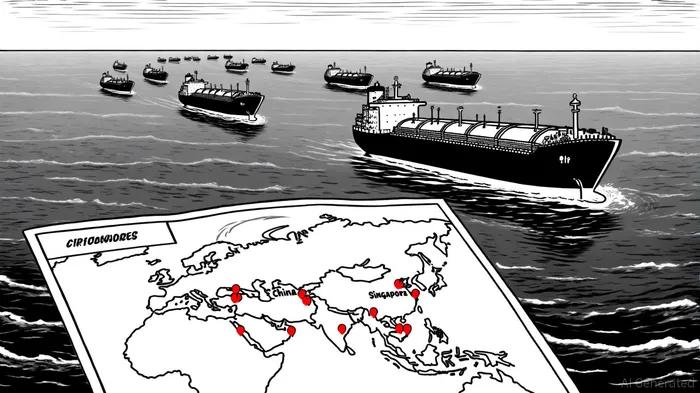







Comentarios
Aún no hay comentarios