
Assessing the Impact of IAEA Director General Rafael Grossi's Statements on Global Uranium and Nuclear Energy Markets
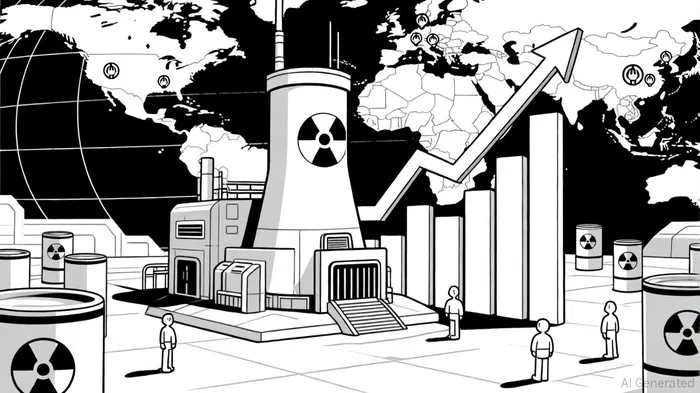
The global uranium and nuclear energy markets are undergoing a seismic shift, driven by IAEA Director General Rafael Grossi's recent statements on Iran's uranium enrichment program and the agency's bold projections for nuclear energy expansion. These developments, coupled with geopolitical tensions and surging investment in nuclear infrastructure, are reshaping the landscape for investors. This analysis unpacks the implications of Grossi's warnings, the IAEA's 2050 growth forecasts, and the strategic opportunities emerging in uranium mining, reactor development, and small modular reactors (SMRs).
Iran's Uranium Enrichment: A Catalyst for Market Volatility
Grossi's statements on Iran's uranium program have underscored a critical risk to global nuclear stability. As of 2025, Iran possesses approximately 200 kg of uranium enriched to 60% purity-a quantity sufficient for five nuclear weapons if further enriched to weapons-grade levels, according to Grossi's UNSC statement. This represents a sevenfold increase in enrichment activity compared to previous years, with Iran's parliament recently suspending cooperation with the IAEA, as reported by UN News, complicating verification efforts. The IAEA has raised alarms about the potential for covert enrichment and the lack of transparency regarding the location of Iran's stockpiles, according to a The National report.
These developments have directly influenced uranium markets. The perceived risk of nuclear proliferation has driven demand for uranium as countries seek to secure their fuel supplies. For instance, the U.S. ban on Russian uranium imports (set to fully take effect by 2028) has accelerated diversification efforts, creating opportunities for Western producers like Kazatomprom and Canadian firms such as Energy FuelsUUUU--, as highlighted in a CruxInvestor analysis. Uranium ETFs, including the Global X Uranium ETF, have surged by 5.1% in response to geopolitical tensions, reflecting heightened investor attention, according to a Prism MarketView analysis.
IAEA's 2050 Projections: A Green Light for Nuclear Expansion
The IAEA's latest IAEA 2050 report projects a 2.6-fold increase in global nuclear capacity, rising from 377 GW in 2024 to 992 GW by 2050. This growth hinges on two pillars: extending the operational lifetimes of existing reactors and scaling up SMRs. In the high-case scenario, SMRs are expected to account for 24% of new capacity, compared to just 5% in the low-case scenario.
The report highlights the critical role of investment in uranium mining, reactor lifetime extensions, and SMR development. For example, Central and Eastern Asia are projected to see the largest capacity increases, driven by China's Hualong One reactors and Russia's Rosatom exports, as noted in a Forbes article. Meanwhile, the U.S. and U.K. are advancing SMR projects through public-private partnerships, with companies like NuScale and Rolls-Royce securing funding for pilot plants, according to a GlobeNewswire report.
Strategic Investment Opportunities in Nuclear Infrastructure
The convergence of geopolitical risks and energy transition goals is creating a "perfect storm" for nuclear infrastructure investment. Key opportunities include:
- Uranium Mining: Structural supply deficits and geopolitical tensions are driving demand for uranium. Kazatomprom's growing ties with China have raised concerns about Western supply chain security, while U.S. and Canadian producers are capitalizing on high-grade discoveries, as explored in a CruxInvestor post.
- SMRs: With shorter payback periods and modular scalability, SMRs are attracting $12 billion in global funding by 2025. The IEA notes that SMRs could meet the energy needs of AI-driven data centers and industrial hubs, making them a cornerstone of the low-carbon transition, according to New Civil Engineer.
- Reactor Lifetimes: Two-thirds of existing nuclear reactors are over 30 years old, creating a $200 billion market for lifetime extensions. Governments are incentivizing these projects to avoid capacity losses, as retiring 156 GW of reactors by 2050 (in the low-case scenario) would derail climate goals, as reported by World Nuclear News.
Geopolitical Dynamics: A Double-Edged Sword
While nuclear energy is increasingly seen as a climate solution, its geopolitical implications are complex. Russia and China are leveraging nuclear exports to expand influence, with Rosatom and CNNC securing contracts in Africa, Southeast Asia, and the Middle East, as discussed in a Defense News commentary. Conversely, the U.S. and U.K. are countering this through the Atlantic Partnership for Advanced Nuclear Energy, aiming to streamline reactor approvals and reduce reliance on foreign fuel.
Iran's uranium program further complicates this landscape. The IAEA's inability to verify the whereabouts of Iran's 60% enriched uranium stockpile has heightened market uncertainty. However, this ambiguity also creates a "flight to safety" in uranium assets, as investors hedge against potential supply disruptions, according to an NCR Iran analysis.
Conclusion: A Golden Age for Nuclear Investment
The IAEA's warnings about Iran and its bullish nuclear growth projections signal a pivotal moment for investors. Uranium mining, SMRs, and reactor lifetime extensions are no longer niche plays but essential components of a decarbonized energy future. However, success requires navigating geopolitical risks and regulatory hurdles. For those who act decisively, the next decade could deliver outsized returns from a sector poised to power the world's clean energy transition.





Comentarios
Aún no hay comentarios