
Assessing the Impact of France's PM Resignation on Eurozone Fiscal Stability
The resignation of French Prime Minister Sébastien Lecornu on October 6, 2025, has sent shockwaves through EU markets, reigniting concerns over sovereign debt risk and fiscal stability in the Eurozone. With France's political landscape now marked by institutional paralysis and the looming threat of snap elections, investors are recalibrating their risk assessments. This analysis examines the implications for sovereign debt dynamics, cross-border spillovers, and the European Central Bank's (ECB) potential role in mitigating contagion.
Sovereign Debt Risk: A New Chapter in Eurozone Vulnerability
France's political instability has immediately exacerbated its fiscal challenges. The CAC 40 plummeted 1.4% following Lecornu's resignation, while 10-year French government bond yields widened to 86 basis points above German Bunds-a level last seen during the 2024 collapse of the Barnier government, according to a Euronews report. This widening reflects investor fears that prolonged political gridlock will delay critical fiscal reforms, pushing the 2026 deficit toward 5% of GDP and public debt above 116% of GDP, according to a FinancialContent report.
The European Commission has already placed France under an excessive-deficit procedure, and without a functioning government, compliance with EU fiscal rules appears increasingly unlikely. INGING-- economist Charlotte de Montpellier warns that institutional paralysis could slow GDP growth by 0.2 percentage points and deepen structural weaknesses in public finances, as discussed in an NBER digest. Such outcomes would not only strain France's credit rating but also amplify contagion risks across the Eurozone, particularly for countries with similarly fragile fiscal positions.
ECB Interventions: A Double-Edged Sword
The ECB's Transmission Protection Instrument (TPI) remains a critical tool to stabilize bond markets, yet its deployment is constrained by strict conditionality. While France's systemic importance in the Eurozone suggests the ECB might act preemptively, analysts argue that the country's current fiscal trajectory-marked by non-compliance with EU deficit rules-limits the TPI's applicability, according to Politico. This contrasts with the ECB's more aggressive interventions during the 2012 debt crisis, when programs like Outright Monetary Transactions (OMT) reduced Italian and Spanish bond yields by 400–500 basis points, as described in a CEPR column.
The ECB's dilemma is further complicated by its reduced sovereign debt holdings and a broader shift toward tightening monetary policy. A report in the ECB Financial Stability Review notes that intensifying trade conflicts and geopolitical uncertainty are already testing financial systems' resilience. Should French bond markets spiral further, the ECB may face a stark choice: either relax TPI criteria, risking accusations of moral hazard, or allow spreads to widen, potentially triggering a self-fulfilling debt crisis.
Cross-Border Spillovers: A Systemic Threat
France's economic turmoil is not confined to its borders. Cross-border spillovers are already evident in sovereign CDS markets, where heightened volatility reflects interconnectedness between financial institutions and public sector stability, according to a ScienceDirect study. For instance, French financial and real estate stocks have suffered disproportionately due to their sensitivity to rising borrowing costs, while energy and tech sectors have shown resilience, according to an ING analysis.
Historical precedents, such as the 2012 Eurozone crisis, underscore the risks of unmanaged spillovers. During that period, Greece's debt crisis triggered a 1,000-basis-point decline in yields for distressed countries after ECB interventions, but also exposed the fragility of the banking-sovereign feedback loop, as noted in a ScienceDirect review. Today, France's size and integration into global supply chains mean its fiscal instability could amplify trade tensions, particularly with the U.S., as highlighted in an ISPI analysis, where looming tariffs threaten to deepen economic fragmentation.
Investment Implications and the Path Forward
For investors, the immediate priority is hedging against currency and sovereign risk. The euro has already weakened against the dollar amid political uncertainty, and analysts warn that snap elections could further depress the currency, according to a DW analysis. Defensive sectors-such as utilities and healthcare-may offer relative safety, while cyclical sectors like industrials face heightened exposure to fiscal drag.
The path to resolution hinges on two scenarios: a swift formation of a new government or a delayed snap election. The former could restore market confidence and enable fiscal consolidation, while the latter risks deepening fragmentation and delaying reforms. Either way, the ECB's TPI remains a critical backstop, but its effectiveness will depend on the ECB's willingness to prioritize systemic stability over strict adherence to fiscal rules.
Conclusion
France's political crisis has reignited long-dormant fears of a Eurozone debt crisis, exposing vulnerabilities in both fiscal governance and market resilience. While the ECB retains tools to mitigate contagion, the absence of a unified fiscal authority in the Eurozone remains a structural weakness. For investors, the key takeaway is clear: sovereign debt risk and market volatility are inextricably linked to political stability, and the coming months will test the Eurozone's ability to navigate this precarious landscape.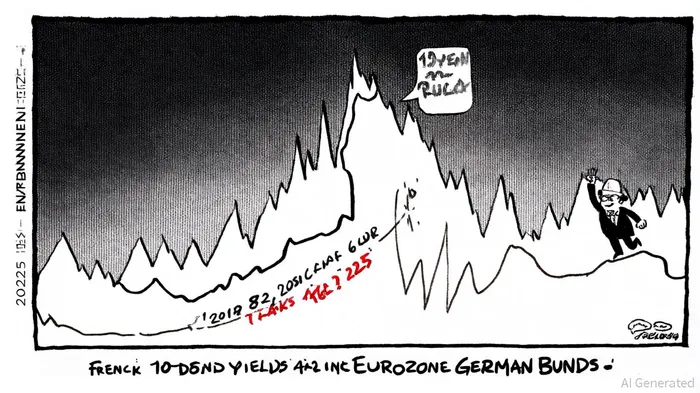





Comentarios
Aún no hay comentarios