
Assessing the Impact of Declining Cattle Futures on Agri-commodity Portfolios
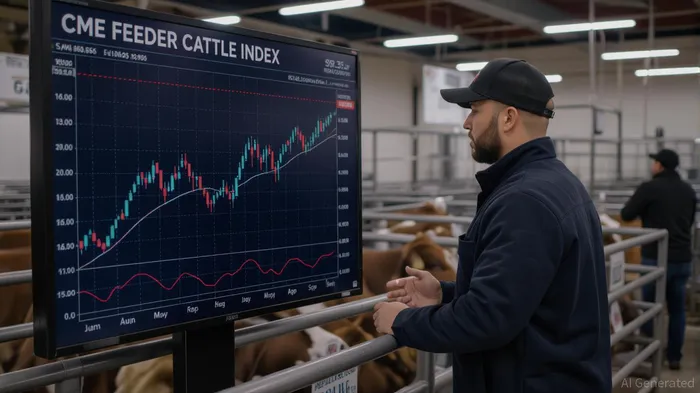
The recent turbulence in cattle futures markets has underscored the fragility of agri-commodity portfolios, particularly in livestock sectors. By September 2025, live cattle futures had plummeted sharply, with October contracts closing at $230.17—a $5.62 drop—and December contracts falling by $6.40 to $231.17[5]. Feeder cattle futures fared no better, with October contracts hitting $349.92 after a $9.25 decline[5]. These movements reflect a market grappling with technical liquidation, liquidity constraints, and heightened volatility, as noted by Producers Livestock[3].
The Broader Market Context
The decline in futures prices contrasts with resilient cash markets. The CME Feeder Cattle Index, for instance, remains near record highs at $365.86, just shy of its peak of $367.03[5]. This dislocation between cash and futures markets—often attributed to delayed reporting and thin liquidity—has complicated hedging strategies for producers. Meanwhile, USDA projections highlight tightening cattle supplies, with calf placements expected to contract through 2026[4]. Such fundamentals suggest that while short-term futures may remain pressured, long-term price support is intact.
Risk Management in a Volatile Landscape
For agri-commodity investors, the key challenge lies in balancing immediate risk mitigation with long-term portfolio resilience. One tool gaining traction is Livestock Risk Protection (LRP), a U.S. Department of Agriculture-backed insurance product that functions as a put option. By locking in a minimum price for feeder or fed cattle, LRP allows producers to hedge against downside risk while retaining upside potential[1]. For example, a producer expecting to sell 700-pound calves in November could secure a coverage price today, insulating against a potential $2.40-per-cwt drop in feeder cattle futures[1].
Complementary to LRP, futures and options hedging remains a cornerstone of risk management. Producers can use futures contracts to lock in prices for future sales, while options provide flexibility to capitalize on favorable price swings. For instance, purchasing a put option on feeder cattle futures ensures a floor price, even as market conditions deteriorate[3]. This approach is critical in markets like cattle, where volatility is driven by factors such as weather disruptions, export demand shifts, and herd dynamics[5].
Strategic Reallocation: Diversification and Innovation
Beyond hedging, strategic reallocation of agri-commodity portfolios has emerged as a vital response to cattle futures declines. Historical data reveals that cattle commodities have demonstrated superior resilience compared to grains and oilseeds during economic downturns, including the Global Financial Crisis[3]. This suggests that increasing exposure to livestock assets—while managing sector-specific risks—could enhance portfolio stability.
Diversification into impact investing further strengthens this strategy. Research indicates that portfolios combining agricultural commodities with impact-focused assets (e.g., sustainable farming technologies, climate-resilient crops) exhibit enhanced hedging effectiveness during crises[2]. For example, investments in precision agriculture or regenerative grazing practices not only mitigate environmental risks but also align with growing consumer demand for sustainable protein sources[4].
A case in point is the Kenya Climate Smart Agriculture Project, which boosted productivity while reducing carbon footprints, demonstrating how impact investing can deliver both financial and social returns[4]. Similarly, startups like Impossible Foods and Aqua-Spark have leveraged capital to disrupt traditional livestock markets with plant-based and aquaculture alternatives, offering investors exposure to high-growth, low-impact sectors[4].
Navigating the Path Forward
The current cattle market environment demands a dual focus on short-term risk mitigation and long-term strategic adaptation. Producers and investors should:
1. Leverage LRP and futures hedging to protect against near-term price declines.
2. Diversify portfolios with impact-driven agricultural assets to hedge against sector-specific volatility.
3. Monitor USDA projections for herd dynamics and beef demand, which will shape long-term price trajectories[4].
Conclusion
The decline in cattle futures underscores the need for robust risk management frameworks and agile portfolio strategies in agri-commodity markets. By integrating tools like LRP, futures hedging, and impact investing, stakeholders can navigate volatility while aligning with evolving market demands. As the USDA projects tighter cattle supplies through 2026[4], the ability to adapt—both in risk management and asset allocation—will determine long-term success in this dynamic sector.







Comentarios
Aún no hay comentarios