
Assessing the Impact of China's Export Curbs on Japan's Tech and Auto Sectors: Investment Risks and Opportunities in Supply Chain Diversification and Rare Earth Alternatives
China's recent export restrictions on rare earth elements and dual-use items to Japan, triggered by diplomatic tensions over Japanese Prime Minister Sanae Takaichi's remarks on Taiwan, have reignited concerns about supply chain vulnerabilities in Japan's technology and automotive sectors. These sectors rely heavily on rare earth elements for high-performance magnets used in electric and hybrid vehicle motors, as well as in advanced electronics. With Japan importing approximately 60% of its rare earths from China, the potential for prolonged export curbs poses significant economic risks. A three-month ban could cost Japanese businesses 660 billion yen ($4.2 billion) and reduce GDP by 0.11%, while a year-long restriction could cut GDP by 0.43%.
The Economic and Strategic Vulnerability
Japan's automotive and tech industries are particularly exposed due to their reliance on rare earths for critical components. For instance, neodymium and dysprosium-used in high-strength magnets-are essential for electric vehicle (EV) motors and wind turbines. China's dominance in refining and magnet manufacturing, controlling over 90% of downstream processing, further amplifies Japan's dependency. This bottleneck has forced Japan to confront the fragility of its supply chains, even as it has historically led global efforts to diversify sources.
Diversification Efforts: Progress and Partnerships
Japan's response to past disruptions, such as China's 2010 export restrictions, has been a blueprint for its current strategy. A key initiative is the partnership between Sojitz Corporation and Australia's Lynas Rare Earths, which established a non-Chinese supply chain involving mining in Australia and refining in Malaysia. This collaboration has reduced Japan's reliance on China from over 90% in 2010 to 60–70% today, with projections to fall below 50% in the near future.
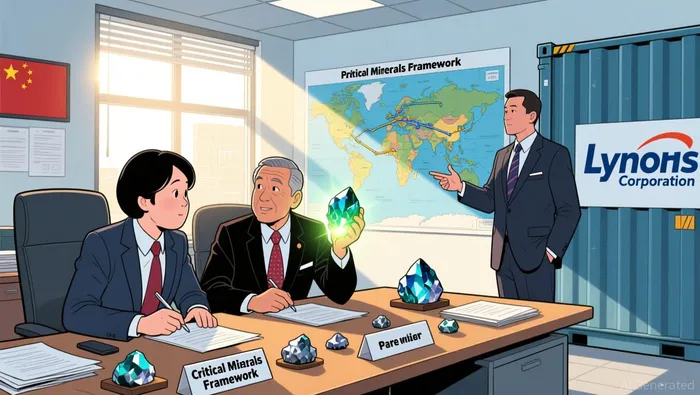 In 2025, Japan formalized a critical minerals partnership with the United States, creating a framework for joint financing, accelerated permitting, and the U.S.–Japan Critical Minerals Supply Security Rapid Response Group. This agreement emphasizes collaboration on mining, separation, and processing projects, aiming to build resilient, allied-controlled supply networks. For example, the Japan Organization for Metals and Energy Security (JOGMEC) signed a memorandum of understanding with U.S. firm REAlloys Inc. to develop rare earth processing technologies.
Domestic Innovation and Seabed Mining: A High-Risk, High-Reward Strategy
Japan is also pursuing domestic resource development, including test mining of rare-earth-rich seabed mud near Minamitori Island, scheduled for early 2026. This project, supported by JOGMEC and the Japanese government, aims to extract neodymium and dysprosium from deep-sea deposits. While the potential economic value of these reserves is substantial-estimated to support decades of supply for Japan's industry-the initiative faces significant risks. Deep-sea mining involves extreme logistical challenges, high costs, and environmental concerns, including disruptions to fragile marine ecosystems. The Japanese government has pledged to monitor ecological impacts and align with international standards, but the project's viability remains uncertain.
Investment Opportunities: Companies, ETFs, and Strategic Alliances
For investors, Japan's supply chain diversification efforts present both opportunities and risks. Key players include:
- Lynas Rare Earths: Japan's exclusive rights to a portion of Lynas's heavy rare earth production, secured in 2023, position it as a critical supplier for Japan's industrial base.
- JOGMEC: The state-backed organization's investments in equity stakes, loans, and technical assistance highlight its role in securing critical minerals.
- U.S. Partnerships: Collaborations with firms like REAlloys Inc. and MP MaterialsMP-- offer exposure to joint processing technologies and magnet manufacturing.
Thematic ETFs, such as VanEck's REMX (Rare Earth/Strategic Metals ETF), provide diversified exposure to companies involved in rare earth production and processing, including Japanese and U.S. firms. Additionally, government-backed initiatives, such as the U.S.-Japan framework, aim to stimulate private capital and streamline permitting for critical mineral projects.
Risks to Consider
While Japan's strategies are ambitious, several risks persist:
1. Geopolitical Tensions: China's dominance in refining and magnet production means even diversified supply chains remain vulnerable to geopolitical shifts.
2. Environmental and Logistical Challenges: Seabed mining projects face regulatory hurdles and ecological scrutiny, which could delay or derail progress.
3. Cost and Scalability: Deep-sea mining and international partnerships require sustained investment, with uncertain returns in the short term.
Conclusion: Balancing Resilience and Innovation
Japan's efforts to diversify its rare earth supply chains reflect a long-term strategy to mitigate China's influence and secure critical materials for its tech and automotive sectors. While partnerships like the U.S.-Japan framework and seabed mining projects offer promising avenues, investors must weigh these against geopolitical, environmental, and financial risks. For those seeking exposure, a diversified approach-combining investments in established players like Lynas, government-backed initiatives, and thematic ETFs-could balance resilience with growth potential in this evolving landscape.





Comentarios
Aún no hay comentarios