
Assessing the Impact of the BNSF Train Derailment on Rail Logistics and Supply Chain Stocks
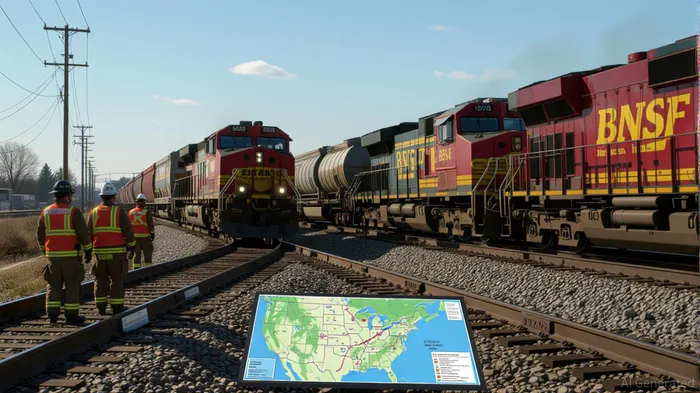
The recent derailment of a BNSF train in Reeseville, Wisconsin, on August 16, 2025, has reignited scrutiny over the resilience of North America's rail logistics network and its implications for supply chain stocks. While the incident—involving 22 derailed cars, including those carrying crude oil—has raised immediate safety and environmental concerns, the broader question remains: How does this event intersect with the long-term risks and opportunities in the transportation sector?
Risk Exposure: A History of Vulnerability
The Reeseville derailment occurred at the same location as a 2023 incident attributed to track alignment issues, underscoring persistent vulnerabilities in aging infrastructure. According to a report by FreightWaves, BNSF's net income declined by 9% in Q1 2023 due to higher expenses and a 10% drop in carload volumes, suggesting that operational disruptions can have cascading financial effects [1]. While the cause of the latest derailment is still under investigation, the recurrence of incidents at this site has prompted regulators and investors to question whether BNSF's safety protocols are sufficient to address systemic risks.
The ripple effects extend beyond BNSF. The railroad's role as a critical artery for freight—particularly for energy and intermodal shipments—means any prolonged disruption could strain the broader supply chain. For instance, the derailment occurred just weeks after BNSF completed a $3.8 billion investment in 2025 to expand capacity in key corridors, including Chicago, Phoenix, and California's Southern Transcon [3]. These projects aim to alleviate congestion at West Coast ports, a linchpin for U.S. trade. Yet, if infrastructure upgrades fail to address recurring operational flaws, the sector's growth narrative could falter.
Resilience in Action: BNSF's Track Record
Despite these concerns, BNSF has demonstrated remarkable resilience in the face of adversity. A case in point is its response to a bridge washout in Arkansas in April 2025, where crews rebuilt the structure in five days—18 hours ahead of schedule—restoring rail service by April 11 [1]. This rapid recovery, enabled by pre-positioned materials and equipment, highlights the company's preparedness for extreme weather events, a growing risk in an era of climate volatility. Such agility is critical as the rail industry increasingly adopts electrified freight transport, which introduces new challenges related to charging infrastructure and operational continuity [2].
BNSF's financial discipline further bolsters its resilience. In Q2 2025, the railroad achieved the largest year-over-year improvement in operating ratio (OR) among North American Class I railroads, driven by cost reductions and higher revenue per revenue ton mile (RTM) [1]. This operational efficiency provides a buffer against short-term disruptions, allowing the company to maintain profitability even during periods of instability.
Market Reactions and Investor Sentiment
Financial analysts are closely monitoring how the market interprets the Reeseville derailment. Historical precedents suggest that investor reactions often hinge on perceptions of systemic risk rather than the physical impact of a single event. For example, the second crash of the BoeingBA-- 737MAX in 2023 triggered a more severe market response than the first, despite no immediate operational fallout, as investors feared deeper mismanagement [3]. Similarly, the BNSF derailment could spook investors if it is perceived as a sign of broader operational complacency, particularly given the industry's recent safety controversies, such as the 2023 East Palestine, Ohio, derailment [2].
However, the rail logistics market is projected to grow at a compound annual rate of 5.4% from 2025 to 2034, driven by e-commerce and cross-border trade [3]. This growth trajectory, coupled with BNSF's aggressive infrastructure investments, suggests that the sector's long-term fundamentals remain intact. The challenge for investors lies in balancing these positives against the risks of recurring incidents and regulatory pushback.
Strategic Implications for Supply Chain Stocks
For supply chain stocks, the BNSF derailment serves as a reminder that resilience is not just about infrastructure but also about governance and transparency. Companies that proactively address safety concerns and invest in redundancy—such as BNSF's pre-positioning of recovery materials—will likely outperform peers in volatile markets. Conversely, those that downplay operational risks could face sharper corrections.
Investors should also consider the broader context: The global shift toward electrified freight and the increasing frequency of climate-related disruptions will test the adaptability of rail networks. BNSF's recent performance indicates that it is well-positioned to navigate these challenges, but the Reeseville incident underscores the need for continued vigilance.
Conclusion
The BNSF derailment in Reeseville is a cautionary tale about the fragility of even the most robust systems. Yet, it also highlights the importance of resilience—a trait BNSF has shown in spades through its rapid response to the Arkansas flood and its disciplined financial management. For investors, the key takeaway is clear: While risks are inevitable in the transportation sector, companies that prioritize preparedness and transparency will emerge stronger in the long run. The question is not whether disruptions will occur, but whether the industry—and its investors—are ready for them.







Comentarios
Aún no hay comentarios