
Assessing Horizon Technology Finance's Long-Term Sustainability Amid Declining Investment Income and NAV Volatility
Horizon Technology Finance (NASDAQ: HRZN) has long positioned itself as a specialized player in the venture debt market, leveraging high-yield loans to technology startups. However, recent financial disclosures and market dynamics raise critical questions about the sustainability of its business model and dividend policy. This analysis evaluates the company's declining investment income, NAV volatility, and strategic responses to determine whether its long-term outlook remains viable.
Declining Investment Income and Yield Trends
Horizon's net investment income (NII) has shown a consistent downward trajectory. For Q2 2025, the company reported NII of $0.28 per share, a 22% decline from $0.36 per share in the same period in 2024[1]. Total investment income for the quarter fell to $24.5 million, down from $25.7 million in Q2 2024[1]. The dollar-weighted annualized yield on average debt investments also dipped to 15.8% in Q2 2025, compared to 15.9% in the prior-year quarter[1].
This trend is not isolated to Q2. Data from Q4 2024 reveals NII of $0.27 per share, a 39% drop from $0.45 per share in Q4 2023[2]. The decline in yields and income reflects broader challenges in the venture capital ecosystem, including tighter credit conditions and reduced valuations for tech startups. As noted in management commentary, these macroeconomic pressures have contributed to net unrealized depreciation of $22.2 million ($0.54 per share) in Q2 2025, compared to net unrealized appreciation of $24.5 million in Q2 2024[1].
Dividend Coverage and Sustainability
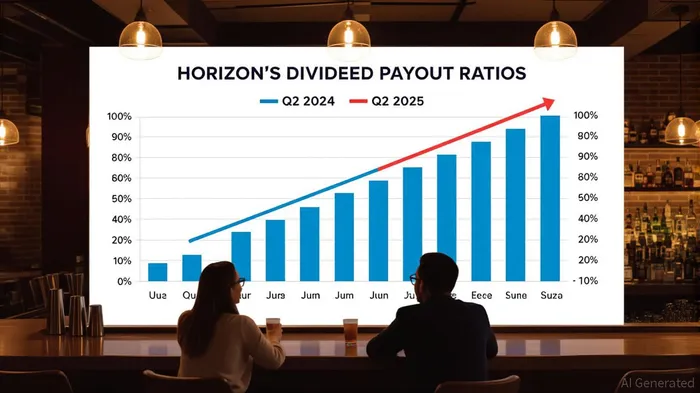
Horizon's dividend policy has historically been aggressive, with monthly payouts totaling $0.33 per share annually[1]. However, the company's NII struggles have raised concerns about coverage. For Q2 2025, Horizon's NII of $0.28 per share implies an annualized NII of $1.12 per share, which is 118% of the dividend payout[1]. This overhang suggests reliance on portfolio gains or reserves to maintain distributions—a precarious position for a business model dependent on consistent cash flow.
The situation worsened in Q4 2024, when NII of $0.27 per share fell to 60% of the $0.45 per share recorded in Q4 2023[2]. While management has emphasized confidence in covering dividends through net investment income, the declining trend underscores the need for strategic interventions.
NAV Volatility and Portfolio Risks
Horizon's net asset value (NAV) has experienced significant erosion. As of June 30, 2025, the company's NAV stood at $6.75 per share, a 6.9% decline quarter-over-quarter and a 13.2% drop year-over-year[1]. This follows a Q4 2024 NAV of $8.43 per share, which marked a 6.9% quarterly decline[4]. The deterioration is attributed to markdowns on stressed investments and broader market uncertainty in the venture debt sector[4].
The company's loan portfolio, while maintaining a weighted average credit rating of 3.0 (indicating standard risk), faces headwinds from rising defaults and reduced borrower valuations[1]. With a 15.8% annualized yield on debt investments, Horizon's portfolio remains attractive, but the ability to sustain this yield amid economic volatility remains untested.
Strategic Initiatives and Future Outlook
Management has outlined several measures to stabilize Horizon's trajectory. The most significant is the merger with Monroe Capital Corp (MRCC), expected to close by December 2025[3]. This transaction will inject $165 million in equity and reduce operating expenses by $2.5 million annually, providing critical liquidity for larger venture lending transactions[3]. Additionally, the merger is projected to enhance portfolio diversification and operational efficiency, mitigating some of the risks associated with a concentrated venture debt strategy.
Horizon has also emphasized selective loan origination and maintaining a robust pipeline. In Q2 2025, the company increased its committed backlog to $149 million, signaling confidence in future deployment[1]. Management's cautious optimism is grounded in the belief that the merger and disciplined underwriting will restore NAV growth by 2026[3].
Conclusion: A Tenuous Path Forward
Horizon Technology Finance's business model faces a crossroads. While its venture debt strategy has historically delivered high yields, the combination of declining NII, NAV erosion, and macroeconomic headwinds poses significant risks. The merger with Monroe CapitalMRCC-- represents a pivotal opportunity to stabilize the company's financial position, but its success hinges on execution and market conditions.
For income-focused investors, Horizon's $0.33 annual dividend remains attractive, but the overhang of payout ratios and NAV volatility necessitates a cautious approach. The company's ability to maintain its 15.8% yield while deploying new capital post-merger will be critical. In the short term, Horizon's sustainability remains contingent on its strategic pivot and the broader recovery of the venture capital market.







Comentarios
Aún no hay comentarios