
Assessing High-Growth Opportunities in AI-Driven Data Centers: A Deep Dive into Applied Digital and Its Peers
The AI-driven data center sector is undergoing a seismic transformation, fueled by surging demand for AI workloads, hyperscaler investments, and cloud computing adoption. By 2030, the global AI data center market is projected to expand from $236.44 billion in 2025 to $933.76 billion, growing at a compound annual rate of 31.6%. This rapid expansion is reshaping infrastructure priorities, with liquid cooling, power availability, and renewable energy integration emerging as critical enablers for high-density computing. However, the sector's financial viability remains constrained by high implementation costs, energy consumption challenges, and supply chain bottlenecks. Against this backdrop, companies like Applied DigitalAPLD--, Dell TechnologiesDELL--, HPEHPE--, and Huawei are vying for dominance through distinct strategies. This analysis evaluates their growth potential and financial health, offering insights for investors navigating this dynamic landscape.
Applied Digital: A Pure-Play AI Infrastructure Model
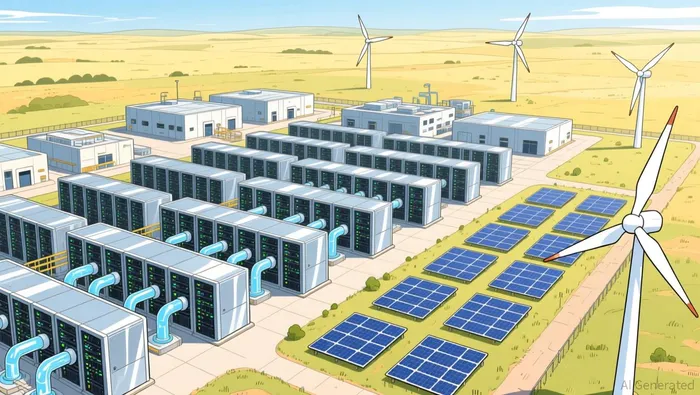
Applied Digital (APLD) has positioned itself as a pure-play player in AI infrastructure, leveraging long-term lease agreements and proprietary technology to secure recurring revenue and operational efficiency. The company's Polaris Forge 1 and 2 campuses in North Dakota have secured $16 billion in contracted lease revenue, including a $11 billion agreement with CoreWeaveCRWV-- for 400 megawatts of capacity and an additional $5 billion for 300 megawatts under construction. These leases, coupled with a 4-gigawatt active development pipeline and a $5 billion preferred equity facility from Macquarie Asset Management, underscore its scalability.
Applied Digital's financials reflect its aggressive expansion. For the fiscal first quarter of 2026, the company reported revenue of $64.2 million, a net loss of $27.8 million, and adjusted EBITDA of $0.5 million. While these figures highlight near-term breakeven challenges, the company's power usage effectiveness (PUE) of 1.18-a 30% improvement over industry averages- positions it to reduce operational costs as demand scales. The key risk lies in its reliance on long-term contracts, which may expose it to liquidity constraints if market conditions shift.
Dell Technologies: Transactional Hardware Leadership
Dell Technologies (DELL) contrasts with Applied Digital's infrastructure model by focusing on AI-optimized hardware sales. In the first nine months of fiscal 2026, Dell secured $30 billion in cumulative AI server orders, with a $18.4 billion backlog. Its partnerships with NVIDIA and rapid deployment capabilities (AI racks within 24–36 hours) have driven strong execution. However, Dell's margins face downward pressure from commodity cost inflation and a competitive server market, limiting its pricing power.
Financially, Dell's Q4 FY2025 results showed $9.7 billion in revenue, with AI systems contributing $1.6 billion-a record high driven by the GB200 System and sovereign customer demand. While its transactional model ensures immediate revenue, it lacks the recurring income structure of Applied Digital, making it more vulnerable to cyclical demand fluctuations.
HPE: Hybrid Cloud and Networking Synergies
Hewlett Packard Enterprise (HPE) is leveraging its hybrid cloud and networking capabilities to capture AI infrastructure growth. In Q4 FY2025, HPE reported $9.7 billion in revenue, a 14% year-over-year increase, with networking revenue surging 150% to $2.8 billion. The company's Juniper acquisition has intensified competition with Huawei in campus switch markets, while its AI systems backlog reached $30 billion in FY2025. HPE's strategic focus on sovereign and enterprise customers, coupled with a $3.5 billion free cash flow target by 2028, highlights its balanced approach to growth and profitability.
HPE's AI infrastructure revenue remains back-end weighted, with 54% of FY2026 earnings expected in the second half of the year. This timing risk, combined with its reliance on external partnerships, could delay near-term returns for investors.
Huawei: Vertical Integration Amid Sanctions
Huawei's AI strategy emphasizes vertical integration, with in-house technologies like the Ascend 910C and 960/970 NPUs enabling strategic autonomy amid U.S. export controls. The company's H1 2025 revenue reached $59.8 billion, up 4% year-on-year, but net profit margins fell to 8.7% due to R&D spending. Despite these challenges, Huawei's AI solutions-such as the Pangu model deployed in steel production-have generated tangible value, with one implementation yielding CNY90 million in annual revenue for Baowu Steel.
Huawei's long-term roadmap, including ARM-based Kunpeng processors and HarmonyOS, positions it to compete in global markets. However, geopolitical risks and supply chain constraints remain significant headwinds.
Comparative Analysis and Investment Outlook
Applied Digital's pure-play model offers high-growth potential through long-term leases and proprietary infrastructure, but its breakeven timeline and liquidity risks require careful monitoring. Dell's hardware-centric approach ensures immediate revenue but faces margin pressures. HPE's hybrid cloud and networking synergies provide a balanced growth path, while Huawei's vertical integration offers resilience against sanctions but at the cost of profitability.
For investors, the AI data center sector presents compelling opportunities, but success hinges on aligning with companies that can navigate infrastructure challenges and scale efficiently. Applied Digital's contracted visibility and technological edge make it a high-conviction play, while HPE and Huawei offer diversified exposure to hybrid and sovereign markets.





Comentarios
Aún no hay comentarios