
Assessing the High-Grade Potential and Strategic Drilling Momentum in Arizona's Gold Projects
High-Grade Gold Discoveries: A Catalyst for Investor Confidence
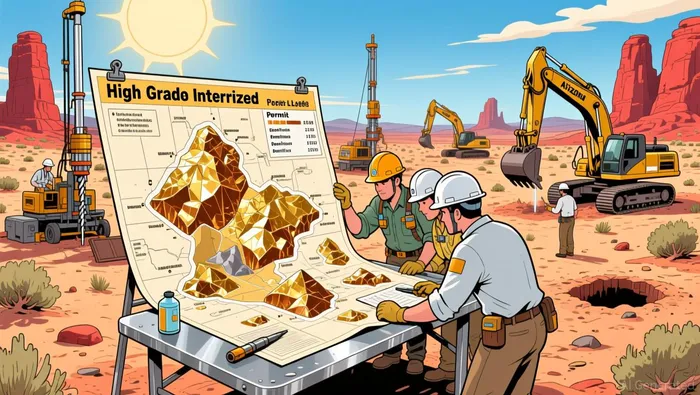
Recent drilling results from Arizona Gold & Silver Inc. at the Philadelphia Project in northwestern Arizona underscore the state's high-grade potential. In drill hole PC25-136, the company reported an intercept of 4.91 meters at 9.20 gpt gold, associated with epithermal quartz and calcite-bearing vein breccia in rhyolitic volcanic rocks. This discovery, part of a mineralized zone where grades improve at depth, has prompted further drilling to assess continuity.
Metallurgical testing using high-pressure grinding rolls (HPGR) on near-surface material has also yielded promising results: 76% gold recovery and 40% silver recovery after 119 days of leaching, significantly outperforming conventional methods. These findings suggest a viable strategy combining heap leaching with underground development of high-grade zones. Additionally, a major step-out intercept at PC25-157- 34.5 meters of mineralization - highlights the potential for expansion along strike and at depth.
Permit-Driven Growth: Accelerating Development Timelines
Regulatory progress is another critical catalyst. Minera Alamos has submitted final amendments to its Mine Plan of Operations (MPO) for the Copperstone Mine in Western Arizona, with approval expected by year-end 2025. This milestone enables parallel site development activities, fast-tracking the project's restart. Meanwhile, G50 Corp has initiated drilling at its Golconda and White Caps Projects in the Wallapai Gold District, leveraging a strategic location near Kinross's Round Mountain operation.
The state's regulatory environment is also fostering momentum. Over 1,200 new mining claims were filed in Arizona in 2025, a 30% increase from 2024, with Yavapai, Mohave, and La Paz counties emerging as key hotspots. This surge reflects growing investor confidence, particularly in polymetallic deposits where gold and copper coexist.
Technological Innovation and Market Dynamics
Arizona's mining sector is increasingly adopting technologies to enhance efficiency and sustainability. Satellite-based monitoring, AI-driven exploration, and blockchain-based traceability are streamlining operations and reducing environmental footprints. These innovations are particularly impactful in polymetallic deposits, where gold and copper extraction can be optimized for both economic and environmental outcomes.
The state's role as the U.S.'s largest copper producer-supplying over 70% of domestic needs-further strengthens its strategic position. Rising gold prices and growing demand for copper in renewable energy and electric vehicle infrastructure are creating a dual tailwind for Arizona's mining industry.
Conclusion: A Convergence of Opportunity
Arizona's gold projects are poised for growth, driven by high-grade discoveries, regulatory progress, and technological advancements. Companies like Arizona Gold & Silver, Minera Alamos, and G50 Corp are demonstrating the state's potential to deliver both near-term production and long-term resource expansion. For investors, the combination of geological promise and a supportive regulatory framework presents a compelling case for exposure to Arizona's evolving mining landscape.







Comentarios
Aún no hay comentarios