
Assessing Henderson Land's Long-Term Investment Appeal Amid a 25% Rebound in 2024
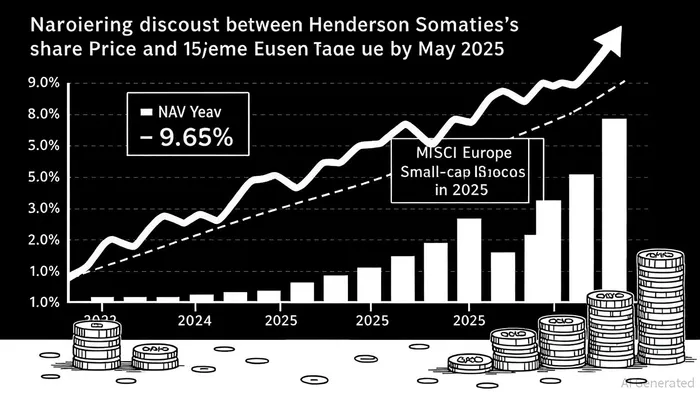
The UK smaller companies sector has emerged as a compelling asset class in 2025, with European small-caps posting a remarkable 23.69% average net asset value (NAV) return year-to-date. This outperformance, driven by attractive valuations, fiscal stimulus, and a favorable interest rate environment, has sparked renewed interest in the resilience of smaller firms [2]. Against this backdrop, Henderson Land’s UK-focused smaller company portfolio warrants closer scrutiny, particularly in light of its 25% rebound in 2024 and the broader market’s structural shifts.
Valuation Sustainability: A Narrowing Discount and Strategic Buybacks
Henderson Smaller Companies Investment Trust (HSC) reported a 5.1% decline in its NAV and a 2.3% drop in share price for the year ended 31 May 2025, underperforming its benchmark by 10.1% [1]. However, the trust’s share price discount to NAV narrowed significantly, from 11.5% at the start of the year to 9.2% by year-end [1]. This tightening discount suggests improving investor sentiment, a trend mirrored in the broader European small-cap sector, where discounts have contracted as confidence in cyclical recovery grows [2].
The Board’s proactive share repurchase program further underscores valuation sustainability. By repurchasing 8.1% of its share capital, HSC enhanced its NAV by 0.7%, signaling confidence in its intrinsic value [1]. Such actions align with historical patterns where disciplined capital management has supported long-term shareholder returns, even amid short-term underperformance.
Portfolio Resilience: Cyclical Exposure and Market Realities
HSC’s underperformance relative to its benchmark is partly attributed to a style tilt toward cyclical stocks, which proved vulnerable to macroeconomic headwinds in 2024 [1]. While this exposure amplified volatility, it also positioned the portfolio to benefit from the subsequent rebound in economic activity. The UK smaller companies market, historically more sensitive to domestic cycles, has shown signs of stabilization, with fiscal stimulus and rate cuts acting as tailwinds [3].
Notably, European small-caps trade at a 12-month P/E of 13.7, a level last seen during the 2008 financial crisis, highlighting their undervaluation relative to global peers [3]. This valuation gap, combined with a 25-year historical outperformance of 4.2% annually over large-caps, suggests that HSC’s cyclical focus, while risky, could pay dividends in a recovery phase [3].
Strategic Adjustments and Dividend Discipline
Despite the NAV decline, HSC maintained its 22nd consecutive year of dividend growth, raising the final dividend to 20.5p per share [1]. This consistency in income generation is a critical draw for long-term investors, particularly in a low-yield environment. Meanwhile, Janus Henderson Group’s Q2 2025 results—marked by a 6% year-over-year EPS increase and $46.7 billion in net inflows—demonstrate the broader firm’s operational resilience, which indirectly supports HSC’s stability [2].
Conclusion: Balancing Risk and Reward
Henderson Land’s UK smaller company portfolio faces near-term challenges, including cyclical volatility and benchmark underperformance. However, the narrowing discount, strategic share buybacks, and the sector’s historically strong valuation metrics suggest a path to sustainable growth. For long-term investors, the key lies in aligning with the trust’s strategic adjustments and the broader macroeconomic tailwinds shaping the European small-cap landscape.
**Source:[1] Annual Financial Report and Final Dividend - Markets data [https://markets.ft.com/data/announce/detail?dockey=1323-17160271-0UND0J14DM84U9U9KQFQFKCM8O][2] The trust world in 2025: Who's winning, who's shrinking [https://www.theaic.co.uk/aic/news/industry-news/the-trust-world-in-2025-whos-winning-whos-shrinking][3] Can European small-caps break free of the shackles? [https://www.trustnet.com/news/13453106/can-european-small-caps-break-free-of-the-shackles]







Comentarios
Aún no hay comentarios