
Assessing Growth Resilience in France Amid Global Uncertainty
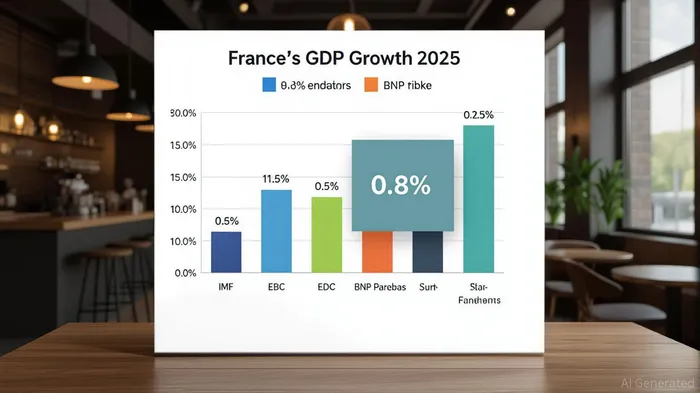
France's economic outlook for 2025 remains cautiously optimistic, with growth projections hovering around 0.8% as a reasonable midpoint between the IMF's 0.6%[1], the ECB's 0.9%[3], and BNP Paribas' 0.7%[2]. While this modest pace reflects broader global headwinds and domestic political uncertainties, it also underscores the need for investors to identify sectors capable of outperforming the macroeconomic backdrop.
Sectoral Resilience: Public Investment and Green Transition
The most compelling opportunities lie in sectors directly tied to public policy and long-term structural trends. According to a report by BNP Paribas, France's government has prioritized green energy and digital infrastructure as pillars of its post-pandemic recovery[2]. These initiatives are expected to drive demand for renewable energy firms, particularly in solar and wind power, where France aims to triple its capacity by 2030. The European Commission's recent approval of a €15 billion green hydrogen fund further reinforces this trajectory[2].
Public consumption, projected to rise in 2026[2], will likely benefit healthcare and education sectors. France's aging population and underfunded public hospitals create a tailwind for private healthcare providers and medical technology firms. Similarly, the government's push to modernize schools and universities could boost demand for edtech solutions and construction services specializing in sustainable buildings.
Cross-Border Synergies: Leveraging European Integration
The ECB notes that improvements in the European economic landscape will bolster France's growth prospects in 2026[3]. This suggests opportunities in export-oriented industries such as aerospace, automotive, and high-tech manufacturing. For instance, Airbus's ongoing shift to electric propulsion systems aligns with both EU emissions targets and France's industrial strategy. Meanwhile, the rise of nearshoring within the EU could benefit French logistics firms and semiconductor manufacturers, which are critical to the bloc's push for supply chain resilience.
Mitigating Risks: Political and Trade Uncertainties
Investors must remain cautious about political fragmentation, which has delayed key reforms such as labor market modernization and tax adjustments[2]. However, the relative stability of France's EU partnerships offers a buffer. Sectors with diversified supply chains or strong domestic demand—such as food and beverage (France's largest export category) and luxury goods—may prove less vulnerable to geopolitical shocks.
Conclusion: Balancing Prudence and Vision
While France's 0.8% growth trajectory is modest, it is not without opportunity. Sectors aligned with green transition, public investment, and European integration offer a path to resilience. As the IMF acknowledges, even in a constrained environment, “policy coherence and structural reforms can unlock potential”[1]. For investors, the challenge lies in aligning portfolios with these long-term trends while hedging against short-term volatility.







Comentarios
Aún no hay comentarios