
Assessing the Geopolitical Risks of China's Economic Policies on Global Markets
In 2025, China's economic policies and geopolitical tensions with the U.S. have created a volatile landscape for global markets, forcing investors to rethink asset allocation strategies. As the world's second-largest economy grapples with structural challenges-ranging from a property market slump to demographic headwinds-its policy responses and trade dynamics are reshaping emerging market volatility and investment flows. This analysis examines how geopolitical risks tied to China's economic trajectory are driving strategic reallocations across sectors and geographies.
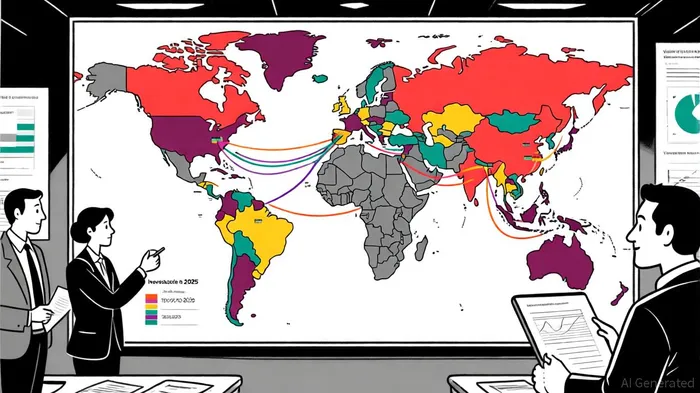
China's Domestic Policies and Global Spillovers
China's 2025 GDP growth slowed to 5.3% in Q2, underscoring structural weaknesses in domestic demand and manufacturing activity, according to Goldman's New Horizons report. To counter this, the government has rolled out targeted stimulus measures, including incentives for durable goods replacement and infrastructure spending. However, these efforts face headwinds from the property sector crisis, which continues to weigh on consumer confidence and corporate debt levels, according to a World Bank report.
The U.S.-China trade negotiations, while temporarily easing tensions, have introduced a new layer of uncertainty. Tariff reductions in May 2025 (U.S. tariffs on Chinese goods cut from 145% to 30%) initially stabilized markets, according to GoldmanGS--, but subsequent escalations-such as the October 2025 hike to 130%-triggered sharp declines in global equities and disrupted supply chains, as highlighted in a LinkedIn analysis. That analysis also noted retaliatory measures, including Chinese antitrust investigations against U.S. firms and port fees on American vessels, which have further amplified volatility.
Emerging Markets: Divergence and Resilience
China's dominance in the MSCI Emerging Markets Index (28% weight) means its performance remains a bellwether for the broader EM landscape, as Goldman observes. Yet, the decoupling of China from other emerging markets has accelerated. Countries like India and Malaysia, with robust domestic demand and structural reforms, have outperformed, while others-such as Mexico and South Korea-face heightened exposure to U.S. trade policy shifts, according to Amundi's 2025 Investment Outlook.
The U.S.-China trade war has also spurred trade realignments. For instance, India's manufacturing sector has attracted capital as firms diversify supply chains away from China, a trend Amundi highlights. Similarly, Vietnam and Indonesia are benefiting from nearshoring trends in technology and semiconductors, a dynamic Goldman documents. These shifts highlight the growing importance of regional diversification in investment strategies.
Strategic Asset Reallocation: Sectors and Geographies
Investors are increasingly adopting a nuanced approach to emerging markets, prioritizing active stock selection and sectoral diversification. Key trends include:
- Sectoral Shifts:
- AI and Technology: China's DeepSeek AI model has reignited interest in tech-driven EMs, with capital flowing into innovation hubs like India and Brazil, a trend noted in a FTSE Russell insight.
- Infrastructure and Utilities: Defensive sectors are gaining traction amid economic uncertainty, supported by Chinese fiscal stimulus and global yield differentials.
Financials: Steepening yield curves in developed markets have bolstered EM financials, particularly in countries with stable regulatory frameworks.
Geographic Diversification:
- EM Local Debt: High-yielding government bonds in Brazil, Mexico, and South Africa are attracting inflows, with Schroders projecting 11%+ returns for diversified portfolios.
China-Plus Strategy: While Chinese equities remain undervalued, investors are hedging by allocating to EM ex-China markets, such as Indonesia and Nigeria, which are pursuing non-traditional industries like renewable energy.
Private Markets and Infrastructure:
Amundi's 2025 outlook emphasizes private equity and infrastructure investments in EMs as a hedge against public market volatility.
Geopolitical Risks and the Path Forward
The interplay of U.S. tariff policies, Chinese fiscal reforms, and EM structural shifts creates a complex risk matrix. For example, while China's "Made in China 2025" initiatives offer long-term growth potential, short-term risks from trade tensions and property sector instability persist, as noted by the World Bank. Similarly, India's demographic dividend and digital transformation are offset by inflationary pressures and currency volatility, observations echoed in Amundi's outlook.
Investors must balance exposure to China's growth story with diversification into EMs less correlated to its cycles. This includes:
- Active Stock Selection: Focusing on firms in AI, semiconductors, and renewable energy with strong balance sheets.
- Regional Hedging: Allocating to EMs with trade ties to non-U.S. partners (e.g., India's partnerships with the EU and Japan).
- Income-Generating Assets: Prioritizing investment-grade bonds and inflation-linked debt to mitigate geopolitical shocks.
Conclusion
China's economic policies and geopolitical tensions are no longer isolated phenomena-they are catalysts for a broader reordering of global capital flows. As the U.S.-China trade war enters its next phase, strategic asset reallocation will hinge on agility, sectoral insight, and geographic diversification. For investors, the key lies in navigating the duality of China's long-term opportunities and its short-term risks while capitalizing on the resilience of EMs that are redefining their economic trajectories.







Comentarios
Aún no hay comentarios