
Assessing Geopolitical Risk in the Middle East: Iran's Protests and U.S.-Backed Unrest
The Middle East remains a focal point of global geopolitical risk, with Iran's 2025-2026 protests and U.S. military posturing reshaping investment dynamics in defense, energy, and regional stability-linked assets. As economic despair and anti-regime sentiment fuel unrest in Iran, Washington's interventionist rhetoric under President Donald Trump has amplified volatility, creating both risks and opportunities for investors. This analysis examines how these developments are influencing strategic positioning across key sectors.
Defense Sector: A Booming Landscape Amid Escalating Tensions
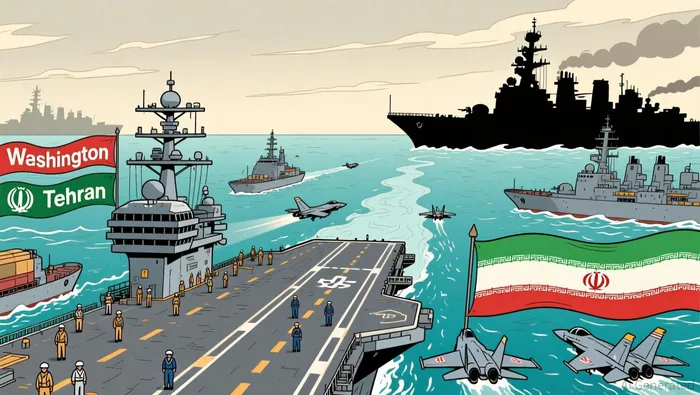
The U.S. military's heightened presence in the Middle East, including the deployment of two aircraft carrier strike groups and 40,000-50,000 troops, underscores a strategic pivot toward deterring Iranian aggression. President Trump's explicit threats to intervene if the Iranian regime resorts to violence have further stoked demand for defense capabilities. The S&P 500 Aerospace & Defense Index has surged over 50% in the past year, outperforming broader markets, as governments prioritize modernization and readiness.
Investors are increasingly turning to defense ETFs such as the iShares U.S. Aerospace & Defense ETF (ITA) and Invesco Aerospace & Defense ETF (PPA), which have benefited from a $3.6 trillion global defense spending projection by 2030. The U.S. Department of Defense's focus on AI-driven command systems and counter-drone technologies is also driving innovation, with contractors like Lockheed MartinLMT-- and Raytheon securing lucrative contracts. However, the sector's performance hinges on the trajectory of U.S.-Iran tensions; a de-escalation could temper growth, while an escalation risks destabilizing markets.
Energy Sector: Volatility and Strategic Rebalancing
Iran's economic collapse-marked by 70% inflation, a devalued rial, and gas shortages-has disrupted its energy exports and forced plant shutdowns. Meanwhile, OPEC+'s strategy of "controlled optionality" to balance market share and price stability has mitigated some volatility, keeping oil prices in the low-to-mid $50s per barrel despite regional tensions. Natural gas, however, is gaining traction as LNG demand rises, driven by industrial growth and winter heating needs.
Middle Eastern national oil companies are leveraging AI and digital tools to offset inflationary pressures, while Gulf states like Saudi Arabia and the UAE are positioning themselves as hubs for green hydrogen and AI-driven logistics. The India-Middle East-Europe Economic Corridor (IMEC), though delayed by U.S.-India trade frictions, remains a long-term catalyst for energy infrastructure investment. Investors should monitor the Strait of Hormuz-a critical oil export route-for potential supply shocks, which could trigger short-term price spikes.
Regional Stability: Diversification and Geoeconomic Shifts
The Gulf Cooperation Council (GCC) is recalibrating its economic strategy amid U.S.-China tensions and regional instability. Countries like Saudi Arabia and the UAE are expanding partnerships with China, New Zealand, and Mercosur to reduce reliance on traditional trade routes. These efforts are complemented by investments in AI, critical minerals, and clean energy, signaling a shift from the "oil-for-security" model to a diversified geoeconomic framework.
However, persistent conflicts in Iraq, Sudan, and Yemen, alongside the Gaza war's spillover effects, highlight the fragility of stability. Regional actors are also pursuing joint defense initiatives, such as a proposed air shield, to enhance strategic autonomy. While these moves reflect a desire to counterbalance U.S. and Chinese influence, they also risk deepening fragmentation. Investors should prioritize assets tied to Gulf resilience, including infrastructure projects and technology-driven industrialization.
Strategic Positioning: Balancing Risk and Opportunity
For investors, the key lies in hedging against geopolitical uncertainty while capitalizing on structural trends. Defense ETFs and energy infrastructure-particularly LNG and green hydrogen-offer exposure to near-term volatility and long-term growth. Regional stability-linked assets, such as GCC-led tech and industrial projects, present opportunities for patient capital.
Yet, caution is warranted. A U.S. military intervention in Iran could trigger market chaos, while a prolonged stalemate might dampen momentum in defense and energy sectors. Diversification across sectors and geographies, coupled with close monitoring of U.S. policy shifts and OPEC+ decisions, will be critical in navigating this complex landscape.







Comentarios
Aún no hay comentarios