
Assessing the Geopolitical Risk to European Tech Stocks Amid US Retaliatory Threats
The escalating trade tensions between the United States and the European Union in 2025 have cast a long shadow over European tech stocks, creating a complex landscape for investors. At the heart of the dispute lies the U.S. government's criticism of EU digital services taxes (DSTs) and regulatory frameworks, which it claims unfairly target American technology firms. In response, the Trump administration has threatened retaliatory measures against EU-based companies, including potential tariffs or operational restrictions. For investors, this geopolitical friction demands a nuanced approach to risk management and strategic positioning in EU tech markets.
The Escalation of US-EU Trade Tensions
The U.S. Trade Representative has explicitly warned that continued EU enforcement of DSTs and other regulatory measures could trigger reciprocal actions under Section 301 investigations. These policies, which have already generated $6.7 billion in fines for U.S. tech giants in 2024 alone, are framed by Washington as discriminatory. 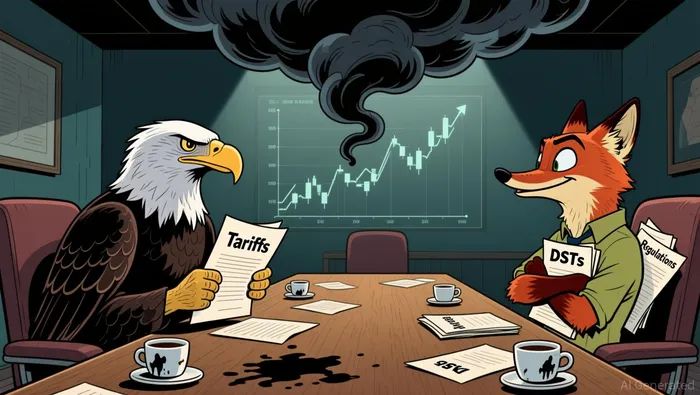 The U.S. has named European firms like AccentureACN--, Siemens, and SpotifySPOT-- as potential targets for retaliation, citing concerns over unequal market access for American companies in the EU. Such threats have introduced volatility into European tech stocks, as investors weigh the likelihood of regulatory crackdowns and cross-border trade disruptions.
The EU, meanwhile, has leveraged its internal trade network-accounting for 70% of its total trade-as a buffer against external shocks. However, this stability is not foolproof. A potential second Trump administration has signaled a willingness to impose tariffs on EU exports, particularly in sensitive sectors like automotive and manufacturing. For tech firms, the risk extends beyond direct penalties to broader uncertainties in cross-border investment and compliance costs.
Strategic Positioning for Investors
Given these dynamics, investors must adopt a dual strategy of risk mitigation and sector-specific opportunism.
1. Hedging Against Volatility
The European Central Bank's Financial Stability Review underscores the persistent risks of trade policy uncertainty, urging investors to hedge against potential spikes in market turbulence. One approach is to diversify exposure across EU tech subsectors. For instance, while manufacturing has lagged in 2025, high-tech industries like aerospace, biotech, and defense have shown resilience due to increased public and private investment. These sectors benefit from EU policy initiatives such as the Clean Industrial Deal, which provides regulatory clarity and financial support.
2. Focusing on Resilient Sectors
The EU's tech sector remains a growth engine, particularly in IT infrastructure, data centers, and software services, driven by enterprise demand. AI implementation is expected to further accelerate in 2026, offering long-term upside for firms with strong R&D capabilities. Investors should prioritize companies with diversified revenue streams and robust compliance frameworks, as regulatory alignment with policies like the Carbon Border Adjustment Mechanism (CBAM) is becoming a competitive advantage.
3. Navigating Retaliatory Risks
The U.S. has historically used trade leverage to pressure allies, and the EU's relative advantage-lower average tariff rates for EU exports to the U.S. compared to other trading partners-offers some optimism. Sectors like semiconductors and pharmaceuticals, which have received exemptions from higher U.S. tariffs, may prove less vulnerable to retaliatory measures. However, investors should remain cautious about firms in electric vehicles and critical minerals, where supply chain diversification is increasingly critical.
Conclusion
The U.S.-EU trade dispute is far from a binary risk for European tech stocks. While retaliatory threats and regulatory friction pose challenges, the EU's internal market strength and strategic policy initiatives create opportunities for selective investment. Investors who focus on resilient sectors, hedge against policy volatility, and monitor evolving trade negotiations will be best positioned to navigate this turbulent environment. As the Trump administration continues to assert its trade agenda, the key to success lies in balancing caution with a long-term view of the EU's technological and regulatory evolution.





Comentarios
Aún no hay comentarios