
Assessing Geopolitical Risk in Equity Markets: A Pre-Call Strategy
Assessing Geopolitical Risk in Equity Markets: A Pre-Call Strategy
The U.S.-China relationship in 2025 remains a fault line for global equity markets, with trade tensions, sanctions, and supply chain realignments creating persistent volatility. As the U.S. and China prepare for a critical leader's call, investors must adopt a strategic approach to mitigate risks while capitalizing on potential opportunities. This analysis examines the current landscape, historical precedents, and actionable strategies for positioning portfolios amid heightened uncertainty.
1. The Escalating Geopolitical Chessboard
Recent developments underscore the fragility of the U.S.-China trade truce. While the May 14 agreement temporarily reduced tariffs—cutting U.S. levies from 145% to 30% and Chinese duties from 125% to 10%—this de-escalation has not resolved deeper structural issues. According to a report by J.P. Morgan, the S&P 500 surged 3% and the Nasdaq 100 climbed nearly 4% in the immediate aftermath of the announcement, but underlying tensions persist[1].
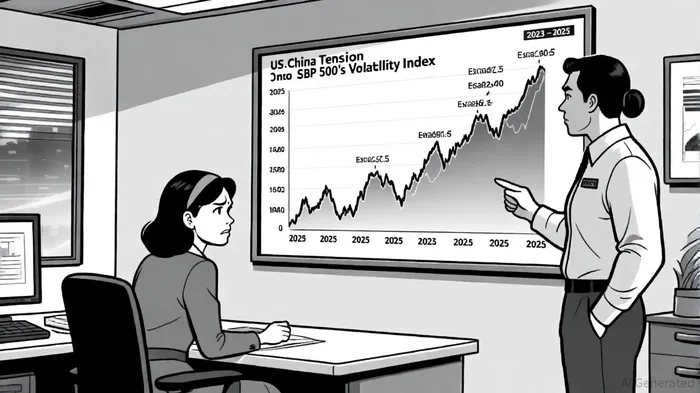
China's retaliatory tariff surge in April, which spiked to 125% on U.S. imports, triggered sharp sell-offs in global equity and bond markets[2]. The U.S. has meanwhile expanded export restrictions on semiconductors and AI technologies, a move that risks retaliatory measures such as cybersecurity attacks or intellectual property theft[1]. These actions have amplified the U.S.-China Tension Index (UCT), which, as empirical studies show, directly correlates with increased volatility in major equity indices[3].
2. Market Volatility and Sectoral Impacts
The UCT's rise has had a measurable impact on investor behavior. Research utilizing the GJR-GARCH-MIDAS model reveals that a 1% increase in the UCT amplifies long-term volatility in the S&P 500 and Nasdaq Composite by 0.3–0.5%[3]. This dynamic is particularly pronounced in sectors reliant on cross-border trade, such as agriculture, IT, and manufacturing[3].
For example, U.S. sanctions on Chinese tech firms have disrupted supply chains, forcing multinationals to shift investments to countries like Mexico, India, and Vietnam[3]. Conversely, China's retaliatory tariffs have disproportionately affected U.S. agricultural exports, with soybean and pork producers facing significant revenue declines[2]. These sector-specific shocks highlight the need for granular risk assessment.
3. Strategic Positioning for Stability
Historical data suggests that while geopolitical shocks often trigger short-term market corrections, long-term returns tend to normalize within six to twelve months[2]. However, the prolonged nature of U.S.-China tensions—compounded by decoupling trends—demands a more proactive approach.
A. Defensive Sectors and Diversification
Investors should prioritize sectors with low exposure to trade volatility, such as utilities, healthcare, and consumer staples. Defensive equities have historically outperformed during periods of geopolitical uncertainty, as noted by J.P. Morgan[2]. Additionally, geographic diversification—particularly into markets less entangled in U.S.-China rivalry, such as Southeast Asia or the Middle East—can reduce portfolio risk[1].
B. Currency and Hedging Strategies
The USD-HKD peg has come under scrutiny due to Hong Kong's role in circumventing U.S. sanctions[1]. Investors should consider hedging against currency fluctuations by allocating to non-U.S. dollar assets or using derivatives to mitigate exposure to the greenback.
C. Capitalizing on Resilience Plays
Defense and cybersecurity equities have gained traction as U.S. defense spending increases in anticipation of potential conflict[2]. Similarly, companies involved in nearshoring—such as logistics providers in Mexico or India—offer exposure to the long-term realignment of supply chains[3].
4. Preparing for the Leader's Call
The upcoming U.S.-China leader's call represents a pivotal moment. While a temporary resolution could spark a market rally, as seen in May[1], investors should remain cautious. Historical precedents, such as the 1973 oil crisis, demonstrate that resource-based shocks can have prolonged effects[2]. Therefore, maintaining a balanced portfolio with liquidity and downside protection is critical.







Comentarios
Aún no hay comentarios