
Assessing the Geopolitical and Market Impact of Trump's Escalating Venezuela Strategy on U.S. and Latin American Defense and Security Sectors
The Trump administration's 2025 military escalation in the Caribbean—framed as a counter-narcotics campaign but widely interpreted as a strategic gambit against Venezuela's Nicolás Maduro regime—has ignited a seismic shift in defense and security dynamics across the Western Hemisphere. This analysis unpacks the geopolitical ramifications, defense sector spending trends, and investment opportunities emerging from the U.S.-Venezuela standoff, drawing on recent military actions, regional responses, and corporate contracts.
Geopolitical Escalation and Strategic Rationale
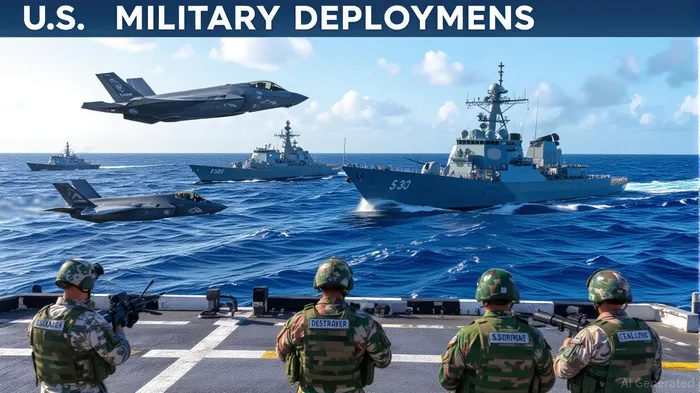
The U.S. kinetic strike on a Tren de Aragua-linked drug vessel in September 2025, which killed 11 individuals, marked a departure from traditional interdiction to direct military engagement[1]. The administration followed with a rapid deployment of 10 F-35 stealth fighters to Puerto Rico, five Arleigh Burke-class destroyers, and a nuclear-powered submarine, signaling a “maximum pressure” campaign against both cartels and Maduro[2]. While Secretary of State Marco Rubio emphasized the focus on “drug cartels operating against U.S. interests,” critics argue the operation blurs the line between counterterrorism and imperialist intervention[3].
Venezuela's response—mobilizing 4.5 million militiamen, activating Russian-supplied S-300 air defense systems, and conducting F-16 flyovers near U.S. ships—has deepened regional tensions[4]. Russia's expanded military cooperation with Caracas, including joint exercises and intelligence sharing, underscores the growing entanglement of drug policy and great-power rivalry[5]. Meanwhile, regional bodies like the Community of Latin American and Caribbean States (CELAC) have called for de-escalation, highlighting diplomatic fractures[6].
Defense Spending Surge: U.S. and Latin American Trends
The U.S. defense budget for 2025–26 is projected to exceed $1 trillion, with $12 billion allocated to Caribbean operations and $20 billion for hypersonic weapons and Indo-Pacific readiness[7]. Latin America's defense market, valued at $26.47 billion in 2025, is expected to grow at a 4.37% CAGR through 2030, driven by Brazil, Mexico, and Colombia[8].
- Brazil: Increased spending by 5.9% in 2025, prioritizing nuclear-powered submarines and FPV kamikaze drones for urban warfare[9].
- Mexico: A 39% budget hike to bolster the National Guard against cartels, with contracts for armored vehicles and surveillance tech[10].
- Colombia: Allocated $15.1 billion to counter residual guerrilla factions, including advanced armored systems[11].
- Argentina: Faces a readiness crisis due to poor pay, but plans to acquire Italian Maestrale-class frigates[12].
The U.S. military buildup has also spurred regional arms races. Venezuela's procurement of Russian SU-30s and S-300 systems, coupled with Brazil's modernization push, reflects a broader trend of technological self-reliance and strategic alignment[13].
Defense Contractors and Investment Opportunities
The U.S. military's Caribbean operations have directly benefited defense firms supplying advanced platforms and infrastructure. Key players include:
- Lockheed Martin (LMT): Provider of F-35B stealth fighters deployed to Puerto Rico and CCA drones for maritime surveillance[14].
- RTX Corporation (RTX): Supplier of P-8A Poseidon maritime patrol aircraft, critical for tracking drug vessels[15].
- General Dynamics (GD): Manufacturer of Arleigh Burke-class destroyers and the USS Newport News submarine[16].
- Northrop Grumman (NOC): Involved in CCA drone development and missile defense systems[17].
Recent contracts tied to the Caribbean buildup include:
- $311 million to TOTE Services Inc. for Sea-Based X-Band Radar Platform operations[18].
- $276 million to Huntington IngallsHII-- for USS Harry S. Truman refueling[19].
- $131 million to Galvion Technologies for integrated helmet systems[20].
In Latin America, regional firms like Brazil's EmbraerERJ-- and Argentina's Fábrica Argentina de Aviones are securing contracts for modernization projects, while international firms like Thales Group and Saab AB expand their footprint[21].
Strategic Investment Themes
- Unmanned Systems and Cybersecurity: The U.S. Navy's CCA drone program and Brazil's FPV drone adoption highlight growing demand for autonomous platforms[22]. Cybersecurity firms like PalantirPLTR-- and Raytheon are also positioned to benefit from heightened surveillance needs.
- Naval and Amphibious Capabilities: Companies producing destroyers, submarines, and logistics infrastructure (e.g., General DynamicsGD--, BAE Systems) are likely to see sustained demand[23].
- Regional Defense Partnerships: Firms engaging in joint ventures with Latin American governments—such as Lockheed Martin's work with Brazil—offer long-term growth potential[24].
Risks and Considerations
While the defense sector presents compelling opportunities, investors must weigh geopolitical risks. The U.S. military's legal and ethical controversies—such as the designation of cartels as FTOs—could invite international backlash or operational constraints[25]. Additionally, economic instability in countries like Argentina and Venezuela may limit long-term procurement capacity[26].
Conclusion
Trump's Venezuela strategy has catalyzed a defense sector boom, driven by U.S. military modernization, regional arms competition, and the blurring of counter-narcotics and counterterrorism objectives. Investors with exposure to advanced military technologies, naval infrastructure, and regional partnerships are well-positioned to capitalize on this volatility. However, success will require careful monitoring of geopolitical shifts and regulatory responses to U.S. interventionism.





Comentarios
Aún no hay comentarios