
Assessing Geopolitical and Infrastructure Risks in Japan's Energy and Reinsurance Sectors Post-Earthquake Activity
Japan's energy and reinsurance sectors face a dual challenge: managing the physical and economic fallout of frequent seismic activity while navigating a volatile geopolitical landscape. Recent earthquakes, including the January 2025 event that caused widespread power outages and infrastructure damage according to reports, have underscored the fragility of the nation's energy systems. Simultaneously, Japan's reliance on imported fossil fuels-accounting for 87% of its total energy supply-exposes it to global supply chain disruptions and geopolitical tensions as research shows. This analysis explores how strategic risk management and market resilience are being redefined in Japan's energy and reinsurance sectors, with a focus on integrating infrastructure and geopolitical risk mitigation.
Infrastructure Vulnerabilities and Energy Grid Resilience
Japan's energy infrastructure remains highly susceptible to seismic disruptions. The January 2025 earthquake, for instance, triggered short-circuit faults, damaged transmission networks, and led to prolonged power outages. Historical precedents, such as the 2011 Tohoku earthquake and tsunami, highlight the scale of such risks: power outages in that event lasted up to nine days, crippling transportation and logistics. A recurrence of a Nankai Trough earthquake-a high-probability event with an 80% chance of occurring within three decades-could reduce power supply capacity in affected regions to as low as 20% of peak demand, impacting millions of buildings.
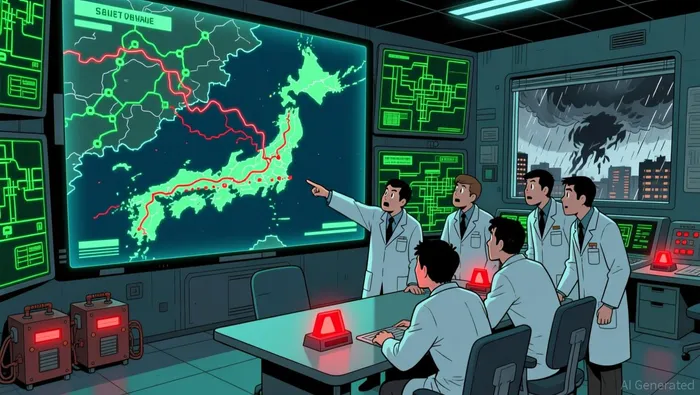 To address these vulnerabilities, Japan has prioritized decentralized energy solutions. Microgrids, distributed generation (DG), and energy storage systems are increasingly deployed to ensure continuity during disasters. For example, post-2025 recovery efforts have emphasized grid modernization, with investments in redundant systems and AI-driven monitoring to detect faults in real time. These measures are critical, as traditional centralized grids remain prone to cascading failures during large-scale disruptions.
Geopolitical Risks and Energy Security
Japan's energy security is further complicated by geopolitical risks. The country's dependence on imported fossil fuels-particularly liquefied natural gas (LNG) and crude oil- leaves it exposed to supply chain shocks from conflicts, trade wars, and sanctions. For instance, the 2025 Seventh Strategic Energy Plan (SEP) aims to increase the self-development ratio of energy resources to 50% by 2030, a strategy that involves direct Japanese investments in overseas fossil fuel projects. However, this approach has drawn criticism for deepening exposure to geopolitical instability, as seen in the Mozambique LNG project, where insurgent attacks and security threats have caused delays and cost overruns.
To counter these risks, Japan is accelerating its transition to renewables. The SEP sets a target of 40–50% renewable energy in the power mix by 2040, though this lags behind international benchmarks like the IPCC's 54% median share by 2030 according to analysis. A Geopolitical Risk Index developed for energy trade highlights the importance of diversifying partnerships, identifying countries like the Nordic states and Singapore as reliable partners for green e-fuel trade. This index serves as a tool for investors to quantify risks and prioritize partnerships that align with both energy security and climate goals.
Reinsurance Strategies: Bridging Infrastructure and Geopolitical Risks
Japan's reinsurance sector has emerged as a key player in mitigating both natural and geopolitical risks. Post-2025, the energy insurance market is projected to grow at a 7.2% CAGR, driven by AI-powered risk assessment tools that integrate real-time data on seismic activity, equipment performance, and geopolitical events. These tools enable dynamic pricing models and streamlined claims processing, reducing costs while improving resilience.
A notable example is Tokio Marine Resilience, a dedicated entity under Tokio Marine, which has developed comprehensive disaster prevention solutions. These include supply chain diversification strategies for SMEs and location-based risk assessments to minimize exposure to both earthquakes and geopolitical shocks. Additionally, Japan's reinsurance sector is leveraging AI to monitor infrastructure vulnerabilities, such as cracks in transmission lines, and to assess cyber risks under stringent data protection laws like the Act on the Protection of Personal Information (APPI) as noted in industry reports.
The 2025 National Security Strategy further underscores the role of reinsurance in stabilizing energy infrastructure. By promoting renewable energy adoption, Japan aims to reduce its reliance on imported fossil fuels and insulate its economy from geopolitical volatility according to policy analysis. However, challenges persist. For instance, Japan's electric utilities have resisted coal phaseouts and lobbied for continued support for thermal power, complicating efforts to align with global decarbonization goals.
Case Studies: Lessons from Post-2025 Developments
The integration of geopolitical and infrastructure risk management is evident in Japan's post-2025 energy insurance landscape. A 2025 global reinsurer summit in Japan brought together over 400 firms to coordinate support for renewable energy projects, emphasizing reinsurance's role in managing large-scale infrastructure risks. This collaboration reflects a shift toward holistic risk frameworks that account for both seismic events and global trade uncertainties.
Another example is the use of AI in underwriting. By 2026, Japan's energy insurance market is expected to reach USD 5 billion, with AI-driven models enabling precise risk profiling. These models incorporate geopolitical factors such as trade policy shifts and supply chain disruptions, providing insurers with a more comprehensive view of exposure. For instance, Deloitte's 2026 global insurance outlook highlights the importance of digital transformation in addressing margin pressures caused by geopolitical volatility.
Conclusion: Toward Integrated Risk Management
Japan's energy and reinsurance sectors are at a crossroads. While seismic risks remain a constant threat, the compounding effects of geopolitical instability demand integrated risk management strategies. The 2025 Seventh Strategic Energy Plan and AI-driven reinsurance innovations represent significant strides, but challenges such as slow renewable adoption and fossil fuel lobbying persist according to industry analysis. For investors, the key lies in supporting initiatives that combine infrastructure resilience-through microgrids and AI monitoring-with geopolitical risk mitigation-via diversified energy partnerships and dynamic insurance products.
As Japan navigates this complex landscape, the lessons from post-2025 developments underscore a critical truth: resilience in the energy sector requires not just technological innovation but also a strategic alignment of infrastructure, policy, and global risk awareness.







Comentarios
Aún no hay comentarios