
Assessing the Geopolitical and Energy-Driven Risks and Opportunities in Latin America Amid Trump's Aggressive Cuba and Venezuela Policy
The U.S. approach to Venezuela and Cuba under the Trump administration has reshaped Latin America's geopolitical and energy landscape, creating both risks and opportunities for emerging markets. By leveraging sanctions, military interventions, and diplomatic pressure, Washington has sought to reassert dominance over the region's energy resources while countering external influences like China and Russia. However, these actions have also triggered regional instability, economic vulnerabilities, and complex interdependencies that investors must carefully evaluate.
Venezuela: A Strategic Energy Battleground
The U.S. has positioned Venezuela's oil sector as a cornerstone of its Western Hemisphere strategy. Sanctions under Executive Order 13850 and military operations, including the 2025 removal of Nicolás Maduro, have disrupted Venezuela's oil infrastructure, reducing production to less than 1 million barrels per day from a peak of 3.5 million in the 1990s. While the Trump administration has emphasized plans to "fix up the oil" and "run" Venezuela during a transition period, the sector's decline-driven by years of underinvestment and mismanagement-poses significant challenges for U.S. ambitions.
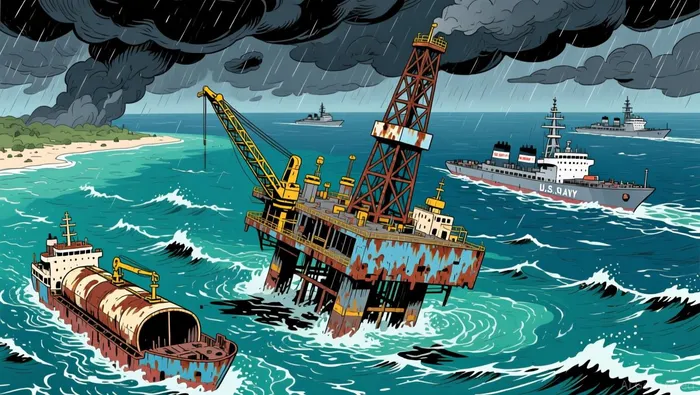 Despite these hurdles, Venezuela's vast oil reserves remain a strategic asset. The U.S. has selectively rolled back sanctions to enable crude exports and authorized imports of oil field equipment, signaling a potential pivot toward supporting energy recovery. However, major U.S. and international oil companies remain hesitant to invest due to political uncertainty and global oil prices hovering around $55 per barrel in 2026. This creates a paradox: while Venezuela's oil could bolster U.S. energy security, its underdeveloped infrastructure and geopolitical tensions limit immediate returns for investors.
Cuba's Energy Crisis and Regional Spillovers
Cuba's energy sector has become a collateral casualty of U.S. policies targeting its alliance with Venezuela. The barter system, which exchanged subsidized Venezuelan oil for Cuban labor and technical services, has been disrupted by sanctions, asset freezes, and maritime enforcement operations. In December 2025, a coordinated U.S. enforcement effort seized a vessel carrying Venezuelan crude, underscoring the administration's commitment to severing this lifeline.
Cuba now faces a severe energy crisis, with 60% of its fuel supply reliant on imports. This vulnerability has pushed Havana to seek alternative partnerships, notably with China, which has invested in wind farms and biomass power plants to diversify Cuba's energy mix. While these projects align with Cuba's renewable energy goals, they also raise concerns about long-term economic dependencies and U.S. countermeasures. For investors, Cuba's pivot to China represents both a risk-heightened geopolitical friction-and an opportunity: access to a market undergoing energy modernization.
Regional Implications: Tensions, Alliances, and Structural Vulnerabilities
The U.S. interventions in Venezuela and Cuba have intensified regional tensions. Neighboring countries like Brazil and Mexico have reacted to Washington's actions, with Mexico recently sending fuel to Cuba amid the energy crisis. These dynamics highlight the fragility of regional alliances and the potential for retaliatory measures against U.S. influence.
According to the Latin American Economic Outlook 2025, Latin America's reliance on primary exports and low innovation capacity exacerbates its susceptibility to external shocks. The report notes that U.S. sanctions and geopolitical interventions have further destabilized economies already grappling with inflation and infrastructure decay. For emerging markets, this creates a dual challenge: navigating U.S.-driven volatility while addressing domestic inefficiencies.
Opportunities Amidst the Uncertainty
Despite the risks, the region offers compelling opportunities for investors who can navigate the geopolitical landscape. The U.S. has signaled openness to selective investments in Venezuela's oil sector, particularly if political stability improves. Similarly, Cuba's renewable energy projects-though constrained by U.S. policies-could attract capital from non-U.S. firms seeking to bypass secondary sanctions.
Moreover, the Trump administration's focus on energy security has spurred interest in alternative energy corridors. For instance, the Orinoco Mining Arc in Venezuela, despite its environmental and security challenges, presents untapped potential for mineral extraction. Investors with expertise in navigating complex regulatory environments may find value in these underdeveloped assets.
Conclusion: Balancing Risk and Reward
The U.S. strategy in Venezuela and Cuba underscores the interplay between energy security and geopolitical power. While sanctions and military interventions have weakened regional adversaries, they have also created economic and political fissures that could destabilize the broader Latin American market. For investors, the key lies in balancing short-term risks-such as sanctions volatility-with long-term opportunities in energy infrastructure and resource extraction.
As the region grapples with these dynamics, emerging markets will require agile strategies that account for both U.S. influence and the rise of alternative partners like China. The path forward is fraught with uncertainty, but for those who can navigate the geopolitical chessboard, Latin America's energy sector remains a high-stakes arena with significant upside.







Comentarios
Aún no hay comentarios