
Assessing the Financial and Operational Risks of Lufthansa's Pilot Dispute
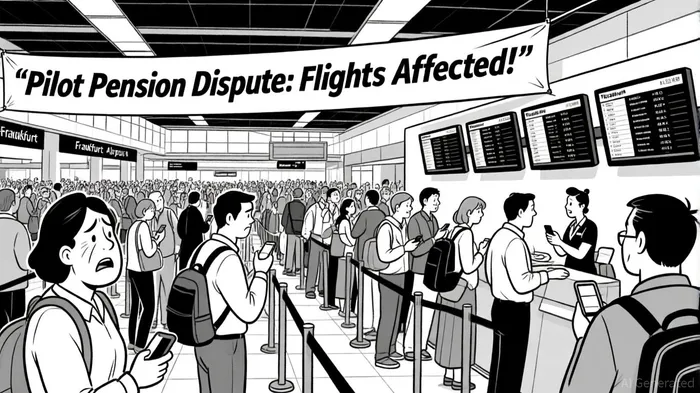
The recent escalation of Lufthansa's pension dispute with its pilots' union, Vereinigung Cockpit (VC), underscores a critical vulnerability for European legacy airlines: the unsustainable strain of labor costs on profitability and valuation metrics. As the airline faces a potential strike ballot over pension reforms, the risks extend beyond operational disruptions to threaten its broader financial strategy and investor confidence. This analysis examines how labor cost dynamics, particularly in pension obligations, are reshaping the valuation landscape for legacy carriers like Lufthansa, IAG, and Air France-KLM.
The Pension Dispute: A Catalyst for Operational and Financial Risk
Lufthansa's shift from a defined-benefit pension model to a capital market-financed defined-contribution system in 2017 has become a flashpoint for industrial action. Pilots argue that this change has eroded retirement security, with the union demanding guaranteed improvements to offset underperforming investments [1]. After seven rounds of failed negotiations, Vereinigung Cockpit has initiated a strike ballot, with results expected by late September 2025. A repeat of the 2022 strike—which grounded 800 flights and stranded 130,000 passengers—could cost Lufthansa hundreds of millions in lost revenue and compensation liabilities, given EU regulations mandating passenger compensation for strike-related cancellations [2].
The financial implications are compounded by Lufthansa's 2026 cost-cutting initiative, which aims to achieve €1.5 billion in savings. Persistent labor disputes threaten to derail these plans, as the airline has already incurred €700 million in additional costs from prior pilot agreements and a €350 million loss during a 2024 strike by cabin crew and ground staff [3]. Analysts warn that unresolved pension disputes could undermine market confidence, particularly as Lufthansa's operating margin contracts to 6.9% in 2024 from 7.4% in 2023 [4].
Labor Costs and Valuation Metrics: A Broader Industry Challenge
Lufthansa's struggles reflect systemic challenges for European legacy carriers, where labor costs now account for 31% of operational expenses—up sharply from pre-pandemic levels [5]. These costs are driven by post-pandemic labor shortages, inflationary pressures, and aggressive wage demands from unions. For instance, IAG (owner of British Airways) has managed to outperform peers like Lufthansa and Air France-KLM by maintaining tighter cost discipline, with a Q3 2024 operating margin of 21.6% compared to Lufthansa's 13.6% and Air France-KLM's 13.1% [6]. This divergence is evident in valuation metrics: IAG's P/E ratio of 5.1x is significantly lower than Lufthansa's 5.26x and Air France-KLM's 3.64x, reflecting stronger investor confidence in its ability to sustain margins [7].
The EBITDA margins of European legacy carriers are also under pressure. Lufthansa's EBITDA for 2024 fell 16.76% to $4.367 billion, while Air France-KLM's “Back on Track” cost-cutting program aims to generate €450 million in savings to stabilize its EBITDA [8]. In contrast, IAG's EBITDA growth—driven by transatlantic demand and efficient cost management—has insulated it from some of the sector's broader headwinds. These trends highlight how labor cost sustainability directly influences valuation multiples: companies with higher EBITDA margins and disciplined cost structures command lower P/E ratios and higher EV/EBITDA multiples [9].
Strategic Implications for Lufthansa and the Industry
For Lufthansa, the pension dispute is not merely a labor issue but a strategic test of its ability to balance employee demands with financial viability. The airline's recent CFO departure has further shaken investor confidence, raising questions about its capacity to execute its turnaround plan [10]. If the pension dispute escalates into a strike, Lufthansa's 2025 earnings outlook—already weakened by a 18% drop in 2024 profits—could face further deterioration. This would exacerbate its valuation challenges, as EBITDA margins and P/E ratios are closely tied to perceived operational efficiency and long-term profitability [11].
The broader industry lesson is clear: European legacy carriers must innovate in labor cost management to compete with low-cost rivals. While IAG's success demonstrates the value of cost discipline, Lufthansa and Air France-KLM remain vulnerable to strikes and rising wage demands. The key to sustainable valuations lies in aligning pension obligations with financial realities, investing in automation to boost productivity, and leveraging regulatory reforms to reduce fixed costs [12].
Conclusion
Lufthansa's pilot dispute epitomizes the precarious balance European legacy airlines must strike between labor obligations and financial sustainability. As pension disputes and rising wage demands strain EBITDA margins and valuation multiples, the airline's ability to resolve this conflict will be pivotal to its recovery. For investors, the broader takeaway is that labor cost sustainability is a critical determinant of airline valuations—a reality that will shape the competitive landscape for years to come.







Comentarios
Aún no hay comentarios