
Assessing the Fed's Rate Pause: Implications for Equity and Bond Markets in 2026
The Federal Reserve's decision to pause its rate-cutting cycle in late 2025, followed by a 0.25 percentage point reduction in December, has set the stage for a year of heightened uncertainty in global financial markets. With policymakers divided on the path forward and central banks diverging in their approaches, investors are left to navigate a landscape where traditional signals-such as yield differentials and inflation trends-are less reliable. As we enter 2026, the implications for equity and bond markets hinge on how the Fed's cautious stance interacts with broader central bank fragmentation and the lingering risks of policy misalignment.
The Fed's Delicate Balancing Act
The Fed's December 2025 rate cut, the third in a row, reflects a central bank grappling with a slowing labor market and stubborn inflation. The 3.5%-3.75% target range, while a significant drop from earlier in the year, remains above the 2% long-run goal. According to the Federal Reserve's statement, future adjustments will depend on "evolving economic outlook and incoming data," a phrase that underscores the uncertainty surrounding the path of monetary policy. This ambiguity is compounded by internal divisions: three policymakers dissented from the December decision, with some favoring a larger cut and others advocating for no change.
The Fed's "dot plot" projections, which suggest only one rate cut in 2026 and another in 2027, further highlight the cautious approach. However, these projections are not immune to shifting dynamics. For instance, the government shutdown that delayed key economic data in late 2025 has left the Fed with an incomplete picture of labor market and inflation trends. This lack of clarity risks prolonging policy uncertainty, which could weigh on market confidence.
Central Bank Divergence: A Structural Headwind
The Fed's relatively tighter stance contrasts sharply with the European Central Bank's (ECB) more aggressive easing cycle. As of December 2025, the ECB's deposit rate stands at 2.25%, a 150–200 basis point differential compared to the Fed's target range. This divergence has created a structural headwind for the euro, with EUR/USD trading persistently lower as investors favor U.S. assets with higher yields and stronger growth prospects. The Bank of England (BoE), meanwhile, is adopting a middle path, with one rate cut expected in Q3 2025 and another in Q4, reflecting its balancing act between inflation control and growth support.
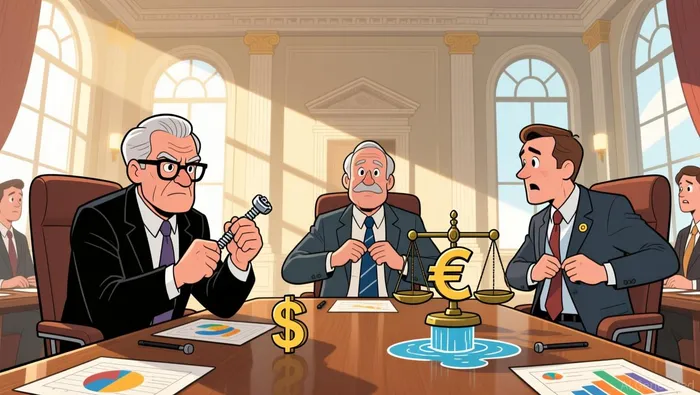 This fragmentation is not merely a U.S.-Europe issue. In Asia, China has introduced stimulus measures to counter weak growth, while emerging market (EM) central banks are cutting rates despite U.S. inflation pressures. Such divergent policies are reshaping capital flows, with U.S. Treasuries and equities attracting inflows as investors seek higher yields amid a global hunt for return.
Bond Market Dislocation: Yields Rise Despite Rate Cuts
The bond market's response to the Fed's rate cuts has been anything but textbook. Treasury yields have risen despite the Fed's easing cycle, a phenomenon attributed to a combination of factors. J.P. Morgan Research points to a surge in term premiums-the compensation investors demand for inflation or debt risks-which has risen nearly a full percentage point since the Fed began cutting rates. Additionally, political pressures, including President Donald Trump's push for more aggressive rate cuts, have eroded confidence in the Fed's inflation-fighting credibility.
This dislocation has created a challenging environment for fixed-income investors. While the Fed's rate cuts typically lower yields, the current backdrop suggests that market forces-such as fiscal expansion and global growth concerns-are overpowering monetary policy signals. The result is a bond market that appears to be pricing in a higher inflation trajectory, even as the Fed remains cautious.
Equity Markets: Sector Rotations and Risk Premiums
Equity markets have shown resilience amid the uncertainty, but the path forward is far from uniform. J.P. Morgan Research notes that a non-recessionary easing cycle-where the Fed cuts rates without triggering a downturn-could benefit U.S. large-cap equities and gold, which serve as a hedge against currency debasement. However, a recessionary scenario would see Treasuries and gold outperform, as investors flee risk.
Sector rotations are also being influenced by macroeconomic dynamics. For example, the reopening of U.S. government operations and the potential for additional rate cuts in 2026 could boost corporate earnings growth, particularly in sectors tied to consumer spending and infrastructure. Conversely, elevated tariffs and trade tensions remain a drag on growth, creating headwinds for export-dependent industries.
The broader equity market is also reacting to central bank divergence. European and Chinese stimulus measures are supporting international equities, while U.S. rate cuts have bolstered domestic large-cap stocks. This multipolar environment suggests that 2026 could see a bifurcation in performance, with U.S. large-cap and international small/mid-cap equities offering distinct opportunities.
Navigating the Uncertainty
As 2026 unfolds, investors must contend with a Fed that is neither fully committed to a rapid easing cycle nor confident in its ability to predict the economic outlook. The central bank's cautious approach, combined with global policy fragmentation, has created a landscape where traditional correlations may break down. For bond investors, the challenge lies in managing duration risk in a high-yield, high-volatility environment. For equities, the key is identifying sectors and geographies that can thrive amid divergent monetary policies.
Ultimately, the Fed's rate pause is not an endpoint but a pivot point. The coming months will test the resilience of markets and the Fed's ability to navigate a world where policy certainty is a relic of the past.







Comentarios
Aún no hay comentarios