
Assessing the Fed's Policy Path in 2026: What December CPI Tells Us About Rate Hikes and Cuts
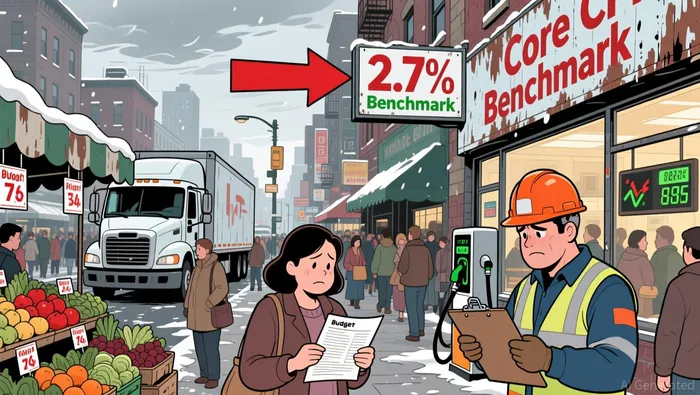
The Federal Reserve's policy trajectory in 2026 hinges critically on the persistence of inflation, as evidenced by the December 2025 Consumer Price Index (CPI) data. With annual inflation holding steady at 2.7% and core CPI (excluding food and energy) also at 2.7%, the U.S. economy remains in a delicate balancing act between price stability and growth. This analysis unpacks the implications of these figures for the Fed's 2026 policy decisions, emphasizing the interplay between inflation stickiness, labor market dynamics, and divergent central bank perspectives.
Inflation Persistence: A Mixed Signal
The December 2025 CPI report, released on January 13, 2026, confirmed that inflation remains above the Fed's 2% target, albeit with signs of moderation. Annual energy prices surged 4.2%, driven by a 11.3% spike in fuel oil and 9.1% rise in natural gas, while food prices climbed 2.6%, led by a 4.7% increase in meats, poultry, fish, and eggs. Shelter costs, a key component of core CPI, rose 3.0%, reflecting ongoing housing market pressures.
However, the data is not without caveats. A government shutdown in October 2025 disrupted data collection, forcing the Bureau of Labor Statistics to use carry-forward imputation methods for October prices. This method, while necessary, may have distorted the accuracy of November and December readings. Economists project a 0.3% monthly CPI increase in December, suggesting a rebound from November's weaker 0.1% rise. Such volatility underscores the challenges of interpreting inflation trends amid methodological constraints.
Fed Policy: Caution Amid Divergence
The Federal Reserve's December 2025 FOMC meeting minutes reveal a divided policymaking committee grappling with these uncertainties. The Fed cut its key interest rate by 25 basis points to 3.6%, the lowest in nearly three years, but the decision passed narrowly (9-3), reflecting deep disagreements. On one side, officials argued for further rate cuts to stimulate a weakening labor market, while others warned against premature easing given inflation's stickiness.
Projections for 2026 are equally split. Seven officials anticipate no rate cuts, eight expect two or more reductions, and four support a single cut. The median projection for the federal funds rate in 2026 is 3.4%, with a projected range of 2.9–3.6%. These divergent views highlight the Fed's cautious approach: while inflation is expected to cool gradually as housing and energy prices stabilize, policymakers remain wary of reigniting inflationary pressures through aggressive rate cuts.
Market Implications: Navigating Uncertainty
For investors, the Fed's policy path in 2026 will likely be shaped by three key factors:
1. Inflation Stickiness: If core CPI remains above 2.5% into early 2026, the Fed may delay rate cuts to avoid undermining credibility. Conversely, a sustained drop toward 2% could prompt a more accommodative stance.
2. Labor Market Weakness: A deteriorating job market, as signaled by rising unemployment or slowing wage growth, may force the Fed to prioritize growth over inflation control.
3. Consumer vs. Business Expectations: While firms' inflation expectations have moderated (mean forecast of 2.6% for their prices), consumer expectations remain elevated at 3.4%. This disconnect could prolong policy uncertainty.
The December CPI data also highlight sector-specific risks. Energy and food price volatility, coupled with rising shelter costs, suggest inflation could remain unevenly distributed. Investors in equities may favor sectors insulated from price pressures, such as technology or healthcare, while fixed-income markets could benefit from a "soft landing" narrative if inflation cools as projected.
Conclusion: A Delicate Tightrope
The Fed's 2026 policy path will require walking a tightrope between inflation control and growth support. December's CPI data, while showing modest progress, underscores the persistence of price pressures and the challenges of navigating a post-shutdown data environment. For investors, the key takeaway is to remain agile: monitor incoming CPI reports for signs of stabilization, track FOMC communications for shifts in policy tone, and prepare for a range of outcomes-from extended rate stability to measured easing. In this climate of uncertainty, patience and adaptability will be paramount.







Comentarios
Aún no hay comentarios