
Assessing the Fed's Growing Dissent and the Implications for 2026 Rate Policy
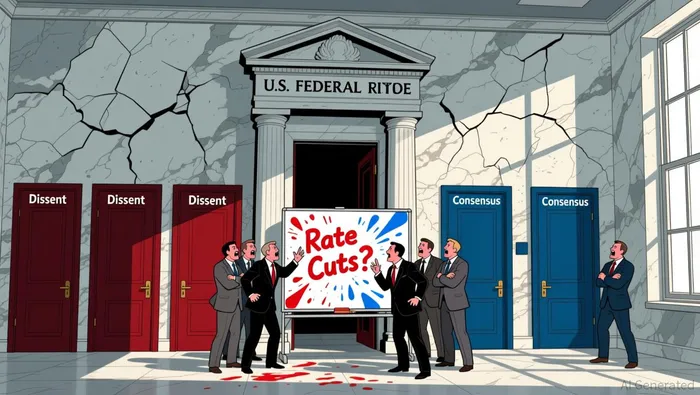
The Federal Reserve's internal divisions have reached a critical juncture, with dissenting votes in monetary policy decisions surging to levels unseen since 2019. By late 2025, five of the 12 voting members of the FOMC had openly challenged the central bank's consensus on rate cuts, reflecting deepening fractures over how to balance inflation control with labor market risks. This fragmentation, fueled by conflicting assessments of economic data and political pressures, has eroded the Fed's ability to project a unified policy message-a vulnerability that will likely intensify in 2026 as the central bank navigates a complex macroeconomic and political landscape according to analysis.
Policy Fragmentation and 2026 Uncertainty
The December 2025 FOMC meeting is expected to crystallize these tensions, with as many as five dissenters opposing further rate cuts despite a softening labor market. Such a split would mark a historic departure from the Fed's traditional consensus-driven approach and raise questions about its institutional independence, particularly as the Trump administration's influence looms over the selection of the next chair. A potential appointee like Kevin Hassett, whose ideological leanings favor aggressive rate reductions, could exacerbate divisions between the Washington-based governors and regional bank presidents, signaling a structural shift in policy formulation.
 The Fed's dual mandate-stabilizing inflation and supporting employment-has become a battleground. While inflation remains stubbornly above 2%, labor market indicators point to weakening conditions, creating a policy dilemma: further cuts could risk reigniting inflation but may be necessary to avert a slowdown. This dichotomy has left markets in limbo, with investors split on whether the Fed will pause after its December 2025 rate cut. The lack of clarity is compounded by a government shutdown that delayed key economic data, forcing policymakers to rely on outdated information and deepening their fixed positions.
Strategic Asset Allocation in a Fragmented Environment
For investors, the Fed's uncertainty demands a recalibration of strategic asset allocation. Traditional diversification strategies are increasingly challenged by the Fed's fragmented messaging and the concentration of equity markets, where the top 10 U.S. companies now account for 22.2% of global equity exposure. This concentration, driven by AI enthusiasm and low bond yields, has left portfolios vulnerable to volatility. To mitigate risks, investors are advised to diversify into alternative assets such as hedge funds and private credit, which offer more stable risk-return profiles in a high-inflation, low-correlation environment.
Sector rotation strategies must also adapt to the Fed's policy ambiguity. Equity long/short funds are positioning for AI-driven growth in technology and industrials, particularly in semiconductors and power generation for data centers. Meanwhile, energy and infrastructure sectors-critical to supporting AI's energy demands-are emerging as long-term value plays according to market analysis. Conversely, cyclical financial assets tied to natural resources may benefit from accommodative liquidity settings as the Fed transitions toward a more dovish stance according to market commentary.
Hedging and Geographic Diversification
Hedging mechanisms are gaining prominence as a tool to navigate Fed policy uncertainty. Rate options and multi-strategy hedge funds are being deployed to protect against abrupt market reactions to policy shifts, with 61% of institutional investors identifying tariffs as a significant inflationary risk. Geopolitical fragmentation, particularly in U.S.-China trade relations, further underscores the need for geographic diversification. Investors are increasingly allocating to Asia's tech sector, where AI-related opportunities offer more affordable valuations compared to U.S. markets.
Conclusion
The Fed's growing dissent and the resulting policy fragmentation present both risks and opportunities for 2026. While the central bank's credibility faces a test, investors who adopt a nuanced approach-leveraging alternative assets, sector rotations, and hedging tools-can position themselves to thrive in an environment marked by uncertainty. As the December 2025 meeting approaches, the market's response will hinge on the Fed's ability to reconcile its internal divisions and maintain a semblance of policy coherence. For now, strategic asset allocation must remain agile, balancing optimism for AI-driven growth with caution against the backdrop of a fractured monetary landscape.







Comentarios
Aún no hay comentarios