
Assessing the Fed's December Rate-Cut Outlook Amid Policy Division and Weak Data Signals
Policy Division: Hawks and Doves in the Room
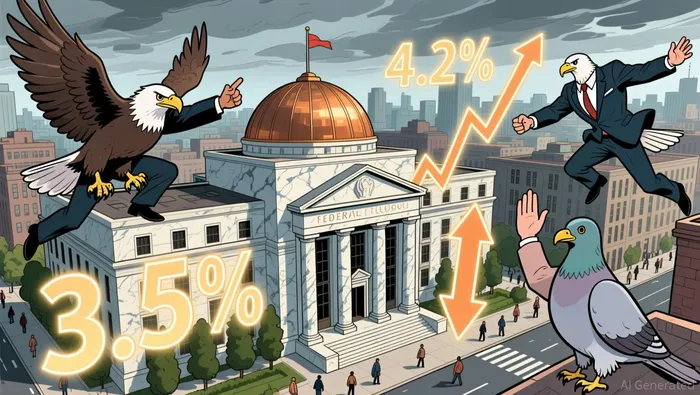
The Fed's internal debate has crystallized into two camps. On one side, officials like Governor Christopher Waller have emerged as vocal advocates for a December rate cut. Waller argues that the labor market is "almost at a standstill," with September employment data-delayed by a 43-day government shutdown-expected to show a downward revision. He emphasizes a "meeting by meeting approach," citing the need to prevent a sharper economic downturn and the disproportionate impact of tight policy on lower- and middle-income groups.
Market Expectations and Data Gaps
Market pricing has reflected this uncertainty. In October, traders priced in a 93.7% probability of a December rate cut, but by mid-November, that probability had collapsed to 50%. The shift underscores the lack of consensus among Fed officials and the absence of updated economic data. For instance, the delayed September jobs report-a critical barometer for labor market health-remains a wildcard. Without this data, policymakers are operating with incomplete information, heightening the risk of a surprise decision.
Strategic Asset Positioning: Preparing for Dollar Weakness and Fed Easing
A potential rate cut, even if delayed, would likely accelerate dollar depreciation and fuel global capital reallocation. Historical precedents from 2000–2025 suggest that accommodative Fed policies typically benefit non-dollar assets, equities, and commodities. For example: 1. US Treasuries: Front-end yields have historically rallied ahead of and after rate cuts, as investors anticipate lower borrowing costs. 2. Equities: Small-cap stocks, which rely heavily on floating-rate debt, tend to outperform in easing cycles. 3. Non-Dollar Assets: Emerging markets and international equities often match or outperform U.S. assets when the dollar weakens. 4. Commodities: Gold and other safe-haven assets have seen record demand as central banks diversify reserves.
The Indian rupee's recent surge-a direct response to dollar weakness-illustrates the potential for emerging market currencies to benefit from Fed accommodation. Similarly, gold's role as a hedge against inflation and geopolitical uncertainty has gained renewed traction, with central banks increasing purchases.
Risks and Considerations
While the case for dollar weakness and asset reallocation is compelling, investors must remain mindful of risks. Premature rate cuts could destabilize inflation control, particularly if supply-side shocks or fiscal policy shifts emerge. Additionally, the Fed's "gradual" approach to reaching neutral policy, as emphasized by Jefferson, may limit the magnitude of rate cuts, capping the dollar's decline.
Conclusion: Balancing Caution and Opportunity
The Fed's December decision will hinge on its ability to reconcile internal divisions and interpret incomplete data. For investors, the key lies in balancing defensive positioning against dollar volatility with opportunistic exposure to non-dollar assets and commodities. A diversified portfolio that incorporates Treasuries, small-cap equities, and emerging market currencies-while hedging against inflation via gold-offers a robust framework for navigating this uncertain environment.
As the Fed inches closer to its meeting, market participants must remain agile, prepared to adjust strategies based on evolving signals from both economic data and policy rhetoric.







Comentarios
Aún no hay comentarios