
Assessing the Fed Chair Conflict: A Structural Threat to Monetary Policy Independence
The conflict has moved beyond rhetoric into a direct assault on the Federal Reserve's institutional core. The immediate trigger is a Department of Justice criminal investigation into Chair Jerome Powell's congressional testimony regarding the central bank's $2.5 billion headquarters renovation. This probe, which has included grand jury subpoenas and threats of indictment, is being framed by Powell as an unprecedented political weapon. He explicitly called it a "pretext," arguing that the real battle is over monetary policy independence. "The threat of criminal charges is simply a consequence," he warned, "of the Fed setting interest rates 'based on our best assessment of what will serve the public,' rather than following the 'preferences of the President.'"
This sets up a stark confrontation between two visions of central banking. Powell's framing centers on the structural threat: whether the Fed can continue making decisions based on evidence and economic conditions, or if monetary policy will be shaped by political pressure. The White House, through senior adviser Kevin Hassett, has directly challenged this narrative. Hassett insists the case is not about political payback over interest rates, but about "dramatic cost overruns" and "inconsistent testimony" related to the renovation. His intervention reframes the DOJ action as a matter of financial accountability, distancing the administration from Powell's warning of political meddling.
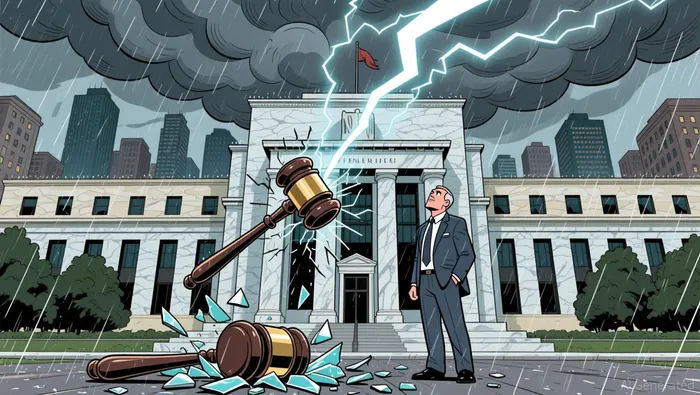
The escalation is clear. What began as months of public pressure for rate cuts and calls for Powell's removal has now materialized into a concrete legal threat against the Chair. This transforms a policy disagreement into a direct attack on the Fed's operational autonomy. The market's immediate reaction-a rally in gold to record highs and a sell-off in stocks-signals that investors perceive this as a fundamental threat to the credibility and insulation of U.S. monetary policy. The investigation is no longer just about a building; it is a test of whether the central bank can withstand political intimidation.
Market and Institutional Reactions: The Immediate Fallout
The initial market calm has given way to developing concern, revealing the fragility of the Fed's institutional shield. On Monday, major indices closed higher, with the S&P 500 and Nasdaq up modestly, as if to shrug off the Fed jitters. Yet the immediate futures reaction tells a different story, with the S&P 500, Nasdaq 100, and Dow Jones all trading lower. This divergence signals that the overnight rally may have been a knee-jerk relief trade, while the deeper implications of a criminal probe into the central bank's head are now settling in. The market's early indifference, which former Fed Chair Janet Yellen found "surprising," is beginning to crack.
Political pushback within the Republican Party is crystallizing into a tangible threat to the Fed's operational capacity. Senator Thom Tillis (R-NC) announced he will oppose any nominee put forward by the administration until the matter is resolved. Given the narrow split in the Senate Banking Committee, this stance could effectively block a nominee from reaching a full floor vote, creating a dangerous vacuum in the central bank's leadership pipeline. This intra-party friction underscores that the conflict is not a simple partisan spat but a deep institutional rift that could paralyze the Fed's ability to function.
The reactions from former officials and economists frame the probe as an existential threat to the central bank's credibility. Yellen called the investigation "extremely chilling" for independence and explicitly warned that the market should be concerned. Economist Justin Wolfers went further, declaring Powell is "going to war" to defend the central bank against what he terms the "Department of Recriminations." Wolfers' characterization of Powell's video address as a direct counter-offensive to the head of state frames the conflict as a constitutional crisis over monetary authority. The fear is that succumbing to political pressure would turn the Federal Reserve into the "Federal Subserve," a catastrophic failure for the rule of law and American credibility.
The bottom line is that the immediate fallout is a mix of market volatility and political paralysis. The futures decline shows the initial shock is fading, but the structural vulnerabilities are clear. With a key Republican senator blocking nominees and former Fed leaders warning of dire consequences, the Fed's independence is under siege from multiple fronts. The market's early calm is a fragile veneer over a system now facing a direct assault on its operational and political foundations.
Structural Implications: For Policy, Valuation, and Future Catalysts
The long-term risk is a fundamental degradation of the U.S. economic framework. A central bank that can be politically targeted faces a clear path to becoming a tool of fiscal policy, not a guardian of price stability. This would likely deliver higher inflation, as the Fed's credibility to anchor expectations erodes. It would also fuel volatile growth, as monetary policy becomes a reactive instrument to political cycles rather than a forward-looking stabilizer. The dollar, reliant on the Fed's perceived independence, would weaken. The structural implication is a move toward a less stable, more unpredictable economic regime.
The primary catalyst for this shift is the Senate's response to future Fed nominations. Senator Thom Tillis's announced opposition to any nominee until the investigation is resolved creates a tangible blockage. Given the narrow split in the Senate Banking Committee, this stance could effectively paralyze the confirmation process. A blocked pipeline severely limits the Fed's ability to function effectively, especially in a crisis. It risks creating a leadership vacuum that could further destabilize policy and market expectations.
For investors, the key is to watch for further market repricing. The initial market calm is fragile. As the conflict's resolution remains uncertain, Treasury yields and equity valuations sensitive to policy certainty will be the first to reprice. The record highs in gold and silver on Monday signaled a flight to perceived safety, a classic reaction to institutional risk. If the Senate confirms a nominee, it may ease some pressure. But if the standoff continues, the repricing could extend to risk assets, with longer-dated Treasuries likely to see upward pressure on yields as the policy uncertainty premium rises.
The bottom line is that this is a test of America's institutional resilience. The conflict has moved from rhetoric to a criminal probe, with a blocked nomination process as the next likely battleground. The market's early indifference is a dangerous illusion. The structural threat to the Fed's independence, as warned by former Chair Janet Yellen and economist Justin Wolfers, is real. It undermines the credibility of U.S. monetary policy, a cornerstone of global financial stability.







Comentarios
Aún no hay comentarios