
Assessing the Fed's Balancing Act: Can a Soft Landing Emerge Without Forced Rate Cuts?
The Federal Reserve faces a pivotal test in 2025: Can it navigate a "soft landing" for the economy without resorting to preemptive rate cuts that risk reigniting inflation? Recent data on labor market dynamics, wage trends, and sector resilience suggest the Fed may have more flexibility than previously assumed. Drawing on insights from Munish Agarwal Slok and other analysts, this article examines how evolving economic conditions could allow the Fed to avoid forced easing while sustaining growth-and what this means for equity and bond investors.
Labor Market Cooling: A Mixed Picture
The U.S. labor market has shown signs of softening, with the unemployment rate rising to 4.3% in August 2025-the highest since late 2021-according to a MarketMinute article. Job creation has slowed sharply, particularly in retail, hospitality, and manufacturing, where payrolls added just 22,000 jobs between July and August 2025, as CNBC reported. However, structural factors complicate the narrative. For instance, healthcare and government sectors remain resilient, adding 117,300 jobs in June 2025 alone, according to a SHRM review. This divergence underscores the challenge of interpreting labor market data: while overall hiring has decelerated, critical industries continue to absorb workers, mitigating the risk of a sharp employment downturn.
The Federal Open Market Committee (FOMC) has responded with a 25-basis-point rate cut in September 2025, framing it as a "risk management" measure to address downside risks, as that MarketMinute article noted. Yet, as Federal Reserve Chair Jerome Powell emphasized during his press conference, the central bank remains cautious about preemptive easing. "We must ensure that policy remains aligned with our dual mandate," Powell stated, highlighting the need to balance employment stability with inflation control, according to a Wedbush MarketMinute.
Wage Dynamics: A Key Leverage Point
Wage growth has emerged as a critical factor in the Fed's calculus. While average hourly earnings rose 3.7% year-over-year in June 2025, the SHRM review noted this figure has decelerated from earlier 2024 peaks. The slowdown reflects reduced labor market dynamism, including a decline in job openings (7.2 million in July 2025) and a low quit rate, the Sherbrooke Record observed. These trends suggest that wage pressures-once a primary inflationary driver-are easing, providing the Fed with room to avoid aggressive rate cuts.
Munish Agarwal Slok's analysis emphasizes that employer-to-employer worker transitions (EE dynamics) play a pivotal role in shaping inflation outcomes, as a Kansas City Fed paper argues. In a cooling labor market, fewer job switches reduce competitive wage pressures, creating a self-correcting mechanism. This dynamic could allow the Fed to maintain its current policy stance without triggering a wage-price spiral. However, risks persist: sectors reliant on consumer spending, such as retail, face heightened vulnerability amid job market uncertainty, as noted earlier.
Sector Resilience and Structural Shifts
The labor market's resilience varies by sector, influenced by structural shifts like AI adoption and demographic trends. For example, automation has reduced labor demand in manufacturing and administrative services, while healthcare and technology sectors have seen sustained hiring, according to Cresset Capital's analysis. This reallocation of labor mirrors a Minneapolis Fed note that capital is shifting toward less labor-intensive industries, explaining the apparent disconnect between a cooling labor market and a buoyant stock market.
The Fed's challenge lies in distinguishing between temporary sectoral adjustments and broader economic weakness. A FEDS paper notes that asymmetric policy responses to labor market shocks are essential for stabilizing inflation. For instance, targeted support for industries facing structural decline (e.g., through retraining programs) could mitigate employment risks without necessitating broad monetary easing.
Implications for Investors: Equities and Bonds in a Nuanced Regime
For equity investors, the Fed's cautious approach creates a mixed landscape. Lower borrowing costs post-September 2025 are likely to benefit growth-oriented sectors like technology and consumer discretionary, which rely on strong wage growth and consumer spending, as highlighted earlier. Conversely, traditional financials-particularly banks with narrow net interest margins-may face headwinds as rate cuts reduce yield spreads, as BlackRock explains.
Bond markets, meanwhile, are navigating a delicate balance. While long-term Treasuries remain vulnerable to inflation surprises, intermediate-term bonds and high-yield credit positions offer better risk-adjusted returns. An Inc. piece notes the "belly" of the yield curve (5–10-year maturities) and corporate credit markets are poised to outperform in a benign inflation environment. Additionally, Apollo Global Management's Torsten Slok anticipates a $2 trillion reallocation from money-market funds into higher-yielding assets as the Fed's easing cycle progresses, according to a Yahoo Finance report, favoring private credit and select equities over cash.
The Path Forward: Soft Landing or Precipice?
The Fed's ability to avoid forced rate cuts hinges on three factors:
1. Sustained wage moderation: If wage growth continues to decelerate, inflationary pressures will ease, reducing the need for preemptive easing.
2. Sectoral rebalancing: Resilience in healthcare and technology could offset weaknesses in retail and manufacturing, stabilizing overall employment.
3. Policy coordination: Complementary fiscal measures (e.g., infrastructure spending, workforce retraining) could address structural labor market challenges without relying on monetary stimulus.
However, downside risks remain. A sharp rise in unemployment-projected to reach 4.4% by late 2024 by some estimates, according to Schwab-could force the Fed's hand. Similarly, persistent inflation driven by tariffs or global supply chain disruptions may limit the central bank's flexibility, as highlighted in an Apollo analysis.
Conclusion
The Fed's 2025 policy trajectory reflects a nuanced balancing act. While labor market cooling and wage moderation provide a window to avoid forced rate cuts, structural shifts and sectoral imbalances demand vigilance. For investors, the key lies in positioning for a regime where growth and stability coexist-favoring equities in resilient sectors and credit assets over cash. As the Jackson Hole symposium approaches, the Fed's messaging will be critical in determining whether a soft landing remains viable.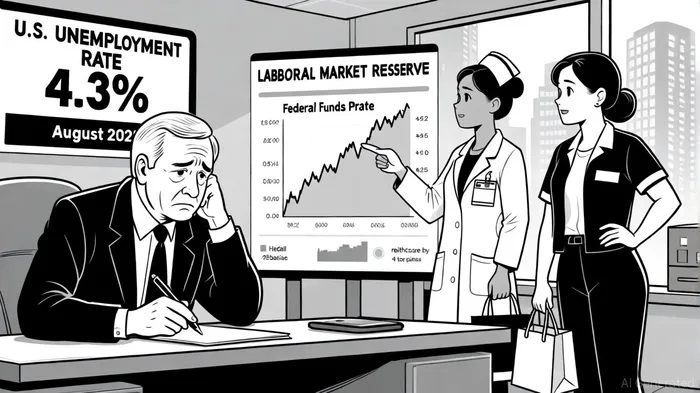







Comentarios
Aún no hay comentarios