
Assessing Eurozone Fragility Amid Rising France-Germany Credit Divergence
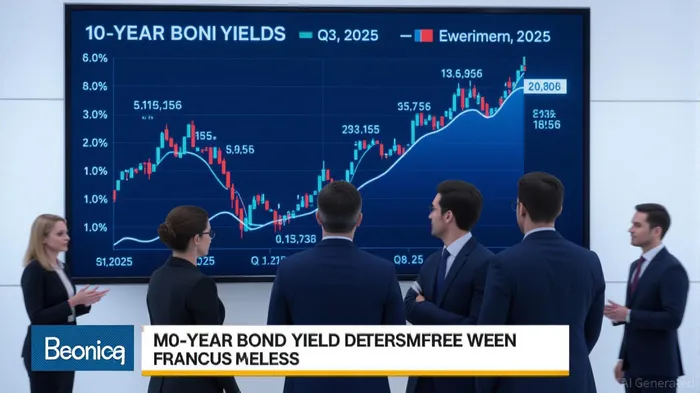
The Eurozone is at a crossroads. As of September 2025, the 10-year bond yield spread between France and Germany has widened to 80–90 basis points, a stark reflection of diverging fiscal trajectories and political risks[1]. France's 3.45% yield on its sovereign debt contrasts sharply with Germany's 2.54% yield, underscoring investor concerns over Paris's fiscal sustainability amid political gridlock and delayed structural reforms[2]. Meanwhile, Berlin's €1 trillion fiscal stimulus package has bolstered market confidence, pulling forward growth expectations and amplifying the yield gap[3]. This divergence, reminiscent of the 2010–2015 Eurozone crisis, raises urgent questions about the resilience of the single currency bloc and the strategies investors must adopt to navigate this fragile landscape.
The Roots of Divergence
The current credit spread reflects more than macroeconomic imbalances. Political instability in France—exemplified by Prime Minister François Bayrou's precarious confidence vote—has stoked fears of delayed budget cuts and weak fiscal discipline[4]. By contrast, Germany's pro-growth policies, including aggressive defense spending and industrial subsidies, have positioned it as a relative safe haven in a region grappling with trade tensions and inflationary pressures[5].
Data from the European Central Bank (ECB) highlights the fragility of this dynamic. While the ECB anticipates cautious rate cuts in late 2025, its ability to offset divergent national policies is constrained. The bank's 2022 Financial Stability Review noted that rising credit spreads in the Eurozone are increasingly driven by “sovereign-specific risks rather than systemic contagion,” a trend now amplified by France's fiscal challenges[6].
Strategic Fixed-Income Positioning
For fixed-income investors, the widening France-Germany spread demands a recalibration of risk exposure. Historical precedents from the 2010–2015 crisis offer instructive lessons. During that period, investors who hedged with Credit Default Swaps (CDS) or diversified into high-quality core Eurozone bonds (e.g., German Bunds) outperformed those relying on indiscriminate diversification[7]. Today, similar tactics remain relevant:
- Leverage CDS for Sovereign Risk Mitigation: Sovereign CDS spreads for France have widened to 150 basis points, reflecting heightened default concerns[8]. Investors can use CDS to hedge long positions in French bonds or short CDS to bet on stabilization if political clarity emerges.
- Prioritize Liquidity and Quality: German Bunds, with their deep liquidity and low volatility, remain a cornerstone of defensive portfolios. The ECB's 2025 Fixed Income Outlook recommends “overweighting core Eurozone debt” amid periphery fragility[9].
- Dynamic Yield Curve Strategies: The steepening yield curves in Europe—driven by divergent monetary policies—present opportunities for curve steepeners. For instance, long-duration German bonds paired with short-term French debt could capitalize on rate differentials while managing credit risk[10].
Risk Mitigation in Practice
The 2010–2015 crisis demonstrated the importance of institutional interventions. The ECB's Outright Monetary Transactions (OMT) program and the European Stability Mechanism (ESM) were critical in stabilizing markets then. Today, investors must monitor whether the ECB will adopt similar measures to curb France's rising borrowing costs. However, political resistance to fiscal transfers within the Eurozone suggests such interventions may be limited[11].
A more pragmatic approach lies in diversifying across asset classes. For example, pairing Eurozone sovereign debt with inflation-linked bonds (e.g., German inflation-linked Bunds) or private-sector credits with strong covenant packages can balance yield and risk. Vanguard's 2025 Fixed Income Perspectives emphasize that “investors should remain agile, adjusting portfolios based on ECB policy signals and regional fiscal developments”[12].
The Path Forward
The Eurozone's fragility is not inevitable. If France can stabilize its fiscal trajectory through credible reforms—such as pension adjustments and public-sector efficiency gains—the yield spread could narrow. However, the current political climate suggests such reforms are far from guaranteed. Investors must prepare for prolonged divergence.
Conclusion
The Eurozone stands at a pivotal moment. The France-Germany credit divergence is a symptom of deeper structural imbalances, but it also presents a testing ground for innovative fixed-income strategies. By combining historical insights with proactive risk management—hedging with CDS, favoring liquidity, and staying attuned to ECB policy—investors can navigate this fragile environment. As the ECB's 2025 outlook warns, “the road ahead is fraught with uncertainty, but preparedness remains the best defense”[13].







Comentarios
Aún no hay comentarios