
Assessing the Elevated Risks Facing Microchip Technology (MCHP)
Financial Performance and Strategic Risks
Microchip's second-quarter fiscal 2026 results underscored the challenges of a market in correction. Net sales fell 2.0% year-over-year to $1.14 billion, with a steeper 5.4% sequential decline attributed to inventory normalization efforts across distribution channels according to financial results. CEO Steve Sanghi acknowledged a "softer business environment" and the impact of tariffs on customer behavior, which pressured demand for Microchip's microcontroller and analog products as reported in the earnings call. Operating margins contracted sharply to 7.8% from 12.6% in the prior-year period, reflecting underutilization charges and inventory write-offs, despite a favorable product mix according to earnings commentary.
The company's forward guidance for Q4-$1.11 billion to $1.15 billion in net sales-fell below analysts' $1.18 billion estimate, reflecting cautious expectations for inventory normalization and macroeconomic uncertainty. While September bookings rose 10% sequentially, a book-to-bill ratio of 1.06 suggests lingering demand imbalances. Management projected Q4 sales of $1.129 billion, plus or minus $20 million, signaling a slow path to recovery.
Industry Position and Competitive Pressures
Microchip's market share in the semiconductor industry remains modest compared to peers. As of Q2 2025, its 12-month market share stood at 1.96%, dwarfed by Intel's 24.53% and Texas Instruments' 7.71%. This disparity highlights Microchip's vulnerability to cyclical downturns and its limited scale in high-growth AI-driven segments. For instance, while global AI chip sales are projected to exceed $150 billion in 2025, Microchip's exposure to this boom is constrained by its focus on industrial and automotive applications, which face softer demand.
Financial performance further underscores this gap. In fiscal 2025, Microchip reported a 42.3% year-over-year decline in net sales to $4.4 billion, contrasting with more stable growth among peers like Intel and Micron. Its stock price has also lagged, with a 21.1% drop in the past month and a -22.0% return over the last year according to financial data. Analysts attribute this to intensified competition, supply chain pressures, and the company's smaller scale in capital-intensive AI infrastructure.
Geopolitical and Supply Chain Challenges
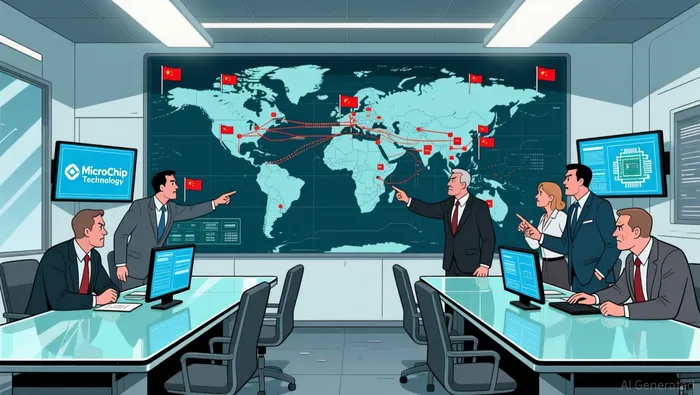
The semiconductor industry's reliance on concentrated manufacturing hubs in Taiwan and South Korea exposes MicrochipMCHP-- to geopolitical risks. U.S.-China trade tensions, including export controls on advanced chipmaking equipment, have disrupted global supply chains. For Microchip, this means navigating a complex regulatory landscape, including the U.S. CHIPS and Science Act's $280 billion investment in domestic production. While these policies aim to reduce reliance on foreign suppliers, they also increase capital costs for firms like Microchip, which must balance reshoring incentives with operational efficiency.
Tariff policies further complicate matters. The U.S. doubled Section 232 tariffs on steel and aluminum to 50%, raising material costs for manufacturers. Additionally, the shift to taxing semiconductors based on Country of Design rather than Country of Origin has added complexity to import planning. Microchip's exposure to these risks is compounded by its reliance on global logistics networks, which remain vulnerable to conflicts in regions like the Middle East and Ukraine.
R&D and Innovation Amidst Uncertainty
Despite these challenges, Microchip has positioned itself as a leader in edge AI and IoT adaptation. Its portfolio of ultra-low-power microcontrollers and secure FPGAs caters to applications requiring real-time processing, such as smart healthcare and industrial automation. The company has also introduced tools like the MPLAB® Machine Learning Development Suite to simplify AI model deployment, enabling developers to scale from proof-of-concept to production.
However, innovation alone may not offset structural headwinds. While Microchip's Gen 6 PCIe switch targets data center workloads, its Q4 guidance reflects conservative expectations for AI-driven demand. Analysts note that the firm's operational efficiency and strong balance sheet could support a rebound, but this hinges on the pace of industry recovery and its ability to capture AI infrastructure growth.
Conclusion
Microchip Technology's strategic vulnerabilities-ranging from cyclical market exposure and competitive pressures to geopolitical and supply chain risks-highlight the challenges of operating in a high-stakes semiconductor landscape. While its R&D initiatives in edge AI and IoT offer long-term potential, the company's smaller scale and reliance on traditional markets leave it exposed to macroeconomic and industry-specific headwinds. For investors, the key question is whether Microchip can leverage its agility and cost-cutting measures to navigate these risks and position itself for a recovery as AI and IoT demand accelerates.







Comentarios
Aún no hay comentarios