
Assessing the Elevated Risk Profile of NATL in a Shifting Market Landscape
In the dynamic and often volatile landscape of financial markets, investors must balance growth potential with risk mitigation. NCR AtleosNATL-- (NATL), a spin-off from NCR Corporation in October 2023, has emerged as a focal point for both optimism and caution. While the company has demonstrated strategic momentum in its ATM-as-a-Service (ATMaaS) division and secured credit rating upgrades, its elevated debt load and liquidity constraints pose significant challenges. This analysis evaluates NATL's risk profile through the lenses of strategic risk mitigation and capital preservation, drawing on recent financial disclosures, industry trends, and expert assessments.
Financial Health: A Double-Edged Sword
NCR Atleos operates with a market cap of $2.90 billion and an enterprise value of $5.59 billion, but its balance sheet reveals stark vulnerabilities. The company's Debt/Equity ratio of 8.66 and Debt/EBITDA ratio of 3.35[1] underscore its heavy reliance on debt financing. Compounding this, a current ratio of 1.05 and quick ratio of 0.54[1] suggest limited capacity to meet short-term obligations without asset liquidation. The Altman Z-Score of 1.38[1], far below the 2.99 threshold for financial stability, signals a heightened risk of insolvency.
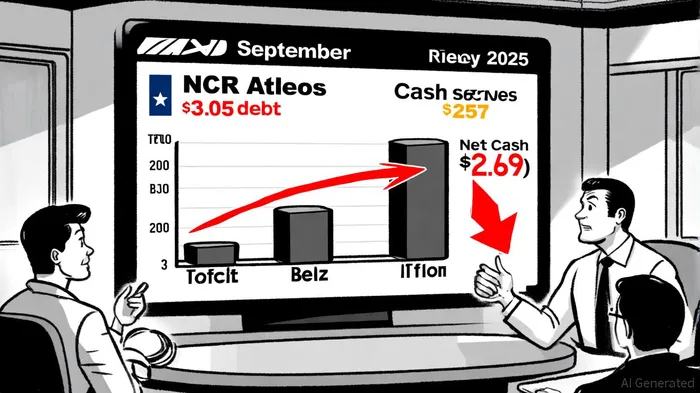
Despite these red flags, NATL has made strides in improving its leverage profile. A credit rating upgrade from Moody's to B1[4] and Fitch's stable outlook[1] reflect confidence in the company's ability to generate free cash flow. However, these improvements are tempered by a net cash position of -$2.69 billion[1], driven by $3.05 billion in total debt and meager $357 million in cash reserves. For capital preservation, such metrics demand rigorous scrutiny.
Strategic Initiatives: Growth vs. Execution Risks
NCR Atleos has prioritized high-margin service offerings, with its ATMaaS business surging 32% year-over-year in Q2 2025[2]. This growth, coupled with a 72% rise in gross profit, highlights the potential of its services-led model. The company's expansion into high-ARPU geographies and partnerships, such as the planned activation of 1,000 locations with FCTI[2], further reinforce its strategic vision.
Yet, execution risks persist. Recurring revenue—a cornerstone of the company's strategy—declined 2.4% year-over-year to $773 million in Q2 2025[2], reducing its share of total revenue from 73% to 70%. This divergence from stated goals raises questions about the sustainability of its as-a-service model. Additionally, operating cash flow turned negative, with $23 million used in operating activities[2], a reversal from the $9 million inflow in the prior year. Such volatility complicates capital preservation efforts, particularly as the board authorizes a $200 million share repurchase program[2] amid constrained liquidity.
Industry-Specific Risks: Navigating a Complex Ecosystem
The enterprise networking sector, a critical segment for NATL, faces mounting challenges. According to a report by NCR Atleos[1], 48% of enterprises cite security and compliance as their top networking challenge, while 46% highlight complexity in network management. These trends align with broader industry shifts toward cloud integration, AI, and private 5G, which demand advanced expertise and capital investment.
External pressures further amplify risks. Tariffs could add $25 million in costs for NATL in 2025[3], while declining BitcoinBTC-- transaction revenue due to regulatory changes[3] threatens non-core income streams. Analysts note that margin pressures from supply chain disruptions and cybersecurity threats[4] could erode profitability, particularly for a company with limited financial buffers.
Capital Preservation: Balancing Shareholder Returns and Prudence
NCR Atleos' recent share repurchase authorization[2] underscores its commitment to returning value to shareholders. However, this move must be weighed against its negative operating cash flow and adjusted free cash flow of just $15 million[2]. For capital preservation, such actions risk exacerbating liquidity strains unless paired with disciplined cost management.
The company's Q2 2025 results offer a mixed signal. While net income surged 50% year-over-year to $45 million[2], driven by hardware demand and outsourcing growth, the discovery of “immaterial misstatements” in prior financial statements[2] raises concerns about internal controls. Such issues could deter institutional investors prioritizing transparency and governance.
Strategic Risk Mitigation: Pathways Forward
To mitigate risks, NATL must accelerate its transition to recurring revenue streams while addressing liquidity constraints. The expansion of cloud-based solutions and cash deposit-enabled locations[2]—which saw a 170% year-to-date growth—offers a promising avenue. Additionally, leveraging its stable credit outlook[1] to refinance high-cost debt could improve its leverage ratios.
However, success hinges on execution. The company's ability to scale ATMaaS, navigate regulatory headwinds, and maintain operational efficiency will determine whether its strategic initiatives translate into sustainable value creation. For investors, diversifying exposure to NATL's high-growth segments while hedging against its debt-driven risks may be prudent.
Conclusion
NCR Atleos occupies a precarious position in the market: a high-growth spin-off with strategic momentum but a fragile financial foundation. While its ATMaaS expansion and credit rating upgrades signal resilience, the company's elevated debt, liquidity constraints, and execution risks demand cautious optimism. For capital preservation, investors must weigh NATL's strategic bets against its structural vulnerabilities, ensuring that risk mitigation strategies align with long-term value preservation. In a shifting market landscape, the path forward for NATL will require not just innovation, but fiscal discipline.





Comentarios
Aún no hay comentarios